The short answer: Georgian food is a shared table of cheese breads (khachapuri), soup dumplings (khinkali), meat grilled over a fire (mtsvadi), and vegetables pounded with walnuts, garlic and fresh herbs, eaten with sour plum sauce and, most of the time, wine. It is herby and sour more often than hot, every region cooks its own versions, and it is easier for vegetarians than its barbecue reputation suggests. This guide covers what to order, where each dish is best, and how to eat it.
Georgian food at a glance
- The essentials: khachapuri and khinkali are on almost every table. Add badrijani (aubergine with walnut paste), pkhali, lobio and mtsvadi and you have tried the core of the cuisine.
- Walnuts and herbs: walnuts go into sauces, soups and vegetable dishes[2], and fresh herbs and a spice blend called khmeli suneli season many of them[5].
- Regional cooking: the tourism board puts it simply: every corner of this small country has its own must-eat dishes[1]. Samegrelo in the west is considered the most famous regional cuisine[2].
- Shared plates: Georgians order for the table, not one dish each. A formal feast is a supra, led by a toastmaster, the tamada[8].
- Wine: Georgia's traditional method of making wine in buried clay jars, qvevri, is on UNESCO's list of intangible heritage[9].
If you only want the list of what to order, our 15 dishes to try in Georgia is the short version. This page is the wider picture: dishes, regions, spice, fasting food, the supra and how Georgian food compares with its neighbours'.
The dishes
Breads and cheese
- Khachapuri: cheese bread, usually made with sulguni or imeruli cheese[2][4]. Imeretian (imeruli) is round with the cheese inside, and the most common; Megrelian (megruli) has more cheese melted on top; Adjarian (adjaruli) is a bread boat filled with cheese and finished with an egg yolk and butter[4]. The khachapuri tradition is on Georgia's national list of intangible cultural heritage[1][4]. Every type, and how to eat the Adjarian one, is in our khachapuri guide.
- Lobiani: bread filled with beans instead of cheese; Rachan lobiani is the most popular version[11].
- Kubdari: the Svan meat bread, filled with spiced lamb, kid or pork and onions[2]. Order it in Mestia.
- Shoti and mchadi: shoti, a traditional white bread, was born in Kakheti[2]; mchadi is the dense cornbread of Guria, Imereti and Svaneti[2]. More in Georgian bread and sweets.
- Cheese: sulguni, imeruli and Tushetian guda are the names you will meet most[2]. See the Georgian cheese guide.
Dumplings and meat
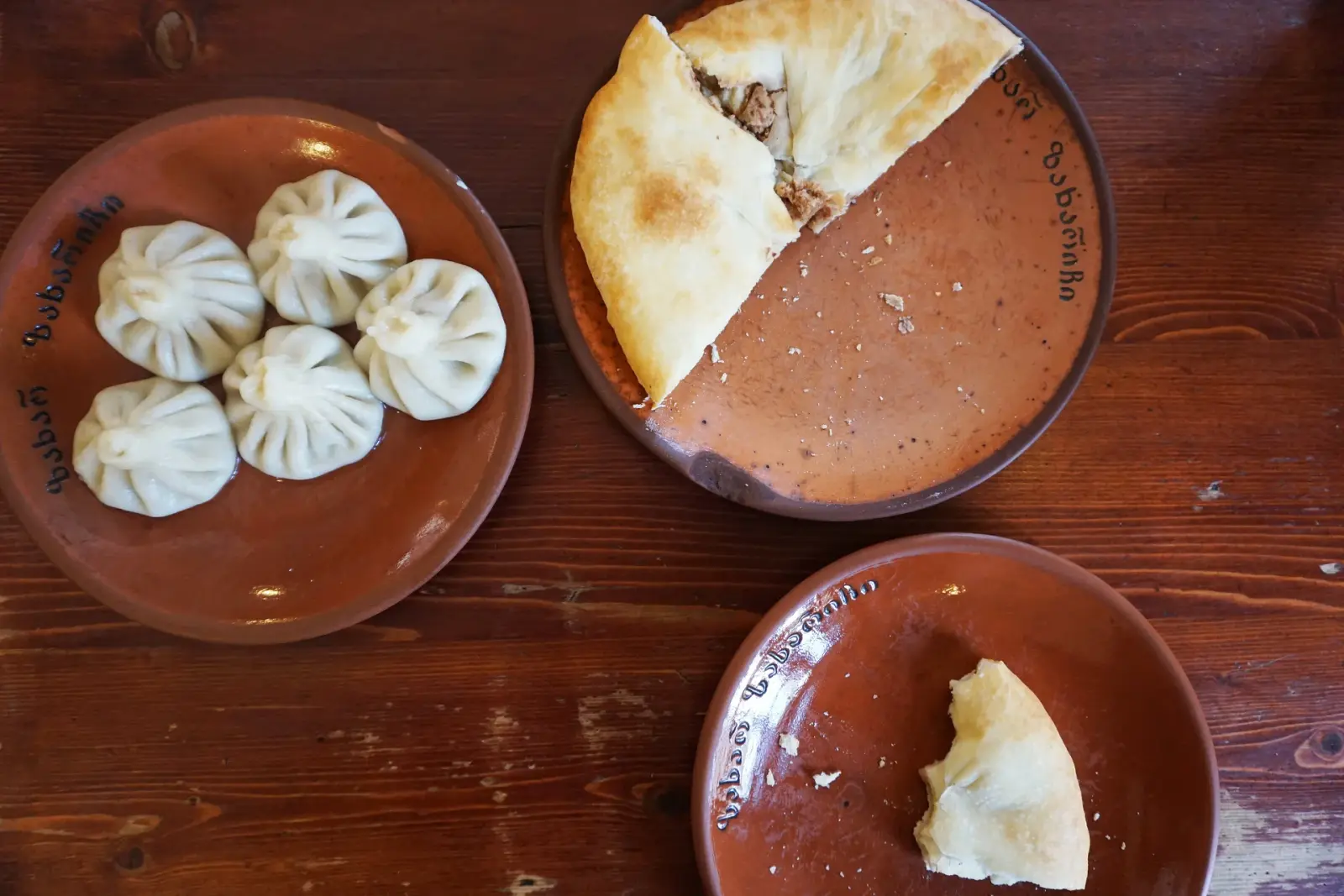
- Khinkali: twisted dumplings of meat, herbs and broth from the mountains of eastern Georgia; khinkali from Pasanauri on the Military Highway are regarded as superior to those from other towns[3]. In the city version the filling is seasoned with parsley and coriander[3]. How to eat them is below, and the full story is in our khinkali guide.
- Mtsvadi: meat cooked on a fire[2], the Georgian barbecue. Eat it with raw onion and tkemali.
- Shkmeruli: chicken in a sauce of cream and garlic, from Racha[2].
- Satsivi: poultry in bazhe, a walnut sauce[2], usually served cold.
- Tolma: the Georgian version of dolma: mostly meat, rolled in cabbage or vine leaves[2].
Vegetables and walnuts
- Badrijani nigvzit: fried aubergine with walnut paste[2], rolled up and often scattered with pomegranate seeds.
- Pkhali: chopped vegetables, mostly spinach, beetroot and cabbage, mixed with walnuts and often topped with pomegranate seeds[2].
- Lobio: kidney beans cooked with spices[2], served in a clay pot with mchadi and pickles.
- Ajapsandali: aubergine, potatoes, onions and spices[2], Georgia's answer to ratatouille.
- Elarji: cornmeal porridge (ghomi) worked with sulguni cheese, from Samegrelo[2].
Soups and stews
- Kharcho: beef soup with rice, cherry plums and walnuts, from Samegrelo[2].
- Chakhokhbili: a stew of poultry and tomatoes[2].
- Chakapuli: lamb or veal stewed with tarragon and cherry plums, from eastern Georgia[2]; the tourism board notes white qvevri wine as a defining ingredient[1].
- Chikhirtma: chicken or turkey soup thickened with egg, traditionally from Kakheti[2].
- Chashushuli: a spicy beef stew with a tomato base[2].
Sweets
- Churchkhela: walnuts on a string coated in grape juice mixed with flour; it comes from Kakheti[2]. Once dried, it packs well for the flight home.
- Gozinaki, honey and fruit preserves are covered in Georgian bread and sweets.
Georgian food by region
- Adjara (Batumi): seaside cooking is more spiced and herby, the mountains richer in dairy; home of Adjarian khachapuri[2].
- Samegrelo: considered the most famous regional cuisine, with plenty of spice and walnuts[2]: elarji, kharcho, gebzhalia, cheese finished with ajika and mint[1]. Read Megrelian food.
- Imereti (Kutaisi): generous with walnuts, and known for its cheeses[2].
- Guria: poultry, cornbread and walnuts; known for satsivi[2].
- Svaneti: kubdari, tashmijabi (mashed potato with sulguni) and Svan salt[2].
- Racha: Rachan ham, lobiani and shkmeruli[2].
- Kakheti: wine country, and the home of shoti, churchkhela and chikhirtma[2].
- The eastern mountains (Mtiuleti, Khevsureti, Tusheti): khinkali[3], seasoned with mountain savory in the highlands[1], and Tushetian guda cheese[2].
- Samtskhe-Javakheti: goose, including goose-filled khinkali; its cooking was shaped by historical Turkish rule[2].
Where to eat it
- Tbilisi: the capital has restaurants for every regional cuisine, so you can taste Megrelian, Rachan or Svan cooking without leaving town. For produce, cheese and churchkhela, go to the Dezerter Bazaar.
- Batumi: the place for Adjarian khachapuri, in its home region.
- Kutaisi: Imeretian and Megrelian cooking, with Samegrelo a short drive west.
- On the road: khinkali in Pasanauri on the way to Kazbegi[3], kubdari in Mestia, mtsvadi and wine in Kakheti.
Spices and sauces
- Khmeli suneli: the Georgian dried spice blend. There is no fixed recipe, but it usually includes coriander seed, dill, blue fenugreek, savory, mint and marigold[5].
- Utskho suneli: the Georgian name for blue fenugreek, the nutty note in many dishes[5].
- Svanuri marili (Svan salt): salt ground with coriander, dill, blue fenugreek, red pepper, marigold, garlic and cumin, from Svaneti[6].
- Tkemali and ajika: a cherry plum sauce, and a hot chili paste[2].
All of them, and which to take home, are in Georgian spices and sauces.
Is Georgian food spicy?
Mostly not. Most dishes are garlicky, herby and sour rather than hot. The heat comes from ajika, the chili paste[2], and from the west: the cooking of Samegrelo and Abkhazia uses many spices[2]. A few dishes, such as chashushuli, are spicy everywhere[2]. Khinkali are eaten plain or with black pepper[3]. If you don't like heat, be careful with anything Megrelian and taste the red sauces before you spoon them on.
Vegetarian and vegan: the fasting table
Orthodox fasting means no meat, poultry, eggs or dairy, and many Orthodox Christians fast up to four times a year; the strictest fast is Lent, the 40 days before Orthodox Easter[7]. That is why so many traditional dishes are meat-free, and why many restaurants offer a samarkhvo (fasting) menu without animal products[7].
- Usually vegan: pkhali, badrijani nigvzit and mchadi[7]; most ajapsandali, although some cooks use butter[7].
- Check first: lobio is meat-free in most places, but the Rachan version can contain ham[7]. Khinkali dough contains egg, so mushroom khinkali are vegetarian, not vegan[7]. Some fasting dishes still contain honey, mayonnaise or cheese[7].
- Vegetarians have it easy: cheese breads, elarji and the walnut dishes are all meat-free.
- Nut allergies: walnuts are in a great many sauces and fillings. Say so clearly when you order.
Our vegetarian and vegan guide has more dishes and phrases.
The supra and its toasts
A supra is a traditional Georgian feast, led by a tamada, a toastmaster elected by the guests or chosen by the host, who introduces each toast[8]. When a toast is proposed, guests raise their glasses but wait to drink; eating during toasts is fine, talking is frowned upon[8]. A festive supra is a keipi; the sombre one held after a burial is a kelekhi[8]. Pace yourself: a supra lasts hours, and dishes keep coming.
Wine is part of it. Qvevri are clay jars in which wine ferments underground; wine plays a vital role in everyday life and in secular and religious celebrations, and the qvevri method was inscribed by UNESCO in 2013[9]. Read the Georgian supra for the toasts and manners, and Georgian wine explained for what to order with dinner.
Georgian food vs Russian, Armenian and Turkish food
- Russian: Georgian cooking is its own cuisine, but it found a place at the Soviet table. Khrushchev recalled the Kremlin constantly hiring Georgian cooks, the Aragvi restaurant in Moscow opened in 1940 as the best-known Georgian restaurant of the Soviet Union, and tkemali sauce was mass-produced from its chef's recipe[10]. Russian travellers often know khachapuri and khinkali before they arrive.
- Armenian: neighbours share dishes. Matsoni, the yoghurt-like dairy product you will see at breakfast, is of Armenian origin, and Georgian tolma is a version of dolma[2].
- Turkish: the south-west shows the link: Turkish rule shaped the cooking of Samtskhe-Javakheti, and the Laz community, especially in Sarpi, keeps dishes such as muhlama (cornmeal with cheese) and anchovy dishes[2].
- What is Georgian: the walnut-and-garlic sauces, blue fenugreek and khmeli suneli[5], the regional cheese breads[4], and wine from qvevri[9].
How to order and eat
- Share. Order several dishes for the table: cold starters such as pkhali and badrijani, one khachapuri, then khinkali or a hot dish. For a table of four, one Imeretian khachapuri is a starter; one Adjarian khachapuri is a meal for one.
- Eat khinkali with your hands. Hold one by the knot of dough on top, take a small bite and drink the broth, then eat the rest. The knot (kudi) is tough and stays on the plate, and a fork is considered wrong, even childish[3].
- Expect dishes to arrive when ready, not in courses. Cold dishes often come first.
- Portions are big. It is fine to leave food; hosts will keep bringing more.
- Bread is the cutlery for lobio, shkmeruli and anything with a sauce.
Food and wine tours
Geotour runs private food tours. The Tbilisi food and wine walk tastes its way through the Dezerter Bazaar, a bakery, khinkali and a wine bar; the cooking class with a market tour teaches you khachapuri and khinkali; and the Kakheti village cooking day is spent baking bread and making churchkhela with a host family. For a day in the wine country, see our Kakheti wine tour guide; for how to choose between food tours and classes, read Tbilisi food tours and cooking classes. Or build your own private trip around what you want to eat.
FAQ
What is traditional Georgian food?
Cheese breads (khachapuri), meat dumplings (khinkali), grilled meat (mtsvadi), bean dishes (lobio), and vegetables with walnuts and herbs (pkhali, badrijani), seasoned with khmeli suneli and served with sour plum sauce and wine[2][5].
What is Georgia famous for in food?
Khachapuri and khinkali above all, plus walnut sauces, churchkhela and qvevri wine. The khachapuri tradition is on Georgia's national heritage list[4], and qvevri winemaking is on UNESCO's[9].
What are the top 10 dishes to try in Georgia?
Khinkali, Imeretian khachapuri, Adjarian khachapuri, badrijani nigvzit, pkhali, mtsvadi, lobio with mchadi, shkmeruli, chakapuli (in spring) and churchkhela. Add elarji if you go west.
What is Georgia's best food?
Ask Georgians and most will name khinkali or khachapuri. The best version of each is the local one: khinkali in the mountains, Adjarian khachapuri in Batumi, kubdari in Svaneti.
Sources
- Georgian National Tourism Administration, "Georgian Cuisine": georgia.travel
- Wikipedia, "Georgian cuisine": en.wikipedia.org
- Wikipedia, "Khinkali": en.wikipedia.org
- Wikipedia, "Khachapuri": en.wikipedia.org
- Wikipedia, "Khmeli suneli": en.wikipedia.org
- Wikipedia, "Svan salt": en.wikipedia.org
- Wander-Lush, "Vegetarian Georgian Food: 19 Traditional Dishes": wander-lush.org
- Wikipedia, "Supra (feast)": en.wikipedia.org
- UNESCO Intangible Cultural Heritage, "Ancient Georgian traditional Qvevri wine-making method": ich.unesco.org
- Russian Life, "When Russian Cuisine Turns Georgian": russianlife.com
- Wikipedia, "Lobiani": en.wikipedia.org
Last checked: November 2026.