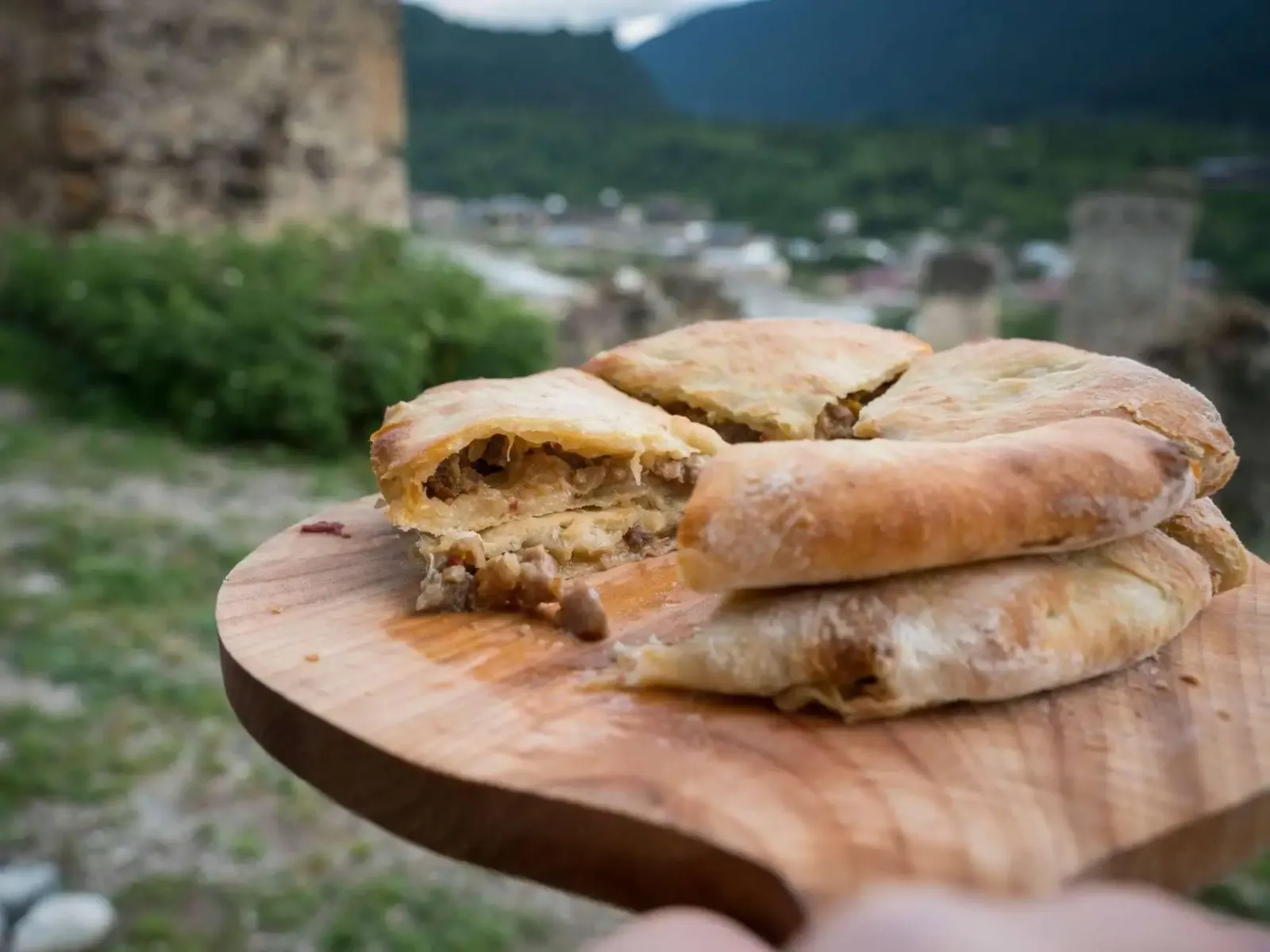
The short answer: the two cheeses you will meet every day in Georgia are imeruli, a fresh, mild, salty cow's-milk cheese from Imereti, and sulguni, an elastic brined cheese from Samegrelo, often smoked. Beyond them are the mountain cheeses: guda from Tusheti, ripened in a sheepskin; stringy tenili from Meskheti; and mould-ripened dambalkhacho from the mountains north-east of Tbilisi. Here is what each is like, and where to try them.
The everyday cheeses
Imeruli
Imeruli is made in the region of Imereti from cow's milk [1]: fresh milk curdled with rennet, worked by hand, salted and kept in brine [2]. It is white, semi-soft, mild and salty, and is eaten young. It is the cheese inside most khachapuri, the one on the plate at breakfast, and the base of a Georgian cheese platter.
Sulguni
Sulguni comes from Samegrelo in western Georgia and is also made in Svaneti [1][3]. It is made from cow's milk, buffalo milk or both, and has a sour, moderately salty taste and an elastic, layered texture [3], a little like a firmer mozzarella. The curd is heated and stretched, then cured in brine, and the cheese matures in only one or two days [3]. In 2012 it received protected geographical indication status [3].
You meet sulguni everywhere: fried in slices, melted on Megrelian khachapuri, and stirred into elarji, the Megrelian cornmeal porridge. Smoked sulguni, golden-brown on the outside, is a Samegrelo speciality and a good buy at the market [2].
Mountain cheeses
Guda (Tusheti)
Tushetian guda is made from sheep's milk, or sheep's and cow's milk mixed, and ripened in a sheepskin bag, the guda, that gives it its name [2]. Layered with salt and turned often, it ages for about two months [2]. The result is a firm, salty, pungent cheese with an earthy edge. In Tusheti, where sheep farming is the main livelihood, your guesthouse will almost certainly serve it; in Tbilisi look for it in the cheese hall of the Dezerter Bazaar.
Tenili (Meskheti)
Tenili, from Meskheti in southern Georgia, is one of the most unusual cheeses anywhere. The curd is pulled into long, fine threads in hot whey, dried, cut, mixed with cream and packed tightly into clay pots, which are then turned upside down and aged for at least two months [2]. It was added to Georgia's list of intangible cultural heritage in 2013 [4]. It is rare and expensive; if you see it, try it.
Dambalkhacho (Pshavi, Mtiuleti, Tianeti)
Dambalkhacho is a mould-ripened cheese from the mountains of Pshavi, Mtiuleti and Tianeti, north-east of Tbilisi [1][2]. Cottage cheese is kneaded with salt, dried, then aged in a clay pot; the outside turns mouldy while the inside stays soft and golden [2]. It is strong and eaten both as it is and fried in plenty of clarified butter. It is described as one of the most ancient and expensive Georgian cheeses [1].
Svan cheeses
In Svaneti, as well as sulguni, families make narchvi: cow's-milk cheese collected in late summer, crumbled with salt, pressed into wooden boxes and ripened for about two months, ready by Christmas [2]. It is a home cheese rather than a shop one.
Soft and fresh
- Nadughi: a soft, creamy fresh dairy product [1], a little like ricotta, eaten fresh rather than aged.
Cheese at the Georgian table
Cheese appears at almost every meal. At breakfast it comes with bread, tomatoes and cucumbers; at a supra, a plate of young imeruli and sulguni sits beside bunches of fresh herbs such as tarragon, coriander and basil, to be eaten together. Fried sulguni, sometimes cooked in a clay dish (ketsi), arrives hot and stringy as a starter.
With wine, the salty young cheeses go well with crisp whites and amber qvevri wines, whose tannins cut through the salt. Stronger mountain cheeses such as guda stand up to red Saperavi. Ask your host what they drink with it; the answer is usually whatever is on the table.
Where to try Georgian cheese
- Markets: the cheese hall of the Dezerter Bazaar in Tbilisi has stalls of imeruli, sulguni, smoked sulguni and, depending on the season, guda and others. Sellers will usually offer a taste.
- At the table: order a Georgian cheese plate in a restaurant, and khachapuri in its regional styles; see our guide to khachapuri.
- In the regions: smoked sulguni in Samegrelo, imeruli around Kutaisi, guda in Tusheti.
Most Georgian cheeses are salty because they are kept in brine. Soaking imeruli in fresh water for an hour or two before eating makes it milder. On Orthodox fast days, including the weeks of Lent, observant Georgians avoid cheese altogether, and bakeries switch to lobiani.
For taking cheese home: brined cheeses do not travel well. Smoked sulguni and hard guda keep better, vacuum-packed. Check your home country's rules on bringing dairy products before you buy.
Tasting Georgian cheese with us
Our trips are private, for 1–8 travellers. The private Tbilisi food and wine walk starts with a market tasting at the Dezerter Bazaar, including cheese, then moves on to a tone-oven bakery, khinkali and a natural-wine bar. In the mountains, the 4-day private Tusheti 4x4 trip stays in family guesthouses on full board, where Tushetian guda is part of the table; the Abano Pass road is open roughly from June to early autumn. For a cooking class that starts in the bazaar's cheese hall, see the private Georgian cooking class. See each tour page for the current price, or build your own food trip. Nothing to pay now.
For more on Tusheti, its sheep and its seasons, read our Tusheti guide.
Sources
- Wikipedia, "Georgian cuisine" (cheeses): en.wikipedia.org
- Georgian National Tourism Administration, "Types of Georgian cheese": georgia.travel
- Wikipedia, "Sulguni": en.wikipedia.org
- Wikipedia, "Georgian cheese": en.wikipedia.org
Last checked: September 2026.