The short answer: Kutaisi, Georgia's third-largest city, is worth a day in itself and even more as a base. In the centre, see the Colchis Fountain, the Green Bazaar, the White Bridge over the Rioni and Bagrati Cathedral on its hill. Just outside are Gelati Monastery, Kutaisi's only UNESCO World Heritage site, and Motsameta, and within an hour are Prometheus Cave and the Martvili and Okatse canyons. Kutaisi is 3–3.5 hours from Tbilisi on the Rikoti highway. Two nights let you see the city and the sights around it without rushing.
A little background
Kutaisi, on the Rioni river in the region of Imereti, is Georgia's third-largest city [1]. It is also one of its oldest. Legend identifies it with Aia, the capital of ancient Colchis, where Jason and the Argonauts came for the Golden Fleece [1]. In the Middle Ages it was a royal capital, and between 2012 and 2019 Georgia's Parliament sat here in a new building, before returning to Tbilisi [1]. Today it is a relaxed provincial city, cheaper and slower than Tbilisi, with an international airport 14 km to the west [1].
What to see in the city
The Colchis Fountain
In the central square, the Colchis Fountain is a modern tribute to the ancient kingdom: around it stand about 30 enlarged copies of Colchian gold jewellery found at archaeological sites such as Vani, many of them animal figures [2]. It is the city's meeting point, and it is lit up in the evening.
The Green Bazaar
A short walk from the square, Kutaisi's covered market is one of the liveliest in Georgia. Look for Imeretian cheese, churchkhela, spices, pickles, honey and the local breads, and come in the morning when it is busiest.
The White Bridge
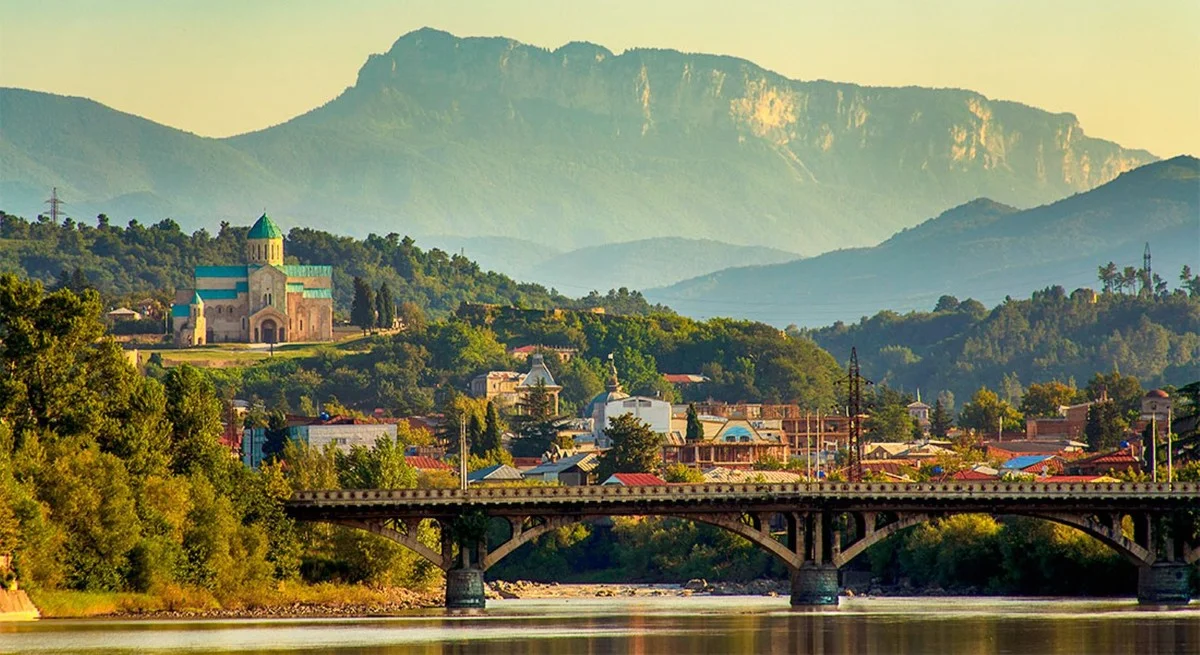
The White Bridge over the Rioni was built in the 19th century and is one of the city's symbols [3]. It has been renovated with glass panels in the deck, so you can look down at the river as you cross [3]. The riverside around it is a pleasant place to walk.
Bagrati Cathedral
On Ukimerioni Hill above the centre stands Bagrati Cathedral, built in the early 11th century under King Bagrat III, the first king of a united Georgia [1]. Over the centuries it was badly damaged, and it was rebuilt, with a restoration finished in 2012 [1]. The reconstruction was controversial, and in 2017 the cathedral was removed from the World Heritage List. It is still a working cathedral and a fine viewpoint over the city, particularly at dusk.
Other stops
- Meskhishvili Theatre: the round theatre building near the Colchis Fountain, built in 1861 [4].
- Kutaisi State Historical Museum: a modest museum with archaeological and church treasures; allow about 30 minutes [4].
- The Botanical Garden: a 19th-century garden on the riverbank with hundreds of plant species [4].
Just outside the city
Gelati and Motsameta
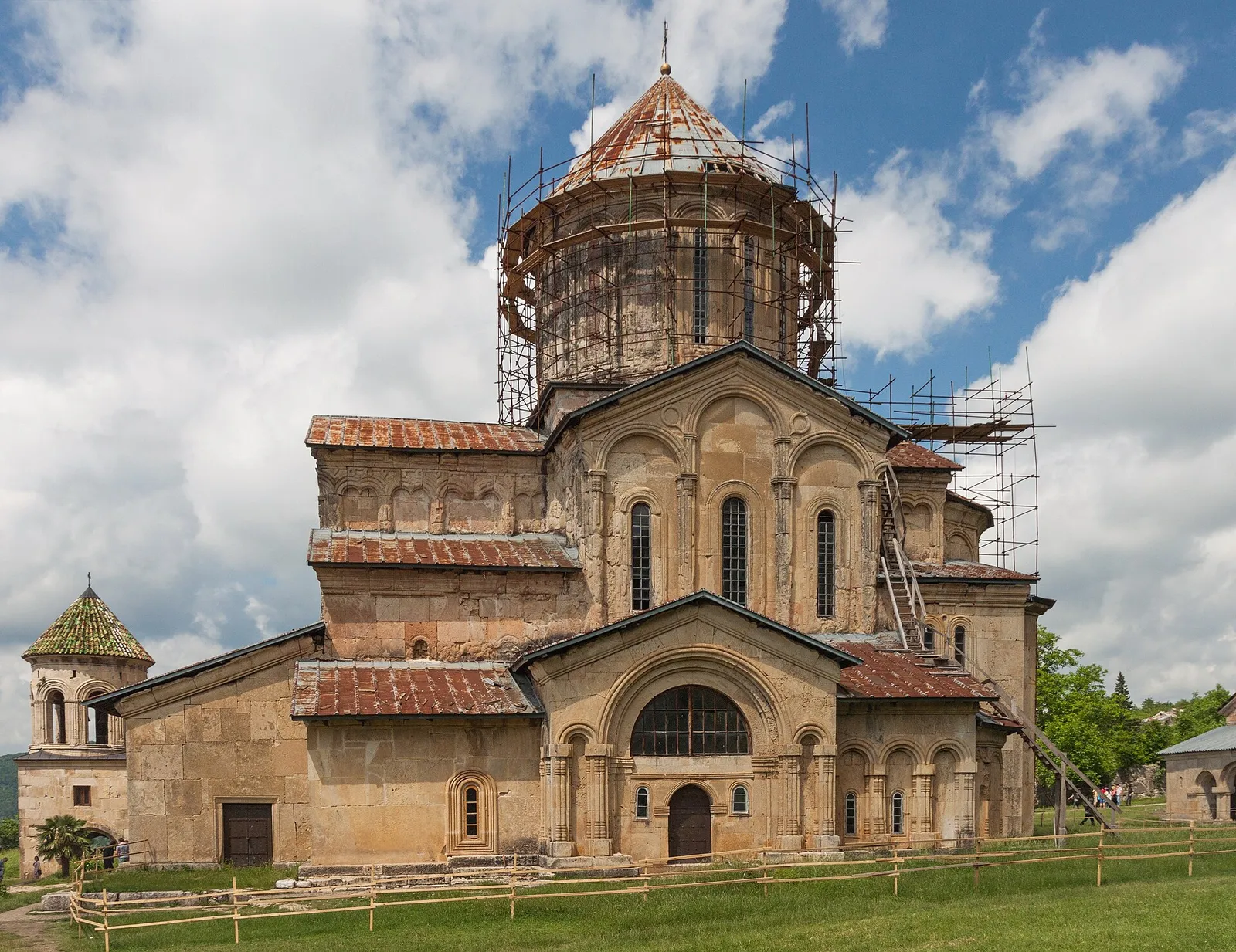
About 10 km north-east of Kutaisi, Gelati Monastery was founded in 1106 by King David IV "the Builder" as a monastery and academy, and its main church has a famous 12th-century mosaic of the Virgin. Gelati is Kutaisi's only UNESCO World Heritage site. In 2026 the main church is under conservation, with scaffolding. Nearby, the small monastery of Motsameta stands on a cliff above a river. Read our Gelati Monastery guide.
Caves and canyons
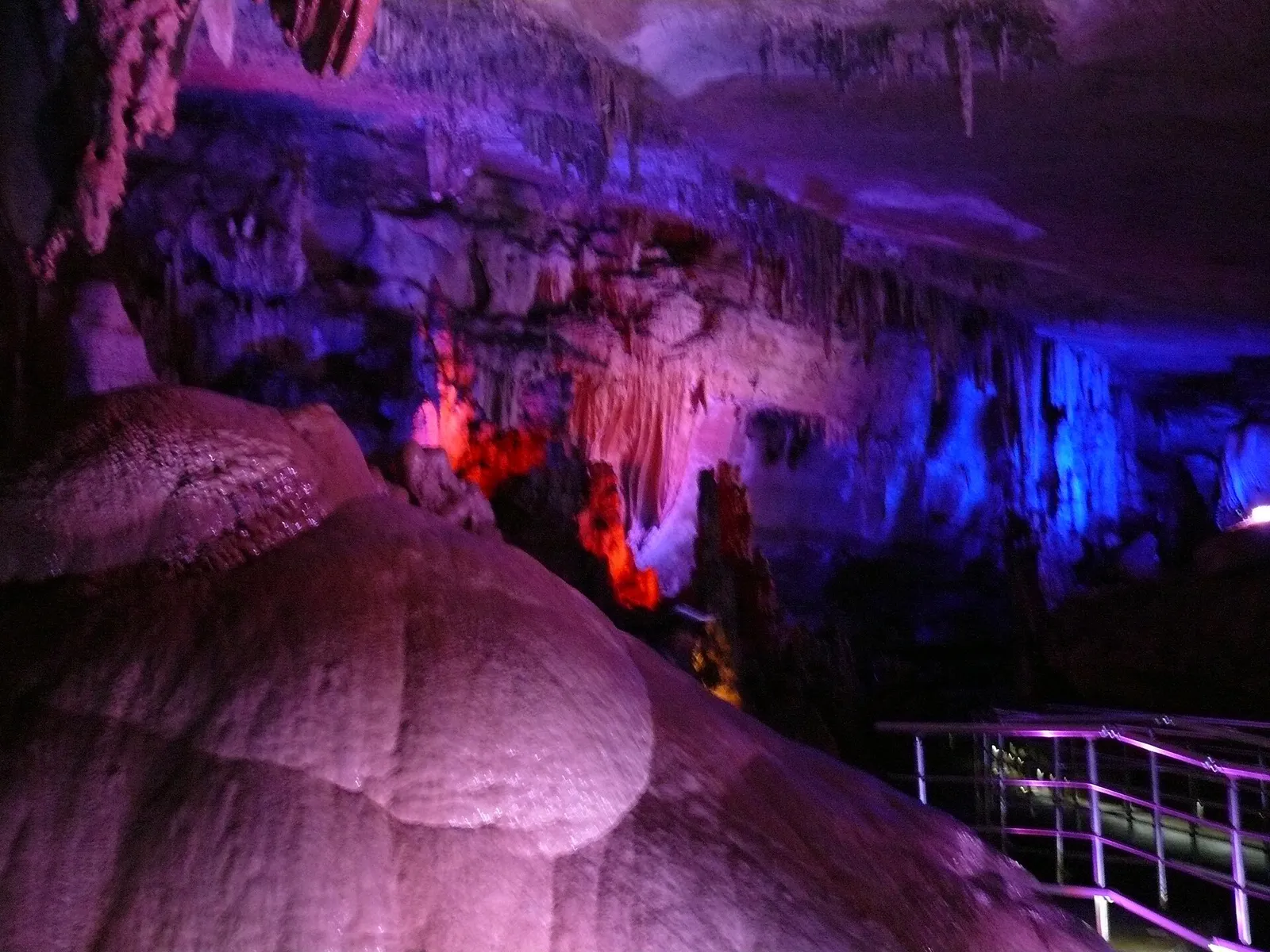
- Prometheus Cave: about 20 km (30–40 minutes) from the city, with an hour-long walk through lit halls and an optional boat ride at the end when the water allows.
- Martvili Canyon: about 50 km (1–1.5 hours), a narrow gorge with blue-green water and short boat rides from roughly May to October.
- Okatse Canyon: about 42 km (around an hour), with a 780 m walkway fixed to the cliff; closed in rain and snow.
- Sataplia: just outside town, with dinosaur footprints, a cave and a glass-floored viewpoint.
All three of the big natural sites fit in one 8–9 hour day; see our Kutaisi caves and canyons day trip.
Kutaisi as a base
- Getting there: 3–3.5 hours from Tbilisi by car on the Rikoti highway, or by train; see Tbilisi to Kutaisi and Batumi. Many budget flights land at Kutaisi airport.
- How long: one night covers the city and Gelati; two nights add the caves and canyons.
- Onward: from Kutaisi, roads go north-west to Svaneti via Zugdidi, and west to Batumi on the Black Sea.
- Season: the city works all year. The canyons are at their liveliest from spring to autumn; the Okatse walkway may close for days in winter.
Eating and staying
Kutaisi is the capital of Imereti, and the food follows: Imeretian khachapuri, the fresh local imeruli cheese and walnut-rich vegetable dishes are the things to order. The Green Bazaar is the place to buy cheese and churchkhela for the road. For a short stay, sleep in the centre, near the Colchis Fountain or in the older streets towards the river, so you can walk to the square, the market and the White Bridge in the evening. Prices for rooms and meals are generally lower than in Tbilisi.
Seeing Kutaisi with us
All our trips are private: your own car and English-speaking driver-guide, for 1–8 travellers. From a Kutaisi hotel, the private Prometheus Cave and Martvili Canyon day trip covers Martvili, Okatse (or Sataplia when Okatse is closed) and Prometheus in about 8.5 hours. Western Georgia and the Black Sea in 6 days goes from Tbilisi to Kutaisi, with Prometheus and Bagrati at dusk, then on to Martvili, Svaneti and Batumi. For history, the Heart of Georgia heritage tour, 5 days spends a morning at Gelati, Motsameta and Bagrati. See each tour page for the current price, or build your own route. Nothing to pay now.
Sources
- Wikipedia, "Kutaisi": en.wikipedia.org
- World History Encyclopedia, "Colchis Fountain in Kutaisi": worldhistory.org
- Gotrip, "Top 10 must-see attractions in Kutaisi": gotrip.ge
- Sailingstone Travel, "A weekend in Kutaisi": sailingstonetravel.com
- UNESCO World Heritage Centre, "Gelati Monastery": whc.unesco.org
Last checked: September 2026. Opening days, fees and boat operation at the caves and canyons change with the season and the weather.