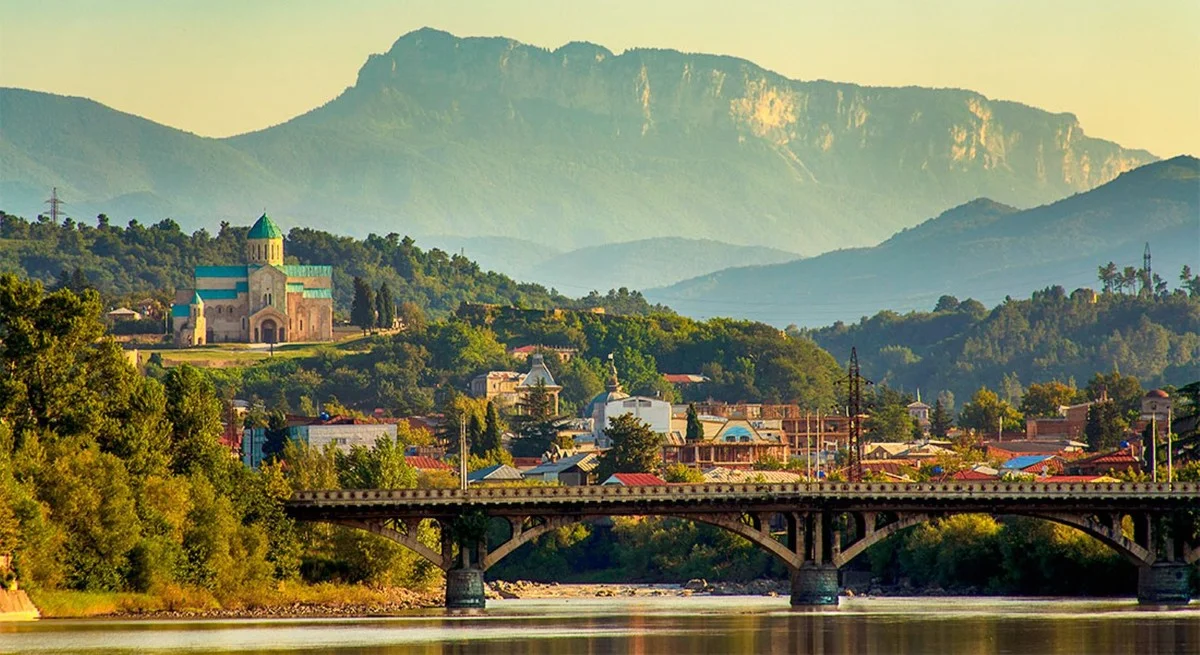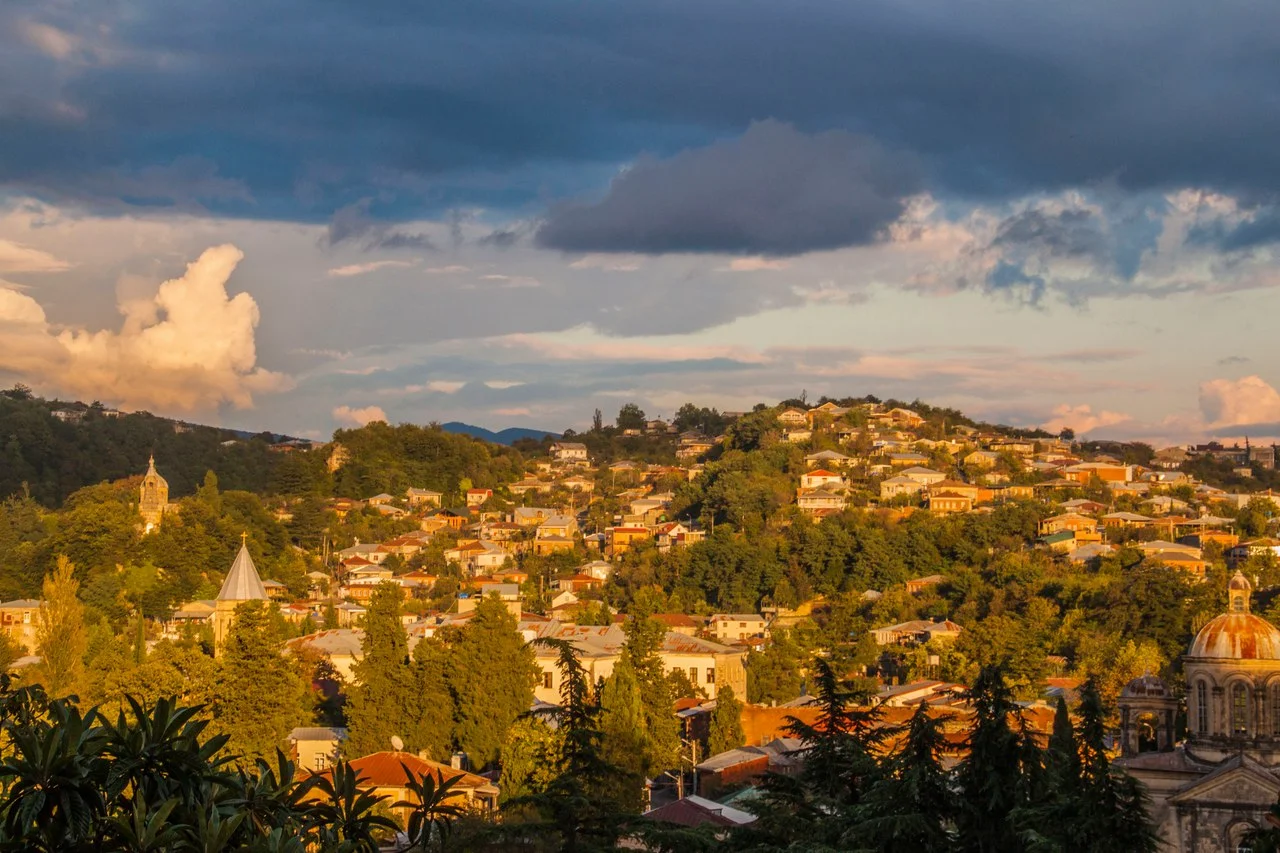
The short answer: the three churches worth seeing around Kutaisi are Motsameta, a small monastery on a cliff above a bend of the Tskaltsitela river; Gelati, founded by David the Builder in 1106 and Kutaisi's only UNESCO World Heritage Site. The third is Bagrati Cathedral, the great 11th-century cathedral on the hill above the city centre. Motsameta and Gelati are on the same road a few kilometres north-east of town, so all three fit comfortably into a morning.
Motsameta: the place of the martyrs
Motsameta sits about 6 km north-east of Kutaisi, on a wooded promontory where the Tskaltsitela river loops around below it[1]. The name means "place of the martyrs"[1].
The legend
In the 8th century two brothers, David and Constantine, noblemen from Argveti, led a revolt against the Arab occupation of western Georgia[1]. They were captured and offered their lives if they converted to Islam. They refused, were tortured and killed, and their bodies were thrown into the river[1]. By tradition the water ran red with their blood, which is how the Tskaltsitela ("red water") got its name, and lions carried their remains up to the hill where the church now stands[1]. The brothers were made saints by the Georgian Orthodox Church.
What to see
The church was founded in the 11th century under King Bagrat IV[1]. Its focus is the reliquary of the two saints, on a raised platform inside. In 1923 the Soviet authorities moved the relics to a Kutaisi museum, but public anger forced their return[1]. A local custom is to crawl three times through the low passage beneath the reliquary while making a wish that harms nobody[2]; you'll see pilgrims doing it. Join in only if you feel comfortable, and do it quietly.
Outside, walk to the edge of the terrace for the view down to the river. It's a short walk from the car park, with some steps.
Gelati: David the Builder's academy
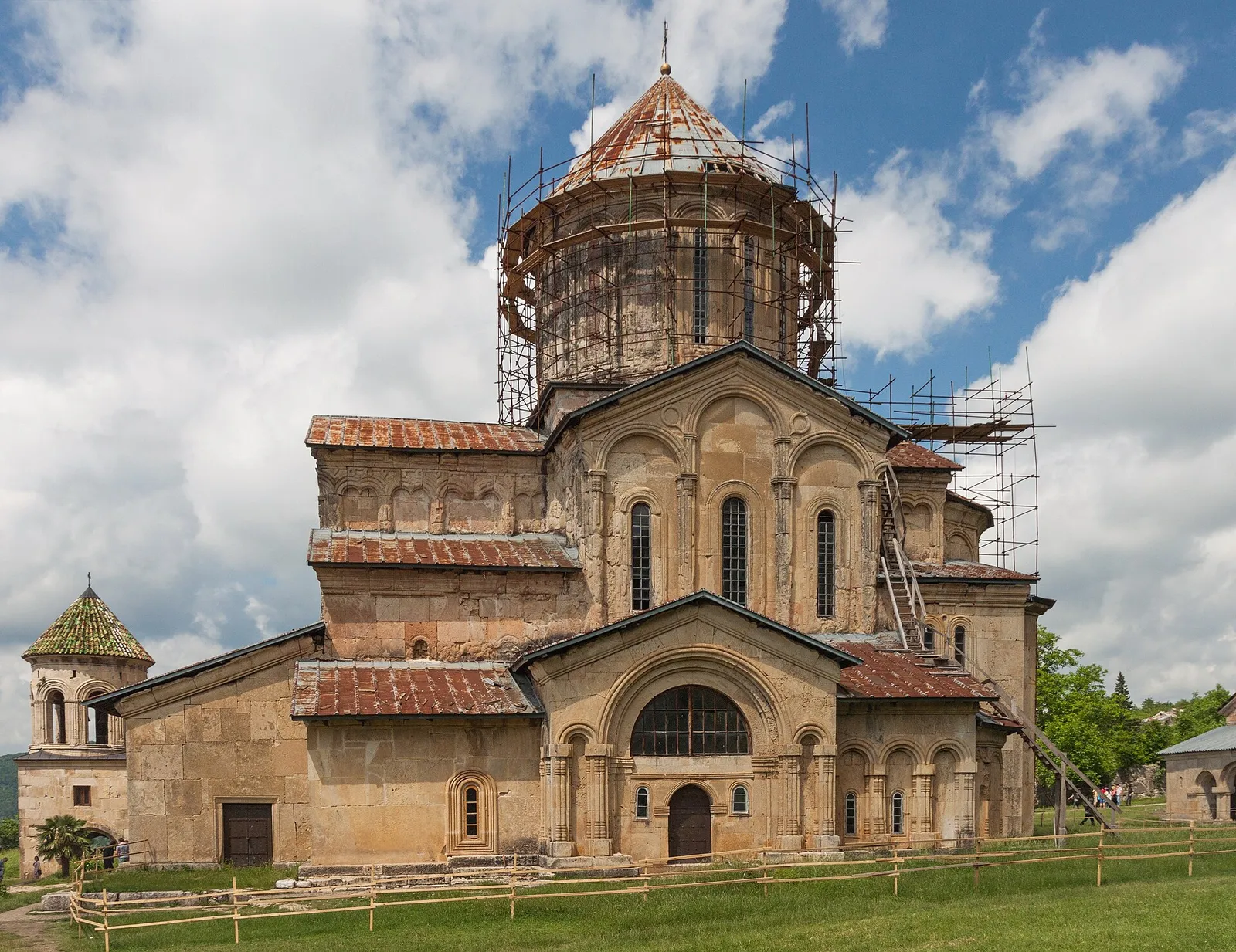
A couple of kilometres further up the same road is Gelati. King David IV, "the Builder", founded it in 1106 as a monastery and a centre of learning; contemporaries called its academy "a new Hellas"[3]. It was inscribed as a UNESCO World Heritage Site in 1994 and is Kutaisi's only listed site today[3].
- The main church, of the Virgin, was completed in 1130[3]. In the apse is a 12th-century mosaic of the Virgin and Child[3], one of the great works of medieval Georgian art, surrounded by later frescoes of kings and saints.
- Two smaller churches, of St George and St Nicholas, date from the 13th century[3].
- David the Builder's grave lies by the gate, near the old gates of Ganja brought back as a trophy in 1138[3].
Gelati is still an active monastery[3], and conservation work continues, so parts may be under scaffolding. Our Gelati Monastery guide goes into more detail.
Bagrati Cathedral: the cathedral on the hill
Bagrati stands on Ukimerioni hill, above the old centre of Kutaisi. It was built under King Bagrat III in the early 11th century; an inscription dates the completion of the floor to 1003[4]. In 1692 Ottoman troops wrecked it, and the dome and roof collapsed[4]. It stood as a roofless ruin for centuries.
Restoration began in the 1950s and was completed, controversially, in 2012, with a new roof and modern materials[4]. Because of that reconstruction the cathedral lost its World Heritage status in 2017[4]. Today it is the seat of the Metropolitan of Kutaisi and a working church, popular for weddings[4]. Come for the scale of the building and the view over the city, particularly in the late afternoon.
How to combine them
- Gelati first, in the morning when the light in the church is good and before any groups arrive. Allow about an hour.
- Motsameta on the way back down, about 45 minutes.
- Bagrati in town, 30–45 minutes, then lunch in Kutaisi.
That leaves the afternoon free for Kutaisi's market and the Colchis fountain, covered in our Kutaisi city guide, or for a cave. For the canyons and caves around the city, see Kutaisi's caves and canyons.
What to wear and how to behave
- Cover shoulders and knees. Women usually cover their hair and wear a skirt; wraps and scarves are often available at the entrance, but carry your own.
- All three are working churches. Speak quietly and stay at the back during services.
- Photography rules vary: avoid photographing services, people praying and the relics at Motsameta, and never use flash on the Gelati mosaics and frescoes.
- Entry is by donation; candles are sold inside.
Who this suits
This is a gentle, half-day outing for anyone interested in history, art or religious traditions, and it works in any season, including winter. Travellers with limited mobility will manage Bagrati and most of Gelati; Motsameta has steps down to the church.
Seeing Kutaisi's churches with us
All our trips are private, with your own car and English-speaking driver-guide.
- Heart of Georgia, 5-day private heritage tour: day three visits Gelati, Motsameta and Bagrati, after Mtskheta, Uplistsikhe and Gori, before Kakheti.
- Prometheus Cave and Martvili Canyon from Kutaisi: a full day of canyons and caves that pairs well with a church morning the day before.
- Western Georgia in 6 days: Kutaisi, Martvili, Svaneti and Batumi, with Bagrati at dusk on the first evening.
See each tour page for the current price, or build your own route. Nothing to pay now.
Sources
- Wikipedia, "Motsameta Monastery": en.wikipedia.org
- Georgia Travel (Georgian National Tourism Administration), "Motsameta Monastery": georgia.travel
- Wikipedia, "Gelati Monastery": en.wikipedia.org
- Wikipedia, "Bagrati Cathedral": en.wikipedia.org
Last checked: September 2026. Conservation work at Gelati can close parts of the complex.