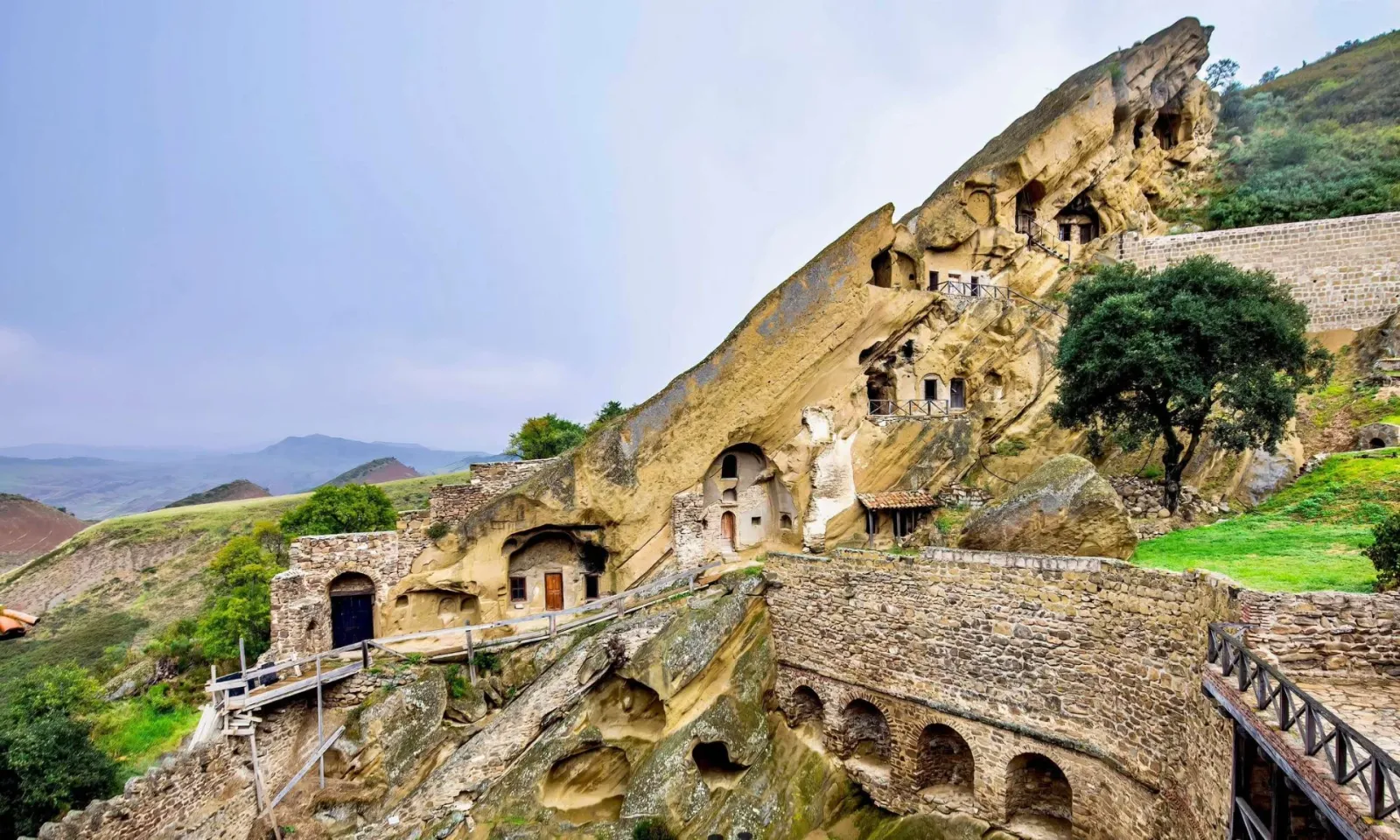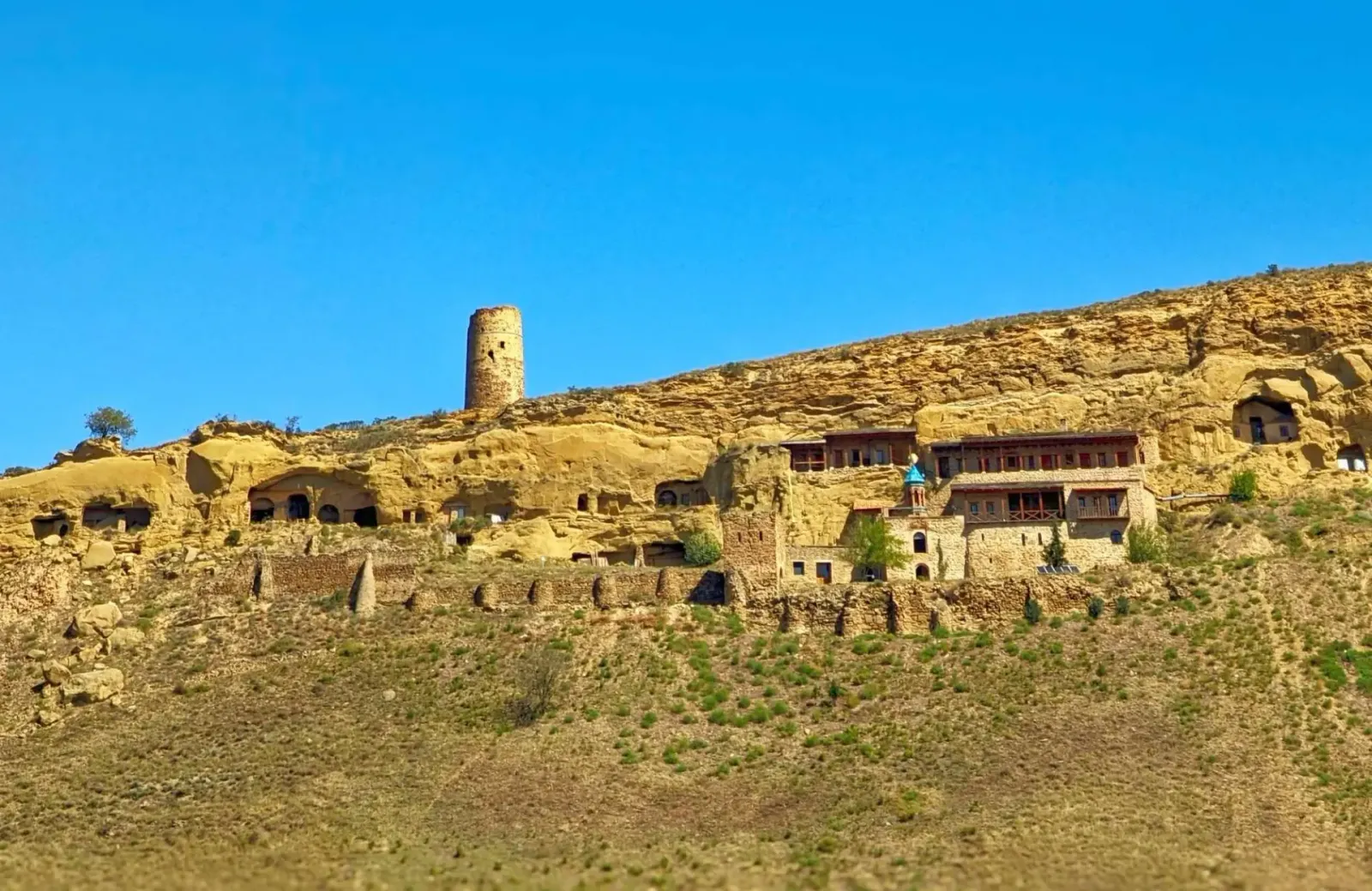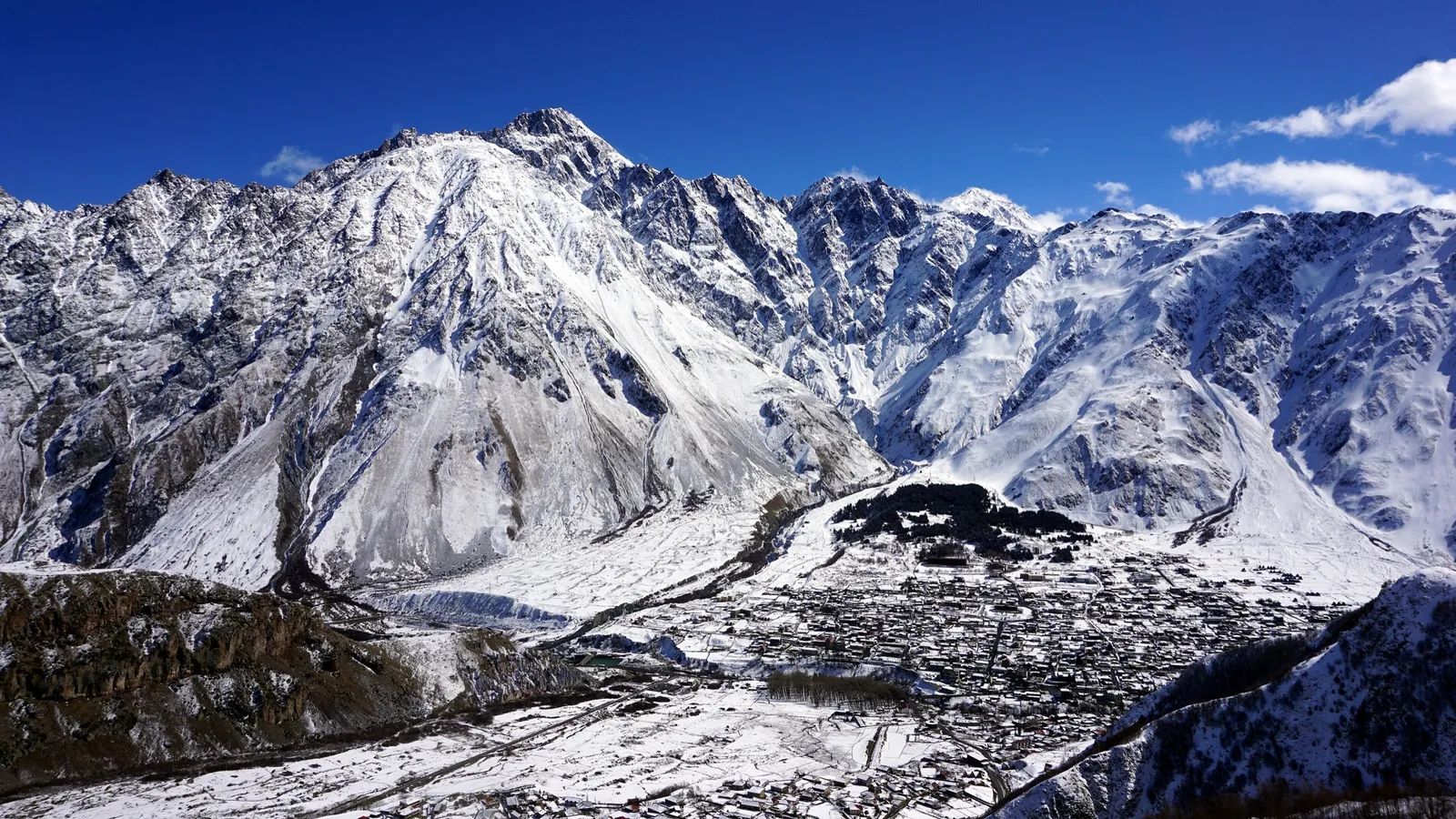
The short answer: Georgia is a good wildlife country if you are realistic. The animals you are most likely to see are birds: vultures and eagles in the semi-desert of Vashlovani, endemic mountain species around Kazbegi, and around a million birds of prey passing Batumi each autumn. Chamois and East Caucasian tur live on the high slopes of Kazbegi, Tusheti and Lagodekhi, and gazelles graze the steppe in Vashlovani. Brown bears are common in the forests but shy, and you should treat a sighting as luck, not a plan.
The mammals, and where they live
East Caucasian tur
The tur is a heavy wild goat with thick, curved horns, found only in the eastern Greater Caucasus. It lives on steep rock and alpine meadow above the tree line. Kazbegi National Park lists the tur as one of its signature animals, and Lagodekhi in the far east of Kakheti holds one of the main protected populations[1][2]. Seeing one means an early start, a long walk and a telescope: tur keep to cliffs and move down to graze at dawn and dusk. Chamois share the same slopes and are easier to spot; on the rocky sides of the Kazbegi valleys they can sometimes be watched at fairly close range[2].
Brown bears
Brown bears live in most of Georgia's forested mountains. Borjomi-Kharagauli National Park, the country's largest forest park, estimates about 135 bears, together with wolves, lynx and around 700 Caucasian red deer[3]. Protected-area teams have also studied bears in Mtirala, Algeti and Vashlovani[4]. Bears avoid people, and most hikers never see one. The honest way to put it: you walk in bear country, and on a quiet trail in late spring or autumn you might see tracks, dug-up ground or, rarely, the animal.
Gazelles, hyenas and the leopard
Vashlovani, the badlands park on the Azerbaijani border, is the one place in Georgia where you watch animals in open country. Goitered gazelles graze on the steppe, and the park is also home to striped hyenas, wolves, jackals and porcupines. For the details, see our Vashlovani National Park guide.
The famous one is the Caucasian (Persian) leopard. A leopard's tracks were found in Vashlovani in 2003, and the animal was followed by camera traps for several years. After a long gap, a camera trap in the Tusheti protected areas photographed a leopard in August 2021, and again in August 2022[5]. Nobody sees one on holiday. It is a sign that the high forests are still wild enough for it.
Birds: the part you can plan around
Vultures and eagles in the east
Georgia has four vultures: the griffon, the Egyptian vulture, the cinereous vulture and the lammergeier (bearded vulture). Eagle canyon in Vashlovani is monitored for its nesting griffons and Egyptian vultures[4], and the Lagodekhi reserve lists bearded vultures and golden, imperial and steppe eagles among about 150 bird species[1]. Lammergeiers are regularly seen over the Kazbegi valleys and the Jvari Pass.
Caucasian endemics in Kazbegi
In May and June, the slopes above Stepantsminda hold birds you can't see anywhere else: Caucasian black grouse displaying at dawn, Caucasian snowcock, Güldenstädt's redstart and great rosefinch, with wallcreepers on the cliffs of the Dariali gorge. It means pre-dawn starts and short, steep walks on cold slopes.
The Batumi raptor migration
From mid-August to mid-October, around a million birds of prey funnel down the Black Sea coast past Batumi, counted from hillside stations above Sakhalvasho and Shuamta[6]. Honey buzzards peak around the turn of August and September, steppe buzzards in late September, and eagles in October. Our guide to the Batumi raptor migration has the dates and watchpoints.
When to go
- April–May: Vashlovani (green steppe, active gazelles, nesting vultures), and the start of the Kazbegi endemics season in mid-May.
- June–September: high-mountain walks in Kazbegi, Tusheti and Lagodekhi, where tur and chamois are on the upper slopes.
- Late August–mid-October: the Batumi migration.
- October–November: Vashlovani again, cooler and usually dry.
- Winter: tur and chamois come lower down, but snow closes most trails and the remote areas.
Watching wildlife without harming it
- Don't pay for photos with bears. Keeping wild-caught bears in private ownership is illegal in Georgia, and the law allows confiscation of the animal[7]. A roadside bear in a cage is a reason to walk on, not to take a picture.
- Keep your distance at leks and nests. Black grouse stop displaying if people walk in close, and vultures can abandon a nest. A good bird guide watches from a fixed spot and keeps the group quiet.
- No drones near cliffs with nesting raptors, or near herds of tur and chamois.
- Never feed wild animals, including the stray dogs that follow hikers into the mountains; food left on trails draws bears towards villages.
- Stay on the tracks in Vashlovani: the steppe is fragile, and driving off the track scars it for years.
- Use local specialists. Our driver-guides know the country, but they are not bird or mammal guides. On our birding tours, a specialist bird guide works with you.
What to bring
Binoculars are the one thing that changes the experience; a telescope helps with tur and distant eagles. Add warm layers for dawn in the mountains (close to freezing in May at Kazbegi), a sun hat for Vashlovani, and patience. Remember that travel insurance with at least 30,000 GEL of cover has been mandatory for visitors since 1 January 2026.
Seeing Georgia's wildlife with us
Three private trips are built around wildlife. The Vashlovani National Park by 4x4, 2 days drives the badland canyons with a night by the Alazani river and an early morning for gazelles and birds of prey (April–May, October–November). The Kazbegi birding tour for Caucasus endemics spends four days around Stepantsminda, the Jvari Pass and Dariali with a specialist bird guide in May and June. And the Batumi raptor migration tour covers the count stations, the Chorokhi delta and Mtirala from late August to early October. See each tour page for the current price, or plan your own route and we send you a private itinerary with a price. Nothing to pay now.
Sources
- Wikipedia, "Lagodekhi Protected Areas": en.wikipedia.org
- Kazbegi National Park, nature and culture: nationalparks.ge
- Agency of Protected Areas, biodiversity of Borjomi-Kharagauli National Park: apa.gov.ge
- UNDP Georgia, biodiversity research in Georgia's protected areas: undp.org
- WWF Caucasus, "Leopard was spotted again in the Tusheti Protected Areas": wwfcaucasus.org
- Batumi Raptor Count: batumiraptorcount.org
- NACRES, Captive Bear Action Plan for Georgia: nacres.org
Last checked: September 2026. Animal numbers are estimates from park surveys, and sightings are never guaranteed.