Georgia has one of the oldest Jewish communities in the world. By tradition it goes back about 2,600 years, and for most of that time Jews in Georgia were largely spared the persecution common elsewhere. Most of the community emigrated to Israel in the 1970s and 1990s, but the synagogues remain, several still in use. The main places to visit are Tbilisi, Kutaisi, Akhaltsikhe and Oni, which fit into a week by car.
A short history
Georgian Jewish tradition holds that the first Jews arrived after Nebuchadnezzar took Jerusalem in 586 BCE. The 11th-century Georgian chronicler Leonti Mroveli tells of Jewish refugees who settled near Mtskheta, the old capital, by paying tribute to its ruler. Other accounts place the arrival later; historians still debate the date. The oldest physical evidence so far is a group of gravestones near Mtskheta from the 3rd–5th centuries CE, inscribed in Hebrew and Aramaic.
Over the centuries Georgian Jews spoke Georgian (with their own dialect, sometimes called Judaeo-Georgian), lived in their own quarters in towns such as Kutaisi, Akhaltsikhe and Oni, and traded across the region. In the 1970s about 60,000 Jews lived in Georgia; large-scale emigration to Israel began that decade and a second wave followed in the 1990s, often with whole communities leaving together. Today around 65,000–75,000 Georgian Jews and their descendants live in Israel, many in Ashdod, while the community in Georgia numbered about 1,400 at the 2014 census, most of them in Tbilisi.
Tbilisi
- The Great Synagogue on Kote Afkhazi Street in the Old Town is a red-brick building built in 1904–1911 by Jews from Akhaltsikhe who had settled in the capital. It follows the Georgian-Jewish rite, was restored in 2011–2012, and is the main active synagogue of the city. There is also a smaller Ashkenazi synagogue.
- The David Baazov Museum of History of the Jews of Georgia, at 3 Anton Katalikosi Street nearby, is named after a leading Georgian Zionist. It was founded in 1933, closed in 1951 and reopened in 1992; since 2014 it has been housed in a restored former synagogue. Exhibits include manuscripts, photographs and traditional dress.
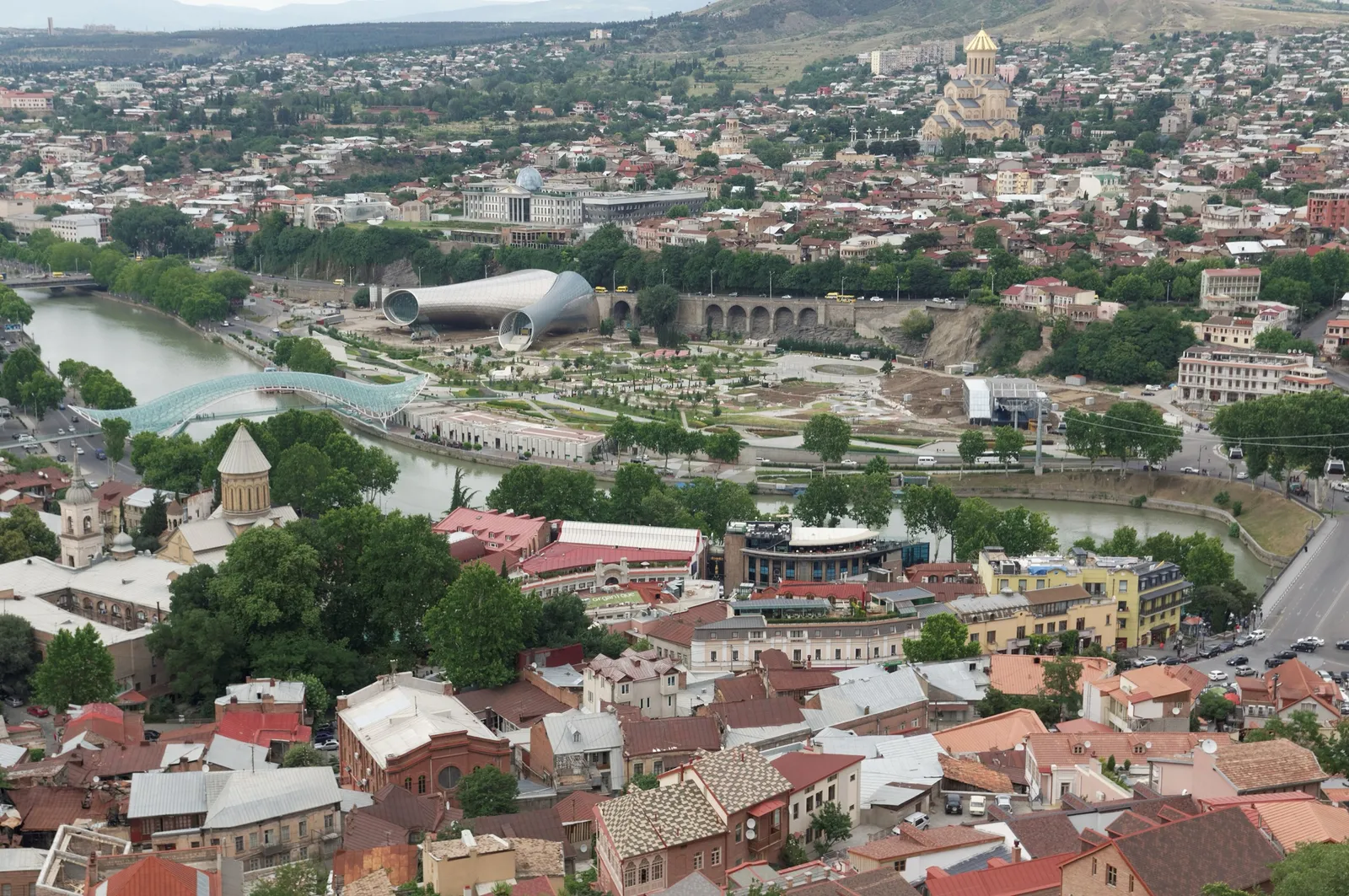
- The old Jewish quarter lies around the synagogue in the lanes below Narikala, a short walk from the sulphur baths. Our guide to Tbilisi in 1, 2 or 3 days covers the rest of the Old Town.
Akhaltsikhe
Akhaltsikhe, in the south, was once one of the largest Jewish centres in Georgia. The Jewish quarter lay west of Rabati Castle. The first synagogue there was built in 1740 and a second in 1863; the 1863 building was renovated in 2012 and has a painted wooden interior. The old Jewish cemetery on the edge of town is worth a visit. Akhaltsikhe is also the base for the Vardzia cave monastery, 60 km away, but part of Vardzia has been closed since the rockfall of 27 May 2026; see what is open at Vardzia in 2026.
Kutaisi
Kutaisi had a large Jewish community, and Gaponov Street, in the old Jewish quarter, still has several synagogues within a few minutes' walk of each other. The largest is a 19th-century stone building and one of the biggest synagogues in the country. Kutaisi also makes a good base for Gelati Monastery, the city's UNESCO World Heritage site.
Oni
In the small mountain town of Oni, in Racha, stands the synagogue built in 1895 in a Moorish-revival style. It is Georgia's third-largest synagogue, after those in Tbilisi and Kutaisi, and stands out among the low houses of the small town. Very few Jews live in Oni today, so visits are arranged with the community. Oni is about 2–2.5 hours from Kutaisi on a winding road, so it makes a full day there and back.
Kulashi and other places
Kulashi, a village near Samtredia in western Georgia, was once so Jewish that it was called the "Jerusalem of Georgia" and produced many of the country's rabbis. Almost all its Jewish families left for Israel from the 1970s, but the synagogues still stand, supported by former residents and their families. Other towns with Jewish heritage include Batumi (synagogue of 1904), Gori, Surami and Vani.
Planning the route
The sites line up well on one route from east to west, so you don't need to double back. From Tbilisi, Akhaltsikhe is about 215 km and 4 hours of driving via Mtskheta and Gori, where there is also a synagogue. From Akhaltsikhe to Kutaisi is about 200 km (3–3.5 hours) by the main highway. Oni makes a day trip from Kutaisi, and Batumi is another 150 km (2–2.5 hours) to the west, with its own airport, so you can fly home from there. A week is enough without rushing, including a quiet Shabbat.
Practical notes
- Opening hours: synagogues open for services and by arrangement with each community, and museum hours vary. Book visits ahead rather than turning up.
- Dress: shoulders and knees covered; men cover their heads in synagogues. In Georgian churches on the way, women cover their hair.
- Kosher food: Tbilisi has kosher restaurants. Outside the capital, kosher meals need to be arranged in advance, usually as packed lunches.
- Shabbat: plan the route so that you are not travelling from Friday evening to Saturday night.
- Language: our tours are guided in English.
Tours for this trip
Our Jewish Heritage of Georgia 7-day private tour visits the Great Synagogue and the Baazov Museum in Tbilisi, the synagogues and cemetery of Akhaltsikhe, Gaponov Street in Kutaisi, Oni and Batumi, with a licensed English-speaking heritage guide, kosher lunches and Shabbat-aware scheduling; we can add Kulashi on request. With only a day in the capital, the Tbilisi City Explorer private walk can include the Great Synagogue. See the tour page for the current price, or build your own route. Nothing to pay now.
Sources
- Wikipedia: Georgian Jews
- Wikipedia: Great Synagogue (Tbilisi)
- Wikipedia: David Baazov Museum of History of Jews of Georgia
- Wikipedia: Akhaltsikhe Synagogue
- Wikipedia: Oni Synagogue
- Georgia National Tourism Administration: Kulashi synagogue
- Jguide Europe: Jewish Tbilisi
- World Jewish Congress: community in Georgia
Last checked: September 2026.