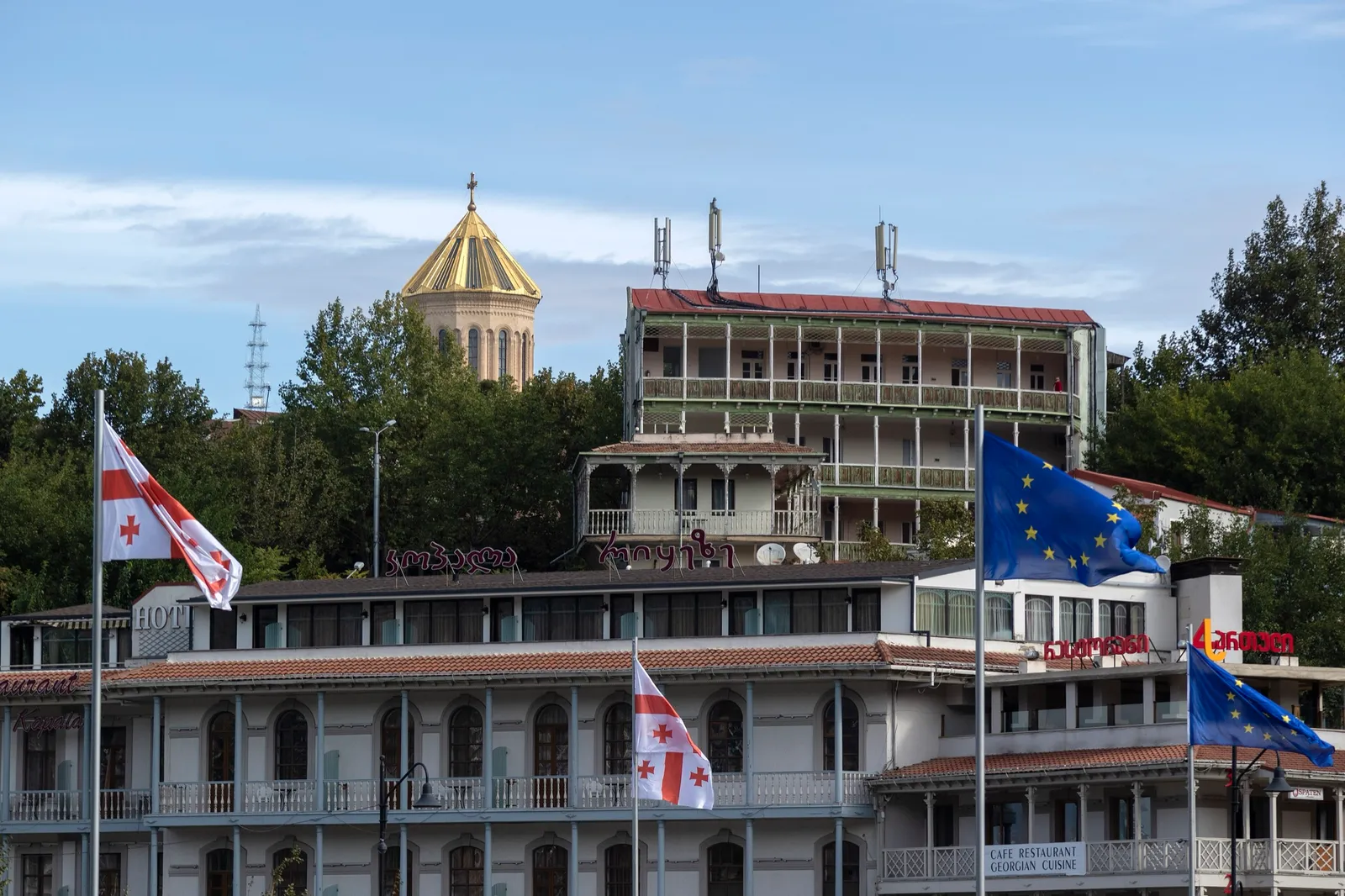
In short: Georgia became Christian in the early 4th century, when St Nino, a woman from Cappadocia in what is now Turkey, converted Queen Nana and then King Mirian III of Kartli, the kingdom of eastern Georgia [1][2]. The king made Christianity the state religion; the date most historians favour is 326, which made 2026 the 1,700th anniversary [2][3]. You can follow her story in three places: Mtskheta, the old royal capital; Sioni Cathedral in Tbilisi, which keeps the grapevine cross said to be hers; and Bodbe in Kakheti, where she is buried.
The story
Most of what we know about Nino comes from Georgian church tradition, with a few early mentions in Greek and Latin church histories [2]. The outline goes like this.
Nino was born in Cappadocia, probably late in the 3rd century, and spoke Greek [1]. Tradition says the Virgin Mary appeared to her in a vision, sent her to Iberia (as outsiders called Kartli), and gave her a cross made of grapevine branches. Nino bound it with her own hair, and it became her symbol [1].
She reached Mtskheta, the royal capital at the meeting of the Mtkvari and Aragvi rivers, and lived simply, praying and healing the sick. Her reputation reached the palace when she healed Queen Nana of a serious illness, and the queen became a Christian [1].
King Mirian III held out. The tradition says that while hunting he was suddenly plunged into darkness, some versions say by a solar eclipse, and lost his sight. He prayed to "the God of Nino", the light returned, and he converted [1][2]. He then made Christianity the religion of the kingdom and asked the Roman emperor Constantine for bishops and priests; the first bishops were Greeks sent from the empire [2].
Nino died in the 330s, by most accounts, and was buried at Bodbe in Kakheti [1]. The Church honours her as "Equal to the Apostles" and the Enlightener of Georgia, and Nino is still one of the most common girls' names in the country [1].
The date: 326 or 337?
Historians have proposed dates from 312 to 337. Many modern scholars favour 326, though 337, once widely accepted, still has supporters [2]. Either way, Kartli was among the first kingdoms anywhere to adopt Christianity as its state religion, alongside neighbouring Armenia [2]. The Georgian Church marked the 1,700th anniversary through 2026, with events from late May culminating at Svetitskhoveli Cathedral on its feast day, 14 October [3].
Conversion at the top did not mean the whole country changed overnight. Christianity spread slowly in the countryside, and it was the Thirteen Assyrian Fathers, monks who arrived in the 6th century and are linked to monasteries such as David Gareja, Nekresi and Ikalto, who carried it into the regions [2].
The grapevine cross
The cross of vine branches, with its arms drooping slightly, is the symbol of the Georgian Church, and you will see it on churches, icons and souvenirs all over the country. The relic itself is kept in Sioni Cathedral in Tbilisi's Old Town, to the left of the altar, in a reliquary given by King Vakhtang III in the early 14th century [4]. Look for it to the left of the altar, and dress for a church.
Where to follow her story
Mtskheta
Georgia's old capital, 25 km from Tbilisi, is where the conversion happened [5]. Three sites matter:
- Jvari Monastery, on the hill across the river, where tradition says Nino raised a large wooden cross on the site of a pagan temple. The present church dates from around 590–605.
- Svetitskhoveli Cathedral, on the site of the first wooden church King Mirian built; the present cathedral is 11th century. The legend of the "living pillar" that rose into the air until Nino prayed is told here.
- Samtavro, where Nino is said to have lived and built a small church, and where King Mirian and Queen Nana are buried [6].
These form part of the UNESCO-listed Historical Monuments of Mtskheta. Our Mtskheta guide covers the visit in detail.
Sioni Cathedral, Tbilisi
In the Old Town, a short walk from the sulphur baths, with the grapevine cross inside [4]. It is on almost every walking route through old Tbilisi.
Bodbe
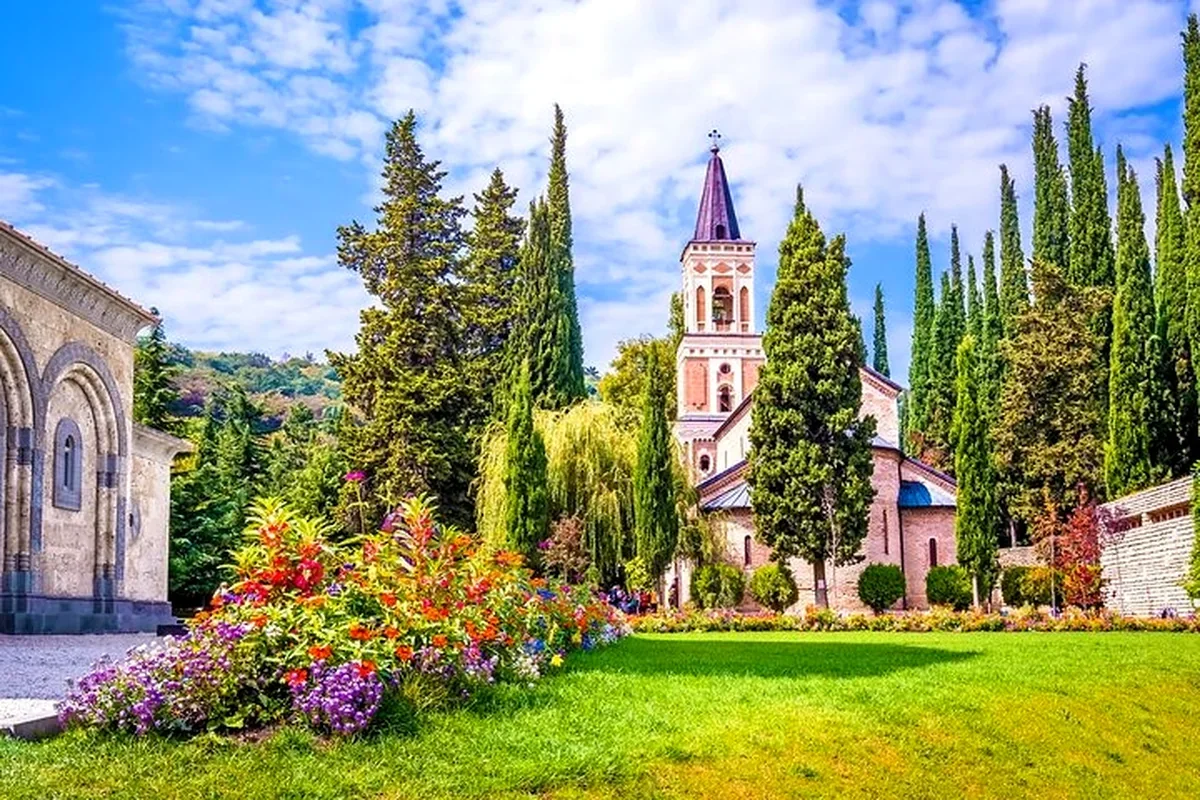
The convent 2 km from Sighnaghi, above the Alazani Valley, holds St Nino's tomb. A monastery was built over her grave in the 9th century, and St Nino's Spring, in a chapel downhill from the church, is believed to have healing waters. It is a place of pilgrimage. Read our Sighnaghi and Bodbe guide.
Her feast day
The Georgian Church marks St Nino twice a year: 27 January (Ninooba), the day of her death, and 1 June, the day of her arrival in Georgia [7]. On Ninooba, services are held in churches across the country, and at Sioni the faithful venerate the grapevine cross [7].
Visiting churches
At every site in this story, the dress code is shoulders and knees covered, and women cover their hair; wraps are usually available at the door. Speak quietly, and ask before photographing inside. Our guide to church etiquette has more. For another great figure of Georgian history, read Queen Tamar: Georgia's Golden-Age king.
Tours for this: St Nino's Georgia with us
Our tours are private, with your own car and English-speaking driver-guide. The Mtskheta and Château Mukhrani half day visits Jvari and Svetitskhoveli before a cellar tour and tasting; ask and we add Samtavro. The Kakheti wine day trip starts at Bodbe convent, where Nino is buried, then goes on to Sighnaghi, Tsinandali and a family qvevri cellar. The private Tbilisi city tour stops at Sioni Cathedral and the grapevine cross. See each tour page for the current price, or plan your own route and we send a private itinerary with a price. Nothing to pay now.
Sources
- Wikipedia, "Saint Nino": en.wikipedia.org
- Wikipedia, "Christianization of Iberia": en.wikipedia.org
- Basilica.ro, "Georgia marks 1,700 years of Christianity with nationwide anniversary events": basilica.ro
- Wikipedia, "Sioni Cathedral": en.wikipedia.org
- UNESCO World Heritage Centre, "Historical Monuments of Mtskheta": whc.unesco.org
- Wikipedia, "Samtavro Monastery": en.wikipedia.org
- Orthodox Times, "Georgian Orthodox Church marks St. Nino's Day": orthodoxtimes.com
Last checked: September 2026.