
Jewish Heritage of Georgia — 7-Day Private Tour
Tbilisi · Mtskheta · Gori Stalin Museum · Akhaltsikhe (Rabati Castle) · Vardzia · Kutaisi · Oni · Batumi
Overview
A seven-day private tour of Georgia's Jewish heritage, from Tbilisi's Great Synagogue to the 1904 synagogue in Batumi, with an experienced English-speaking heritage guide alongside your driver. Highlights: Kutaisi's three synagogues on Gaponov Street, Oni's 1895 synagogue in the Racha mountains and Akhaltsikhe's old Jewish cemetery. In Tbilisi you visit the Great Synagogue (1904–1911), built largely with money from Akhaltsikhe Jews who had moved to the capital, and the David Baazov Museum of Georgian Jews, with a kosher lunch. On the way west you stop in Mtskheta and in Gori, where a small community still keeps its synagogue. Two nights in Akhaltsikhe leave time for the 1860s synagogue in the Rabati quarter, the cemetery and, if you wish, the Vardzia cave monastery. From Kutaisi you make a day trip to Oni, and the tour ends in Batumi. The pace is easy, with 2–5 hours of driving on travel days. On request we order the days around Shabbat and pack kosher meals outside Tbilisi.
Itinerary
8 stops: Tbilisi, Mtskheta, Gori Stalin Museum, Akhaltsikhe (Rabati Castle), Vardzia, Kutaisi, Oni, Batumi
1Day 1Jewish Tbilisi
Airport pickup, then a walking afternoon with your heritage guide. If you land late, we move part of the programme to the morning of day 2.
Airport pickup and hotel check-in
Kosher lunch (included)
Great Synagogue on Kote Afkhazi Street
David Baazov Museum of Georgian Jews
Walk through the old Jewish quarter and the Old Town
Overnight: Tbilisi (hotel, breakfast)
 TbilisiDay 1: the Great Synagogue on Kote Afkhazi Street (1904–1911), known as the synagogue of the Akhaltsikhe Jews, the David Baazov Museum of Georgian Jews, a kosher lunch and a walk through the old Jewish quarter.
Day 1: the Great Synagogue on Kote Afkhazi Street (1904–1911), known as the synagogue of the Akhaltsikhe Jews, the David Baazov Museum of Georgian Jews, a kosher lunch and a walk through the old Jewish quarter.
Tbilisi, Georgia's capital, spreads along the Mtkvari river gorge between Narikala fortress and the Mtatsminda ridge. It is where most trips begin and end, and it deserves 2–3 days of its own. Walk the Old Town from the domed sulphur baths of Abanotubani up to Narikala, cross the Bridge of Peace, spend a morning with the gold of the Georgian National Museum and eat your way through the city's wine bars and khinkali houses. Every day trip in this area starts from here.
View destination details
2Day 2Mtskheta and Gori to Akhaltsikhe
About 215 km and 4 hours of driving.
Depart Tbilisi
Svetitskhoveli Cathedral, Mtskheta
 MtskhetaDay 2: about an hour at Svetitskhoveli Cathedral in Mtskheta, Georgia's old capital, where tradition says Elioz, a Jew of Mtskheta, brought back the robe of Christ from Jerusalem.
Day 2: about an hour at Svetitskhoveli Cathedral in Mtskheta, Georgia's old capital, where tradition says Elioz, a Jew of Mtskheta, brought back the robe of Christ from Jerusalem.
Mtskheta, about 25 km (30 min) north of Tbilisi where the Aragvi meets the Mtkvari, was the capital of the ancient kingdom of Kartli (Iberia) and the place where Georgia adopted Christianity in the 4th century. Its churches are a UNESCO World Heritage Site: Svetitskhoveli Cathedral in the old town, Jvari Monastery on the hill opposite with the classic view over the river confluence, and the Samtavro convent. Allow half a day, or combine it with Gori and Uplistsikhe or a Mukhrani winery.
View destination details
Gori synagogue
 Gori Stalin MuseumDay 2: Gori's synagogue, in use since the 1940s, where a community of a few dozen people is one of the few still active outside Tbilisi.
Day 2: Gori's synagogue, in use since the 1940s, where a community of a few dozen people is one of the few still active outside Tbilisi.
Gori, in Shida Kartli about 86 km west of Tbilisi, is the town where Joseph Stalin was born in 1878, and its Stalin Museum is the main reason travellers stop. The museum complex keeps the small house where he spent his first years under a marble pavilion, a Soviet-era exhibition that still presents him largely uncritically, and his green armoured railway carriage. Above the town stands the medieval Gori Fortress. Allow 1–1.5 hours for the museum and fortress, and combine it with Uplistsikhe cave town, 12 km away.
View destination details
Packed kosher lunch (included)
Arrive in Akhaltsikhe
 Akhaltsikhe (Rabati Castle)Days 2–3: the 1860s synagogue in the Rabati quarter (restored in 2012), the building of a second, early-20th-century synagogue, the old Jewish cemetery and Rabati Castle. Two nights.
Days 2–3: the 1860s synagogue in the Rabati quarter (restored in 2012), the building of a second, early-20th-century synagogue, the old Jewish cemetery and Rabati Castle. Two nights.
Akhaltsikhe is the main town of Samtskhe-Javakheti in south-west Georgia, about 205 km (3–3.5 h) from Tbilisi via Borjomi, and the usual stop on the way to Vardzia. Its landmark is Rabati Castle, a 7-hectare walled complex where a church, a mosque, a madrasa, a Jakeli palace, a bathhouse and a history museum stand side by side, restored in 2011–12. Most travellers spend an hour inside the walls; the old Jewish quarter and its synagogue lie just west of the castle.
View destination details
Overnight: Akhaltsikhe (hotel, breakfast)
3Day 3Akhaltsikhe's synagogues and cemetery
A short day in town; Vardzia (about 60 km, 1–1.5 h each way) is optional in the afternoon.
Synagogue in the Rabati quarter and the second synagogue building
Old Jewish cemetery
Rabati Castle
Optional Vardzia (about 2 h on site), or a free afternoon
 VardziaDay 3 option: the 12th-century Vardzia cave monastery, 1–1.5 h from Akhaltsikhe. Part of the route has been closed since the May 2026 rockfall; we confirm current access.
Day 3 option: the 12th-century Vardzia cave monastery, 1–1.5 h from Akhaltsikhe. Part of the route has been closed since the May 2026 rockfall; we confirm current access.
Vardzia is a 12th-century cave monastery cut into the cliff of Erusheti mountain above the Mtkvari river in Samtskhe-Javakheti, about 60 km south of Akhaltsikhe and 4.5–5 h from Tbilisi. Hundreds of rock-cut rooms, stairways and tunnels open onto the gorge, and the Church of the Dormition holds original frescoes with a portrait of Queen Tamar. Since a rockfall on 27 May 2026 the visitor route ends shortly after the church, so about half of the complex is closed; we confirm current access before your trip.
View destination details
Overnight: Akhaltsikhe (hotel, breakfast)
4Day 4To Kutaisi: Gaponov Street
About 200 km via Khashuri and the Rikoti highway (3–3.5 h); the shorter Zekari pass road is still partly unpaved on the Abastumani side.
Drive to Kutaisi
 KutaisiDays 4–5: the Jewish quarter on Gaponov Street, with the Great Synagogue (1886) and two smaller synagogues a few minutes' walk apart. Two nights in Kutaisi.
Days 4–5: the Jewish quarter on Gaponov Street, with the Great Synagogue (1886) and two smaller synagogues a few minutes' walk apart. Two nights in Kutaisi.
Kutaisi, Georgia's third-largest city, sits on the Rioni river in Imereti, about 230 km west of Tbilisi. It is the natural base for western Georgia: UNESCO-listed Gelati Monastery and the hilltop Bagrati Cathedral are on its edge, and Prometheus Cave, Sataplia, and the Martvili and Okatse canyons are within an hour. In town, walk the Green Bazaar, the White Bridge and the old Jewish quarter, then eat Imeretian khachapuri with a glass of local Tsitska or Tsolikouri white wine.
View destination details
Packed kosher lunch (included)
Gaponov Street: the Great Synagogue and the smaller synagogues nearby
Gelati Monastery (UNESCO) if time allows
Overnight: Kutaisi (hotel, breakfast)
5Day 5Oni in Racha
About 2–2.5 hours each way on a winding mountain road via Ambrolauri.
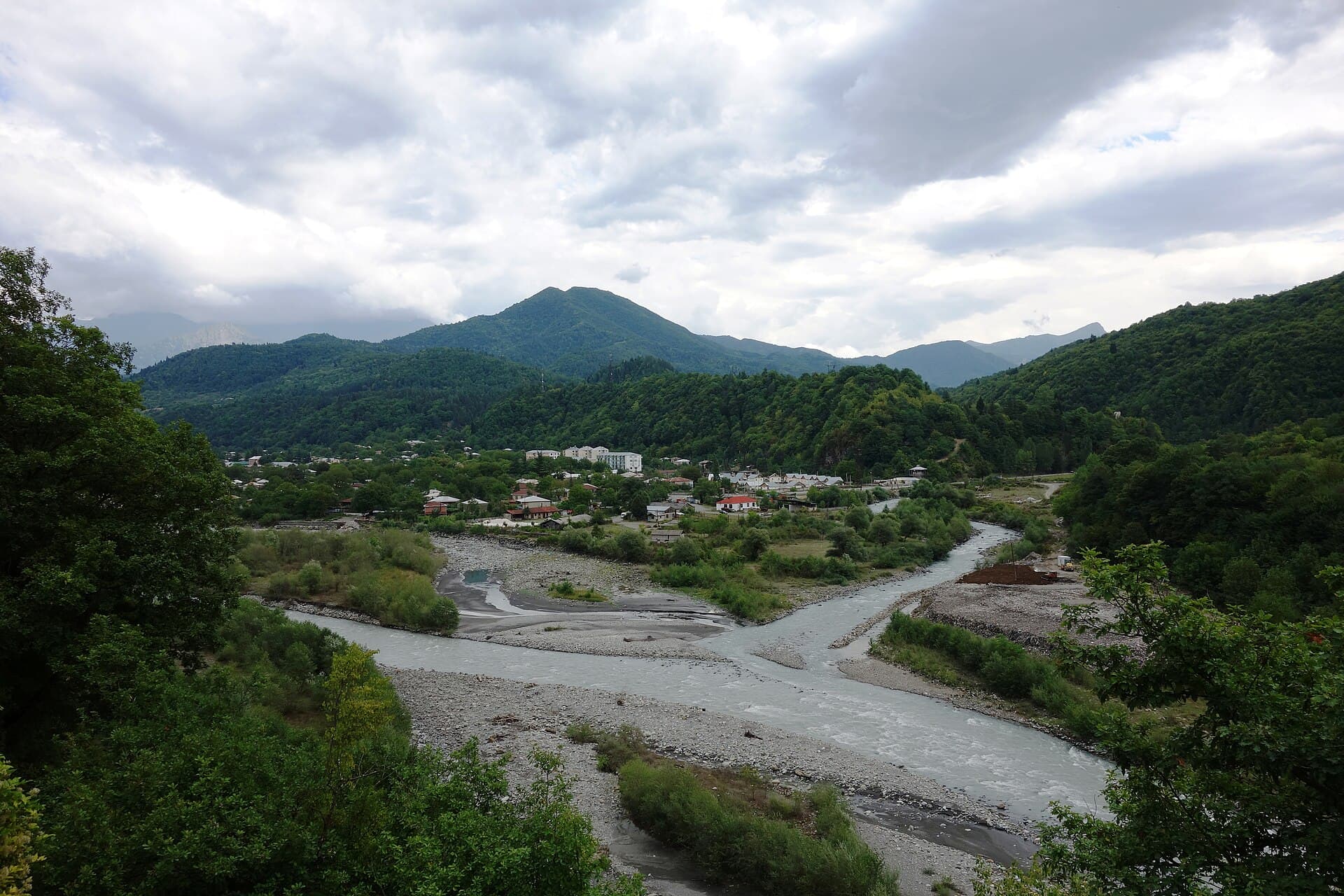 OniDay 5: a day trip into Racha to Oni's synagogue (1895), the third-largest in Georgia, restored in 1995 after damage in the 1991 Racha earthquake; its congregation is now very small.
Day 5: a day trip into Racha to Oni's synagogue (1895), the third-largest in Georgia, restored in 1995 after damage in the 1991 Racha earthquake; its congregation is now very small.
Oni is the small main town of upper Racha, on the Rioni river at about 800 m, some 27 km (30 min) north-east of Ambrolauri. Its synagogue, built in 1895, is one of the largest in Georgia and a reminder of the town's once-large Jewish community. The town is also the gateway to the upper Rioni valley, the Shovi area and the high passes towards the Russian border, and the start of rafting trips down the Rioni.
View destination details
Drive into Racha
Oni synagogue (1895) and the town
Packed kosher lunch (included)
Drive back
Back in Kutaisi
Overnight: Kutaisi (hotel, breakfast)
6Day 6Kutaisi to Batumi
About 150 km (2–2.5 h).
Drive to Batumi
 BatumiDay 6: Batumi's 1904 synagogue and an evening on the seafront boulevard; night in Batumi, then Batumi airport on day 7.
Day 6: Batumi's 1904 synagogue and an evening on the seafront boulevard; night in Batumi, then Batumi airport on day 7.
Batumi is Georgia's main Black Sea city and the capital of Adjara, about 370 km (5.5–6 h by road, about 5–5.5 h by train) from Tbilisi and 150 km from Kutaisi. Its seafront Boulevard runs for about 7 km past palms, pebble beaches and modern towers, and the compact old town around Europe Square has 19th-century houses, cafés and the Piazza. Travellers come for the sea from June to September, the Botanical Garden on Green Cape, Adjarian food and day trips into the green hills of mountainous Adjara.
View destination details
Packed kosher lunch (included)
Batumi synagogue (1904)
Evening on the seafront boulevard
Overnight: Batumi (hotel, breakfast)
7Day 7Departure from Batumi
The tour ends in Batumi; the airport is about 15 minutes from the centre.
Transfer to Batumi airport at any hour
Make this tour your own:Build your own tour
What's Included
Included
- Private car or minivan with fuel and parking (sedan for 1–3 travellers, minivan for 4–8)
- English-speaking driver throughout
- Experienced English-speaking Jewish-heritage guide throughout
- Tbilisi airport pickup on arrival and Batumi airport drop-off on departure
- 6 nights in hotels, twin/double rooms, breakfast included (Tbilisi 1, Akhaltsikhe 2, Kutaisi 2, Batumi 1)
- Kosher lunch in Tbilisi and packed kosher lunches on travel days
- Entry fees: David Baazov Museum and Rabati Castle
- Bottled water
Not included
- Dinners, and lunches not listed as included (about 30–50 GEL per person per meal)
- Entry fees: Vardzia if chosen, about 15 GEL plus 2 GEL shuttle
- Donations at synagogues
- Single room supplement
- Tips (optional)
- Travel insurance (mandatory for visitors to Georgia from 1 January 2026)
- Flights
Map
Good to know
- Best Time to Visit
- March–November
- Physical Requirements
- Suitable for most fitness levels. Involves some walking on mostly flat terrain with minimal elevation changes.
- Cancellation Policy
- Nothing to pay now. Your quote includes the cancellation terms before you pay anything.
- Shabbat
- tell us when you book and we order the days so that you do not travel from Friday evening to Saturday night; this can mean a slower day in one town.
- Kosher food
- tell us your standard of kashrut; outside Tbilisi lunches are packed in advance, and dinners are not included, so we plan them with you.
- Opening hours
- synagogues open for services and by arrangement with each community, and museum hours vary; we book every visit ahead.
- Dress code
- shoulders and knees covered in synagogues and churches; men cover their heads in synagogues, women their hair in churches.
- Pace
- easy town walking; the longest drives are day 2 (about 4 h) and the Oni day trip on day 5 (4–5 h there and back).
- Ending in Batumi
- fly home from Batumi, or ask us to add the evening train back to Tbilisi (about 5 h).
Categories:
Round trip (6–14 days)
History & culture
You Might Also Like

Georgian Wine Tour: Kakheti & Kartli — 7-Day Private Tour
Private · 7 days
$1,115/person · 4 travellers

Mtskheta, Gori & Uplistsikhe — Private Day Trip from Tbilisi
Private · 1 day
$69/person · 4 travellers