The short answer: these are two of the finest medieval churches in central Georgia, both a short detour from the main road west of Tbilisi. Ateni Sioni, in a vine-covered valley 10–12 km south of Gori, is a 7th-century church with a complete cycle of 11th-century frescoes and the oldest known inscription in the modern Georgian script. Samtavisi, built in 1030 near Kaspi, about 45 km from Tbilisi, has an east facade covered in carved stone ornament. Either adds an hour to a day at Uplistsikhe and Gori; both together add two to three.
Ateni Sioni
The church
Ateni Sioni stands in the village of Ateni, in the valley of the Tana river south of Gori[1][3]. It was completed in the early 7th century and follows the same four-apse plan as Jvari Monastery above Mtskheta, which is why scholars group them together as "Jvari-type" churches[1]. An Armenian inscription names a builder, Todosak, though historians debate whether he built the original church or worked on a later renovation[1]. Outside, look for carved reliefs of stags, a hunting scene and a horseman[3].
The frescoes
The interior was painted in the second half of the 11th century by at least four artists[1]. The cycle includes the Virgin and Child with archangels in the apse, apostles, scenes from the life of Christ and the Last Judgement, alongside saints and Georgian rulers[1][3]. It is one of the most complete medieval wall-painting programmes in Georgia. The light inside is dim; give your eyes a few minutes.
The inscriptions
Ateni's walls are also a stone archive. They carry the earliest known inscription in the Nuskhuri script, dated 835, and the earliest in Mkhedruli, the script Georgians use today, from 982[1]. Other inscriptions record events such as the siege of Tbilisi by the Arab general Bugha in 853[1]. For the story of the three scripts, read the story of the Georgian scripts.
Ateni wine
The Ateni valley is also a wine appellation, Georgia's only one dedicated to sparkling wine[4]. Only two local white grapes are allowed, Chinuri and Goruli Mtsvane, grown at about 620–750 m, and both the traditional method and tank fermentation are permitted[4]. The result is crisp and light. A few wineries in the valley welcome visitors; a glass of Atenuri makes a good end to the visit.
Samtavisi Cathedral
The building
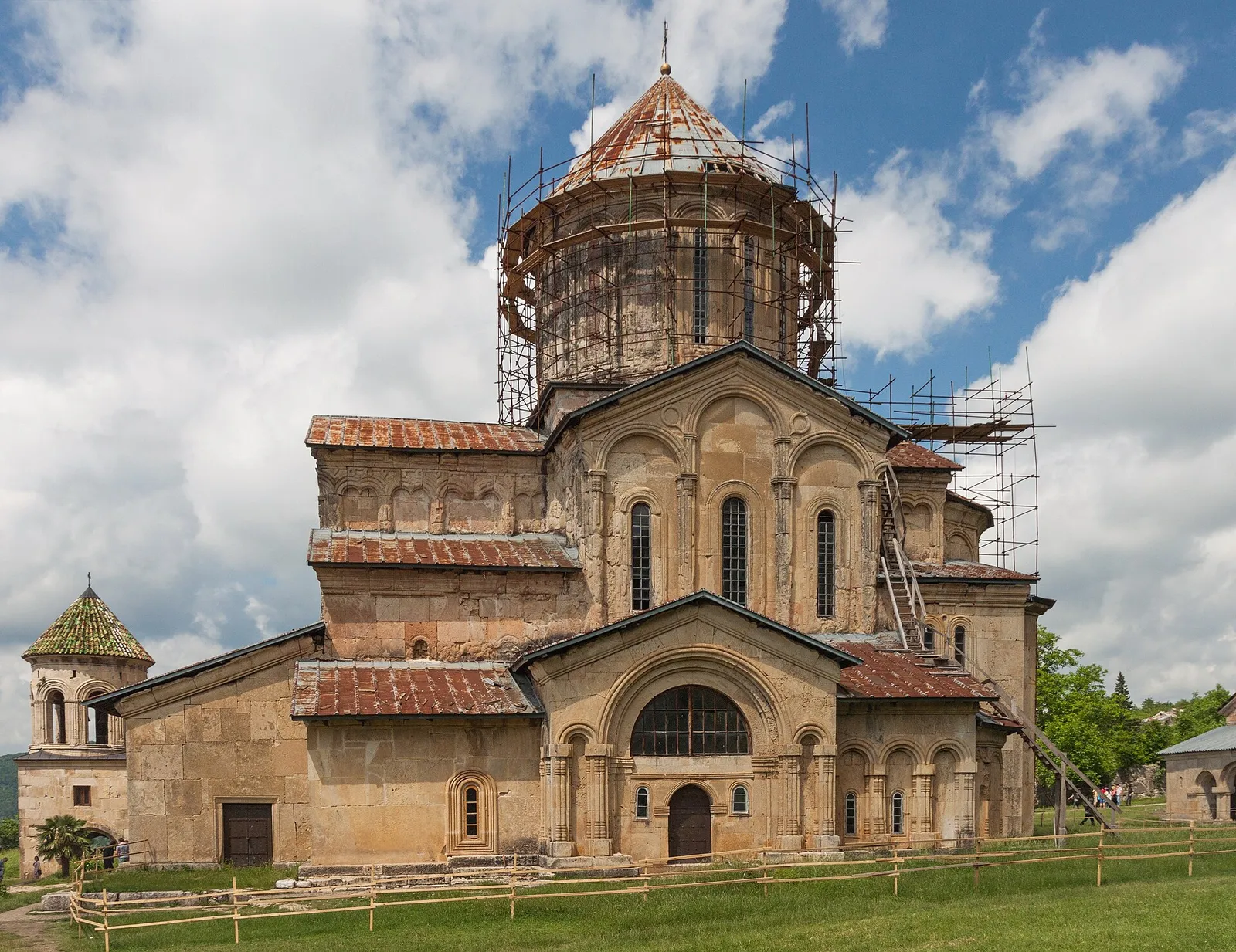
Samtavisi stands on the left bank of the Lekhura river, about 11 km from Kaspi and roughly 45 km from Tbilisi[2]. It was built in 1030 by the architect Hilarion, and it is a landmark of Georgian architecture: the church that set the Georgian version of the cross-in-square plan[2]. It is still the seat of a bishop of the Georgian Orthodox Church[2].
The east facade
The reason to stop is the east wall. It is decorated with a great carved cross, deep decorative niches and bands of intricate stone ornament, with relief creatures among them[2]. Walk round to the back of the church first; morning light shows the carving well.
Inside
Earthquakes damaged the dome and walls over the centuries, and the church was rebuilt in the 15th–16th centuries and restored again in the 19th, when some original decoration was lost[2]. Inside are fragments of 11th-century painting and more complete 17th-century frescoes, including Christ Pantocrator with seraphim and the evangelists[2].
How to add them to a Gori day
The classic day west of Tbilisi takes in Mtskheta, the rock-cut town of Uplistsikhe and the Stalin Museum in Gori. Both churches sit close to that route:
- Samtavisi is a short detour from the main highway between Tbilisi and Gori. Allow 20–30 minutes at the church, on the way out or back.
- Ateni Sioni is 10–12 km south of Gori, up the Tana valley. Allow about an hour and a half for the drive there and back and a proper look at the frescoes; more with a wine tasting.
Adding both makes the Gori day long, so something usually gives. Many people drop the Stalin Museum or see Mtskheta on another day; our guide to Gori and the Stalin Museum helps you decide whether it is for you.
Visiting tips
- Dress: both are working churches. Cover shoulders and knees; women usually cover their hair.
- Photos: ask before photographing inside, and never use flash on the frescoes.
- Services: if a service is on, wait quietly at the back.
- Bring a torch: a small light (not a flash) helps with the darker corners of Ateni's walls.
- Insurance: since 1 January 2026, travel insurance with at least 30,000 GEL of cover is mandatory for visitors to Georgia.
Who they suit
These two churches suit travellers who enjoy medieval art and architecture, and anyone who has already seen Mtskheta and wants something quieter. They suit less well if you are short of time on a first trip, when Uplistsikhe and Mtskheta come first, or if you are travelling with young children, who usually prefer the caves of Uplistsikhe.
Seeing them with us
Our Mtskheta, Gori and Uplistsikhe private day trip runs all year; tell us when you enquire and we can swap the Stalin Museum or part of Mtskheta for Ateni Sioni and Samtavisi. For more time, the Heart of Georgia 5-day private heritage tour passes this way on the drive west to Kutaisi, and the churches can be added to that day. Both are private, with your own car and English-speaking driver-guide; see the tour page for the current price. Or build your own heritage route. Nothing to pay now.
Sources
- Wikipedia, "Ateni Sioni Church": en.wikipedia.org
- Wikipedia, "Samtavisi Cathedral": en.wikipedia.org
- Georgia.to, "Ateni Sioni Church": georgia.to
- WineTourism.com, "Ateni wine appellation": winetourism.com
Last checked: September 2026.