In short: Tamar (c. 1160–1213) was the first woman to rule Georgia in her own right. Crowned co-ruler by her father in 1178, she reigned alone from 1184 until her death in 1213, under the title mepe, "king", rather than the word for a queen consort [1]. Her reign is remembered as the height of the medieval Georgian kingdom: military victories, a network of allied states, church building and The Knight in the Panther's Skin, the national epic. You can still see her portrait on the wall of the cave church at Vardzia, painted in her lifetime [2].
Her life, briefly
Tamar was the daughter of King George III. With no son to succeed him, George had her crowned as co-ruler in 1178 in front of the nobility and clergy, and she ruled alone after his death in 1184 [1]. A woman on the throne was new, and the great nobles pushed back; the early years of her reign were a contest over how much power the crown would share with them [1].
Her first marriage, in 1185, was to the Russian prince Yury Bogolyubsky. It went badly: she divorced him in 1187, citing his drunkenness and misconduct, and he was sent to Constantinople, from where he twice tried and failed to take power [1]. In 1191 she married David Soslan, an Alan prince, and their two children, George IV Lasha and Rusudan, both ruled after her [1].
She died on 18 January 1213 after falling ill near Gori [1].
What her reign achieved
- Military power. Georgian armies, led by David Soslan and the Zakarian brothers, won major battles at Shamkor in 1195 and Basiani in the early 1200s against Seljuk-led coalitions, and pushed Georgian control across much of the South Caucasus and into Armenia [1][3].
- Trebizond. In 1204 Tamar backed the founding of the Empire of Trebizond on the Black Sea coast by her Komnenos relatives [1].
- Culture. Church building and wall painting flourished, and coins bore inscriptions in both Georgian and Arabic [1].
The period from her great-grandfather David the Builder to the end of her reign is what Georgians call the Golden Age. The Mongol invasions that began under her children brought it to an end.
Rustaveli and The Knight in the Panther's Skin
The poet Shota Rustaveli served Tamar, and from 1191 is said to have been her treasurer, or minister of finance [4]. His long poem, The Knight in the Panther's Skin, is Georgia's national epic, and it is read as an allegory of her reign, with its ideals of loyalty, friendship and chivalry [4]. A fresco of Rustaveli survives at the Monastery of the Cross in Jerusalem, with an inscription naming him as a treasurer [4]. Rustaveli Avenue, Tbilisi's main street, is named after him.
History and legend
Tamar is a saint of the Georgian Orthodox Church, with a feast day on 14 May, and she is a national symbol: on banknotes, in songs and in the dance Samaia, danced by three women as princess, mother and ruler [1]. That makes it easy for legend to run ahead of history.
- Her grave: the chronicles say her body went first to the cathedral at Mtskheta and then to Gelati, the royal burial ground near Kutaisi [1]. Legend says she was secretly reburied so enemies could not find her, or that she lies in the Holy Land near Jerusalem, as she had wished. Nobody knows for sure [1].
- "Tamar's" everything: all over Georgia, bridges, castles and caves are called Tamar's. Some really date from her time; many are older or later and simply borrowed her name. Guides will usually tell you which is which if you ask.
- "King Tamar": this one is true. The title mepe was a statement that she ruled, not just reigned beside a husband [1].
Places linked to Tamar
Vardzia
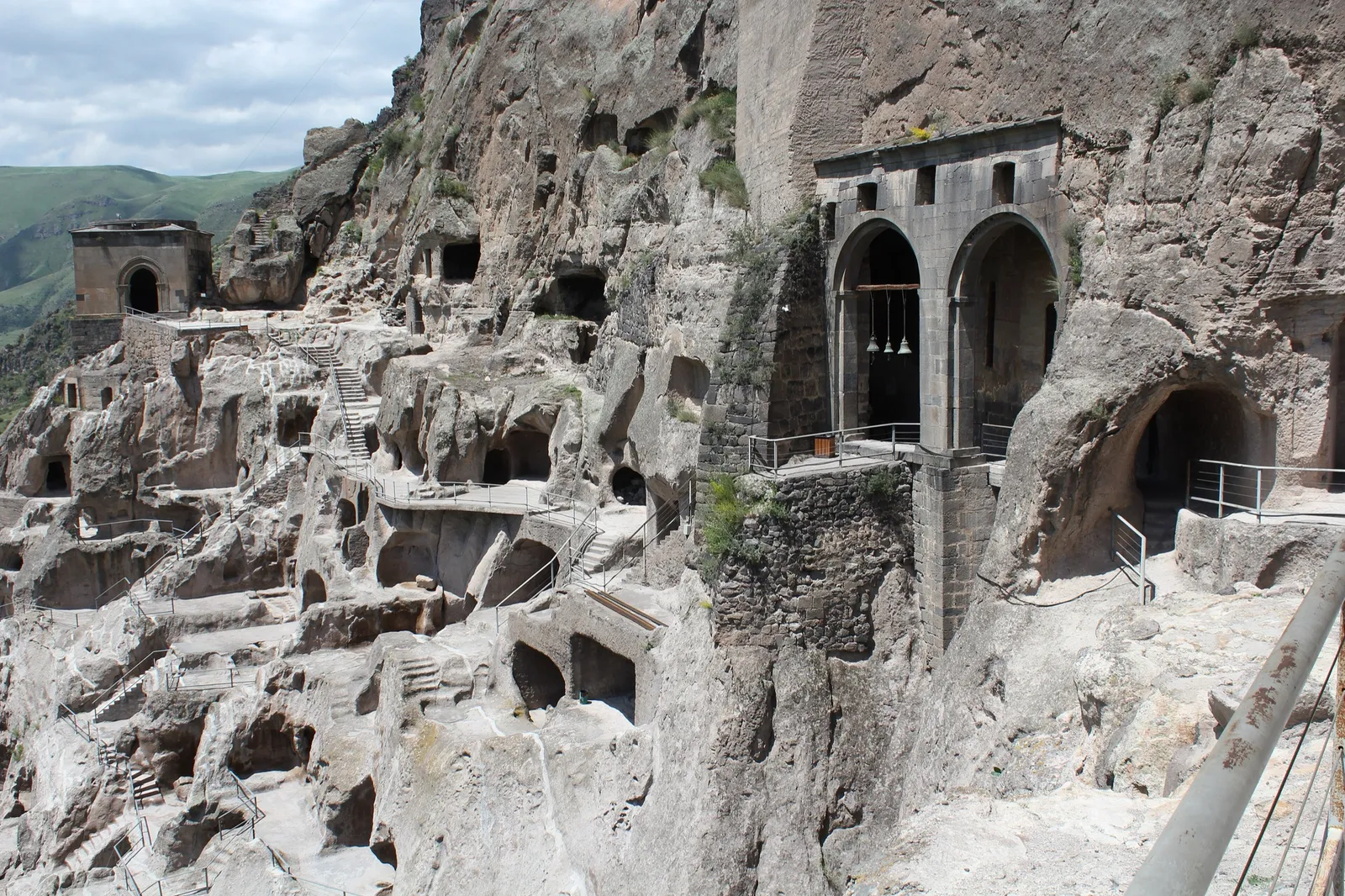
The cave monastery cut into the cliffs above the Mtkvari in the far south was built mainly in the second half of the 12th century, under George III and then Tamar [2]. In the Church of the Dormition, the wall painting of the royal founders, George III and Tamar holding a model of the church, is dated to between 1184 and 1186, which makes it her earliest surviving portrait [1][2]. Part of Vardzia has been closed since the rockfall of 27 May 2026; visits currently turn back shortly after the church, which is still on the open route. Read Vardzia in 2026: what's open before you go.
Betania and Kintsvisi
Two more monasteries have 13th-century portraits of Tamar: Betania, in the wooded hills south-west of Tbilisi, and Kintsvisi, in Shida Kartli [1]. Both are small and quiet, and a detour rather than a main stop.
Gelati
The monastery above Kutaisi, founded by David the Builder, was the royal burial ground and, by the chronicles' account, one of her resting places [1]. It is Kutaisi's only UNESCO World Heritage site. Our Gelati Monastery guide explains what you can see.
Uplistsikhe
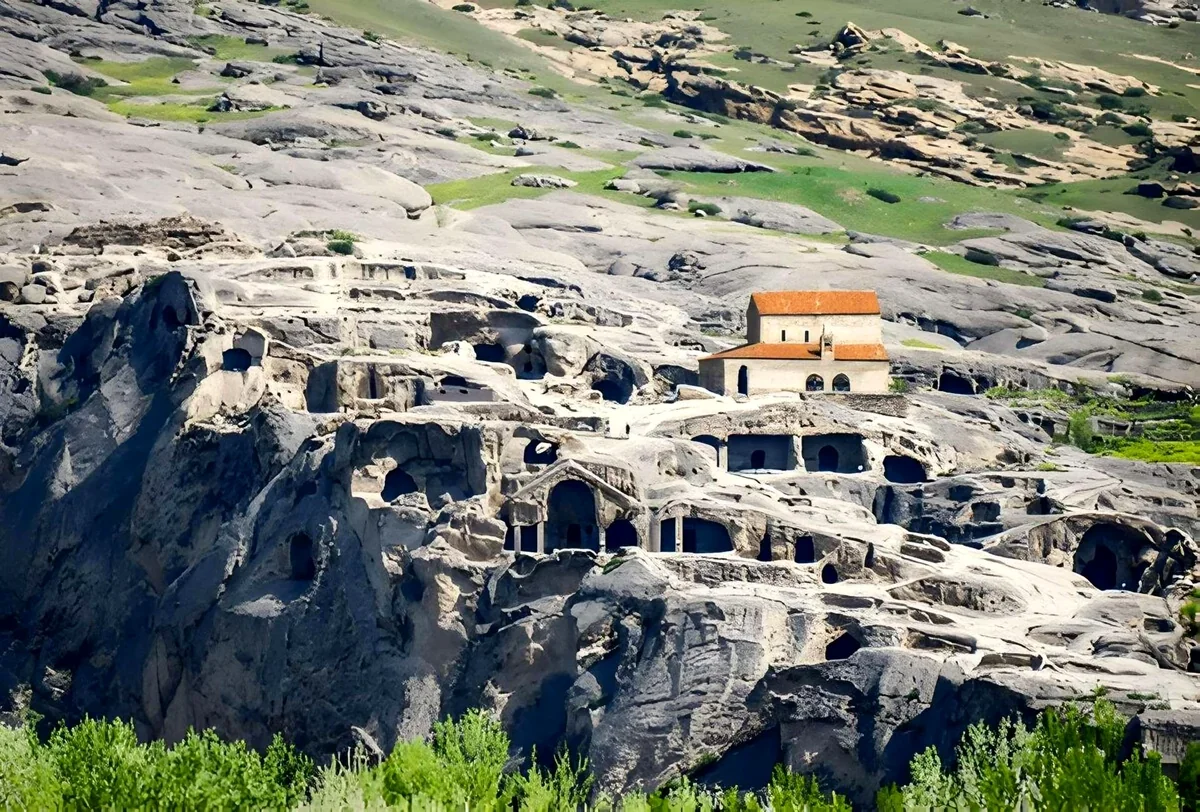
The rock-cut town near Gori has a large hall that tradition names after Tamar [5]. It is part of the classic day west of Tbilisi; see Uplistsikhe or Vardzia.
Tamar's Bridge in Adjara
The stone arched bridge at Makhuntseti, in the hills behind Batumi, carries her name, one of several arched bridges in the region linked to her by tradition.
Tours for this: Tamar's Georgia with us
Our tours are private, with your own car and English-speaking driver-guide. The Vardzia and Borjomi tour, 2 days spends a morning at Vardzia with a site guide, with a night nearby so you arrive before the crowds. The Central Georgia heritage tour, 5 days takes in Mtskheta, Uplistsikhe, Gelati and Kutaisi. For a single day, the Mtskheta, Gori and Uplistsikhe day trip covers the old capital and the rock town. See each tour page for the current price, or plan your own route and we send a private itinerary with a price. Nothing to pay now.
Sources
- Wikipedia, "Tamar of Georgia": en.wikipedia.org
- Wikipedia, "Vardzia": en.wikipedia.org
- World History Encyclopedia, "Tamar of Georgia": worldhistory.org
- Wikipedia, "Shota Rustaveli": en.wikipedia.org
- Geotour destination research, Uplistsikhe ("hall of Tamar"); see also Wikipedia, "Uplistsikhe": en.wikipedia.org
Last checked: September 2026. Vardzia's open route may change as repairs go on; we confirm it before you travel.