
Grand Tour of Georgia — 10-Day Private Tour, Mountains to the Black Sea
Private · 10 days
$1,365/person · 4 travellers




Photos: Jon Gudorf Photography (CC BY-SA 2.0) · Spetznaz1991 (CC BY 2.0) · Wikimedia Commons
Tbilisi · Mtskheta · Bodbe · Sighnaghi · Telavi · Alaverdi · Ikalto · Shuamta · Ananuri Fortress · Kazbegi · Trinity Church Gergeti · Gori Stalin Museum · Uplistsikhe Cave Town · Borjomi · Akhaltsikhe (Rabati Castle) · Vardzia · Khertvisi Fortress · Gyumri · Yerevan · Garni Temple · Geghard Monastery · Lake Sevan · Etchmiadzin · Khor Virap · Noravank
A twelve-day private tour of Georgia and Armenia: seven days in Georgia, from Tbilisi and Kakheti's wine country to Kazbegi, Uplistsikhe and the Vardzia cave monastery, then five in Armenia with Gyumri, Yerevan, the Garni temple, Geghard, Lake Sevan and Khor Virap facing Mt Ararat. In Georgia you travel with our English-speaking driver-guide. On day 8 you cross into Armenia at the Ninotsminda–Bavra border, where our Armenian partner's English-speaking guide and vehicle take over. In Armenia you see the 1st-century Garni temple (rebuilt in the 1970s from its original stones), the rock-cut churches of Geghard, Etchmiadzin Cathedral, reopened in 2024 after restoration, and Noravank in its red-rock gorge. The tour ends in Yerevan. Days 6 and 11 are long, with about 5 hours of driving each, and the border day adds passport checks on both sides. Hotels, breakfasts, three dinners, a family-marani lunch in Kakheti and the listed entrance fees are included. Part of Vardzia has been closed since a rockfall in May 2026, so we confirm current access before you travel.
25 stops: Tbilisi, Mtskheta, Bodbe, Sighnaghi, Telavi, Alaverdi, Ikalto, Shuamta, Ananuri Fortress, Kazbegi, Trinity Church Gergeti, Gori Stalin Museum, Uplistsikhe Cave Town, Borjomi, Akhaltsikhe (Rabati Castle), Vardzia, Khertvisi Fortress, Gyumri, Yerevan, Garni Temple, Geghard Monastery, Lake Sevan, Etchmiadzin, Khor Virap, Noravank
Airport pickup at any hour.
Airport pickup and hotel check-in
Welcome dinner (included)
Overnight: Tbilisi (hotel, breakfast)
TbilisiDays 1–2: the Old Town and the cable car to Narikala, with a welcome dinner on day 1. Nights 1, 2 and 4 in Tbilisi.Days 1–2: the Old Town and the cable car to Narikala, with a welcome dinner on day 1. Nights 1, 2 and 4 in Tbilisi.
Tbilisi, Georgia's capital, spreads along the Mtkvari river gorge between Narikala fortress and the Mtatsminda ridge. It is where most trips begin and end, and it deserves 2–3 days of its own. Walk the Old Town from the domed sulphur baths of Abanotubani up to Narikala, cross the Bridge of Peace, spend a morning with the gold of the Georgian National Museum and eat your way through the city's wine bars and khinkali houses. Every day trip in this area starts from here.
View destination detailsCity walk and a 30-minute drive.
Old Town walk and the cable car to Narikala
Lunch (not included)
Jvari and Svetitskhoveli in Mtskheta
MtskhetaDay 2 afternoon: Jvari Monastery and Svetitskhoveli Cathedral in UNESCO-listed Mtskheta, 30 minutes from Tbilisi.Day 2 afternoon: Jvari Monastery and Svetitskhoveli Cathedral in UNESCO-listed Mtskheta, 30 minutes from Tbilisi.
Mtskheta, about 25 km (30 min) north of Tbilisi where the Aragvi meets the Mtkvari, was the capital of the ancient kingdom of Kartli (Iberia) and the place where Georgia adopted Christianity in the 4th century. Its churches are a UNESCO World Heritage Site: Svetitskhoveli Cathedral in the old town, Jvari Monastery on the hill opposite with the classic view over the river confluence, and the Samtavro convent. Allow half a day, or combine it with Gori and Uplistsikhe or a Mukhrani winery.
View destination detailsOvernight: Tbilisi (hotel, breakfast)
About 3.5 hours of driving.
Depart Tbilisi
Bodbe convent
BodbeDay 3: Bodbe convent, the burial place of St Nino, 2 km below Sighnaghi.Day 3: Bodbe convent, the burial place of St Nino, 2 km below Sighnaghi.
Bodbe is a working convent 2 km from Sighnaghi in Kakheti, about 115 km (2 h) from Tbilisi, and the burial place of St Nino, who brought Christianity to Georgia in the 4th century. Her tomb lies in a small basilica first built between the 9th and 11th centuries, set among cypress trees and flower gardens with a wide view over the Alazani valley to the Caucasus. From the convent a long, steep path of steps leads down to St Nino's Spring, where pilgrims collect water and bathe.
View destination detailsSighnaghi; family-marani lunch and tasting (included)
SighnaghiDay 3: Sighnaghi's walls above the Alazani Valley, then lunch and a tasting at a family marani.Day 3: Sighnaghi's walls above the Alazani Valley, then lunch and a tasting at a family marani.
Sighnaghi is a small walled town at about 790 m on a ridge above the Alazani Valley in Kakheti, about 113 km (2 h) east of Tbilisi. Its 18th-century defensive wall with towers looks across the vineyards to the Greater Caucasus. You walk a section of the wall, see Niko Pirosmani's paintings in the Sighnaghi Museum, taste qvevri wine in the town's cellars, and visit Bodbe convent, the burial place of St Nino, 2 km away. It works as a half-day stop or a relaxed overnight in wine country.
View destination detailsDrive to Telavi
TelaviNight 3 in Telavi, Kakheti's main town.Night 3 in Telavi, Kakheti's main town.
Telavi is the main town of Kakheti, Georgia's wine region, on the slopes of the Gombori range above the Alazani Valley, about 95 km (2 h) from Tbilisi. It is a practical base for the wine country: the Tsinandali estate, Alaverdi Cathedral, the Ikalto academy and the royal town of Gremi are all within 30 minutes. In town you see the fortress and palace of King Erekle II, the giant plane tree and a lively morning market, then spend the afternoon at family cellars and wineries.
View destination detailsOvernight: Telavi (hotel, breakfast)
Back to Tbilisi over the Gombori pass (about 2 h).
Alaverdi Cathedral
AlaverdiDay 4: Alaverdi Cathedral (11th century), about 55 m tall and the tallest church in Georgia until 2004.Day 4: Alaverdi Cathedral (11th century), about 55 m tall and the tallest church in Georgia until 2004.
Alaverdi Cathedral rises over the vineyards of the Alazani valley in Kakheti, about 20 km north-west of Telavi and 2–2.5 hours from Tbilisi. The 11th-century church of St George, about 50 m tall, was the tallest church in Georgia until Tbilisi's Sameba Cathedral in 2004, and the monks still make wine in qvevri clay jars. Visitors walk the walled grounds, see the frescoed interior and can buy the monastery's own qvevri wine; it combines easily with Telavi and Tsinandali.
View destination detailsIkalto monastery and academy
IkaltoDay 4: Ikalto monastery, founded in the 6th century, and the ruins of its 12th-century academy, where tradition says Shota Rustaveli studied.Day 4: Ikalto monastery, founded in the 6th century, and the ruins of its 12th-century academy, where tradition says Shota Rustaveli studied.
Ikalto Monastery stands among old trees on a slope above the village of Ikalto, about 10 km west of Telavi in Kakheti. Founded in the 6th century by St Zenon, one of the Thirteen Assyrian Fathers, it later housed one of medieval Georgia's two great academies, where tradition says the poet Shota Rustaveli studied. You see three churches, the roofless academy building and the remains of its wine press and qvevri, a reminder that the monks taught viticulture as well as theology. A quiet 45-minute stop, often combined with Alaverdi and Telavi.
View destination detailsLunch (not included)
Old and New Shuamta
ShuamtaDay 4: the early churches of Old Shuamta in the forest and the 16th-century New Shuamta convent, on the Gombori road back to Tbilisi.Day 4: the early churches of Old Shuamta in the forest and the 16th-century New Shuamta convent, on the Gombori road back to Tbilisi.
Shuamta is a pair of forest monasteries on the Gombori range, just off the road about 7 km before Telavi in Kakheti. Old Shuamta has three early churches from the 5th–7th centuries among the trees; New Shuamta, about 2 km away, is a working 16th-century convent founded by Queen Tinatin, with frescoes and Chavchavadze family graves. Together they make a quiet 45–60-minute stop on the drive between Tbilisi and Telavi.
View destination detailsTbilisi
Overnight: Tbilisi (hotel, breakfast)
152 km, 3–3.5 hours of driving; 6–7 hours with stops.
Depart; Ananuri fortress
Ananuri FortressDay 5: Ananuri, the 17th-century fortress above the Zhinvali reservoir.Day 5: Ananuri, the 17th-century fortress above the Zhinvali reservoir.
Ananuri is a 17th-century fortress of the Dukes of Aragvi above the turquoise Zhinvali reservoir, about 70 km (1–1.25 h) north of Tbilisi on the Georgian Military Highway. Inside its walls stand two churches, one with richly carved façades from 1689, and a square watchtower you can climb for a view down the reservoir. It is the usual first stop on the way to Kazbegi or Pasanauri, and 30–45 minutes is enough to see it.
View destination detailsKazbegiNight 5 in Stepantsminda under Mt Kazbek (5,054 m), with dinner included.Night 5 in Stepantsminda under Mt Kazbek (5,054 m), with dinner included.
Stepantsminda, still widely called Kazbegi, is the mountain town at about 1,740 m on the Georgian Military Highway, 152 km north of Tbilisi (3–3.5 h) and 15 km from the Russian border. Above it the 14th-century Gergeti Trinity Church stands at 2,170 m with Mount Kazbek (5,054 m) behind. It is the base for walks to Gergeti, the Gveleti waterfall and the Dariali gorge, and by 4x4 for the Truso and Juta valleys. Come as a long day trip, or stay a night or two to walk in the morning light.
View destination detailsLunch in Pasanauri (not included)
Gergeti Trinity Church
Trinity Church GergetiDay 5: Gergeti Trinity Church (14th century, 2,170 m), by local 4x4 up the steep road.Day 5: Gergeti Trinity Church (14th century, 2,170 m), by local 4x4 up the steep road.
Gergeti Trinity Church (Tsminda Sameba) stands alone on a grassy ridge at 2,170 m above Stepantsminda, about 152 km north of Tbilisi, with the glaciated cone of Mount Kazbek (5,054 m) behind it. The 14th-century church and its bell tower are a working Orthodox site and the classic view of the Georgian Caucasus. You reach it by car on the paved road from town or on foot in about 1–1.5 hours up through meadows, 430 m of climbing. Most people stay 45–60 minutes for the church, the views and the photos.
View destination detailsDinner (included)
Overnight: Stepantsminda (hotel, breakfast and dinner)
⚠ About 290 km and 5–5.5 hours of driving.
Drive south down the Military Highway
Uplistsikhe rock-cut town
Uplistsikhe Cave TownDay 6: Uplistsikhe, a rock-cut town above the Mtkvari river; about 1.5 h on uneven rock.Day 6: Uplistsikhe, a rock-cut town above the Mtkvari river; about 1.5 h on uneven rock.
Uplistsikhe is a rock-cut town on a sandstone ridge above the Mtkvari river, about 12–15 km east of Gori and 1.25–1.5 h west of Tbilisi. Over roughly 2,000 years people carved halls, houses, temples, wine presses and streets into the rock here. You walk up the ancient main street past the cave halls to the 9th–10th-century brick basilica on the summit, then leave through a tunnel toward the river. Most visitors spend 1–1.5 hours, often combined with Mtskheta and the Stalin Museum in Gori.
View destination detailsLunch in Gori (not included) and the Stalin Museum
Gori Stalin MuseumDay 6: the Stalin Museum in Gori, with his birth house and armoured railway carriage.Day 6: the Stalin Museum in Gori, with his birth house and armoured railway carriage.
Gori, in Shida Kartli about 86 km west of Tbilisi, is the town where Joseph Stalin was born in 1878, and its Stalin Museum is the main reason travellers stop. The museum complex keeps the small house where he spent his first years under a marble pavilion, a Soviet-era exhibition that still presents him largely uncritically, and his green armoured railway carriage. Above the town stands the medieval Gori Fortress. Allow 1–1.5 hours for the museum and fortress, and combine it with Uplistsikhe cave town, 12 km away.
View destination detailsDrive to Borjomi (about 1.5 h)
BorjomiNight 6 in Borjomi, with a morning walk in the Central Park on day 7.Night 6 in Borjomi, with a morning walk in the Central Park on day 7.
Borjomi is a 19th-century spa town in a forested gorge of the Mtkvari river, about 160 km (2.5 h) west of Tbilisi, famous across the former Soviet Union for its salty, naturally carbonated mineral water. You can taste the warm water straight from the spring in the Central Park, ride the cable car above the town, bathe in the open-air sulphur pools higher up the valley, and walk into Borjomi-Kharagauli National Park from the visitor centre. It is the usual stop on the way to Vardzia and Bakuriani.
View destination detailsOvernight: Borjomi (hotel, breakfast)
About 2.5 hours of driving.
Borjomi Central Park
Rabati Castle, Akhaltsikhe
Akhaltsikhe (Rabati Castle)Day 7: Rabati Castle in Akhaltsikhe, with a mosque, church and museum inside its restored walls.Day 7: Rabati Castle in Akhaltsikhe, with a mosque, church and museum inside its restored walls.
Akhaltsikhe is the main town of Samtskhe-Javakheti in south-west Georgia, about 205 km (3–3.5 h) from Tbilisi via Borjomi, and the usual stop on the way to Vardzia. Its landmark is Rabati Castle, a 7-hectare walled complex where a church, a mosque, a madrasa, a Jakeli palace, a bathhouse and a history museum stand side by side, restored in 2011–12. Most travellers spend an hour inside the walls; the old Jewish quarter and its synagogue lie just west of the castle.
View destination detailsLunch (not included)
Vardzia (about 2 h on site)
VardziaDay 7 afternoon: Vardzia, the 12th-century cave monastery of Queen Tamar. Part of the route has been closed since the May 2026 rockfall; we confirm current access. Night near Vardzia or in Akhaltsikhe.Day 7 afternoon: Vardzia, the 12th-century cave monastery of Queen Tamar. Part of the route has been closed since the May 2026 rockfall; we confirm current access. Night near Vardzia or in Akhaltsikhe.
Vardzia is a 12th-century cave monastery cut into the cliff of Erusheti mountain above the Mtkvari river in Samtskhe-Javakheti, about 60 km south of Akhaltsikhe and 4.5–5 h from Tbilisi. Hundreds of rock-cut rooms, stairways and tunnels open onto the gorge, and the Church of the Dormition holds original frescoes with a portrait of Queen Tamar. Since a rockfall on 27 May 2026 the visitor route ends shortly after the church, so about half of the complex is closed; we confirm current access before your trip.
View destination detailsOvernight: Vardzia area or Akhaltsikhe (hotel, breakfast)
About 150–200 km and 3–4 hours of driving, plus the border crossing. Our Armenian partner meets you at the border.
Khertvisi fortress
Khertvisi FortressDay 8: Khertvisi fortress on its rock above the Mtkvari, on the way to the border.Day 8: Khertvisi fortress on its rock above the Mtkvari, on the way to the border.
Khertvisi is a medieval fortress on a rocky spur where the Paravani river joins the Mtkvari, in Samtskhe-Javakheti, about 16 km before Vardzia. Its towers and curtain walls climb the ridge above the gorge, and it is one of the oldest fortifications in Georgia. Most travellers stop for 30–45 minutes on the way to the Vardzia cave monastery: walk up to the gate, look along the two river canyons and photograph the walls from the road bridge below.
View destination detailsAkhalkalaki and Ninotsminda
Ninotsminda–Bavra border crossing
Your Armenian guide and vehicle take over
Evening in Gyumri
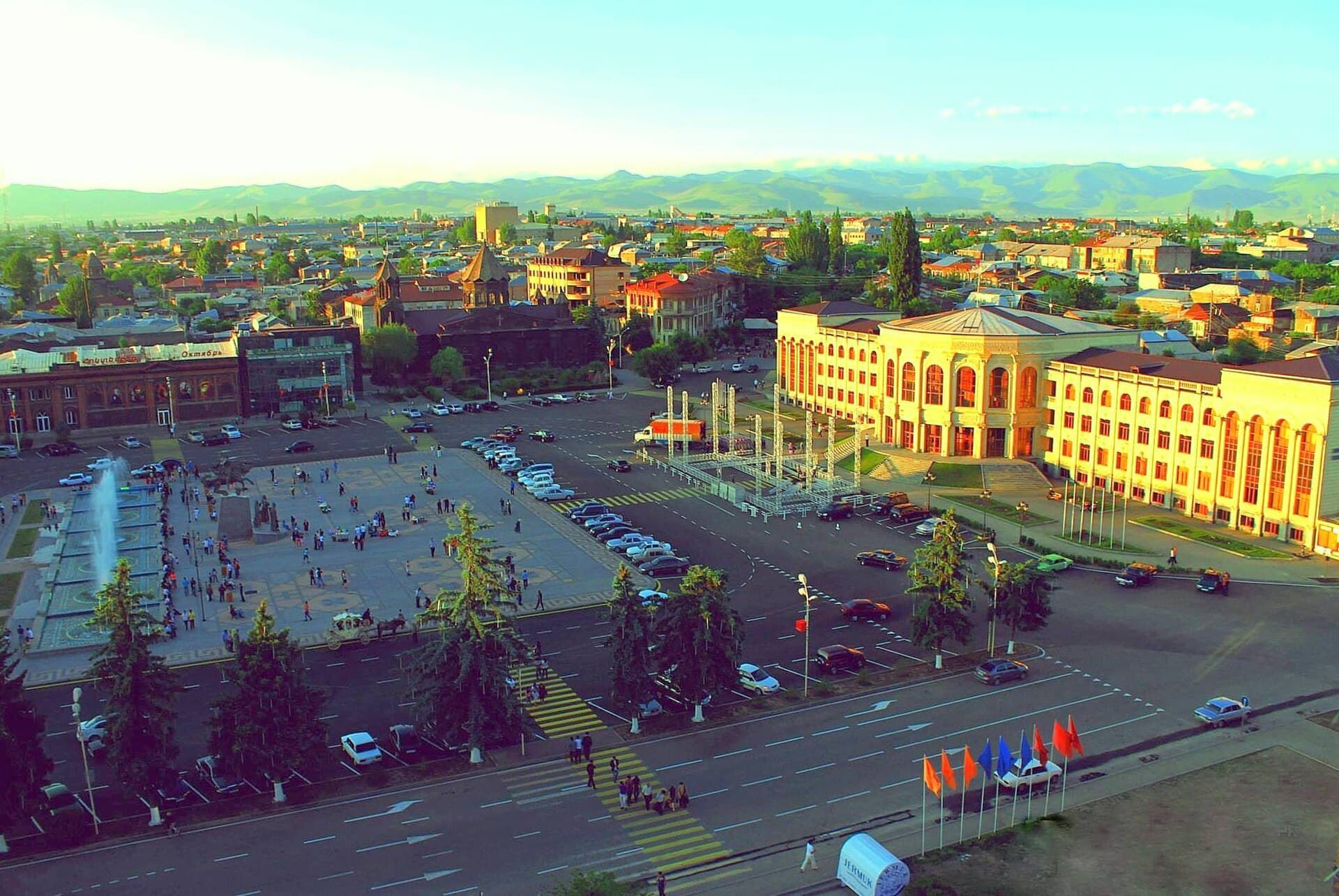
GyumriDay 8: across the Ninotsminda–Bavra border to Gyumri, Armenia's second city, with 19th-century black-tuff houses in its Kumayri quarter; night in Gyumri.Day 8: across the Ninotsminda–Bavra border to Gyumri, Armenia's second city, with 19th-century black-tuff houses in its Kumayri quarter; night in Gyumri.
Gyumri is Armenia's second city, on the Shirak plateau about 50 km from the Georgian border at Bavra and 120 km north-west of Yerevan. Its Kumayri historic district keeps more than a thousand 19th- and early 20th-century buildings in black and red volcanic tuff, with craft workshops and old churches. The city was badly damaged in the 1988 Spitak earthquake, and its cathedral of the Holy Saviour was only re-consecrated in 2024. You walk the old streets, visit a house museum and look out from the Black Fortress. It makes a good overnight stop between Georgia and Yerevan.
View destination detailsOvernight: Gyumri (hotel, breakfast)
About 2 hours of driving.
Morning walk in Gyumri's old Kumayri quarter
Drive to Yerevan
YerevanNights 9–11 in Yerevan; on day 9 a walk from Republic Square to the Cascade.Nights 9–11 in Yerevan; on day 9 a walk from Republic Square to the Cascade.
Yerevan is the capital of Armenia, a city of pink and ochre volcanic tuff on the Hrazdan river, with Mount Ararat on the horizon across the Turkish border on clear days. It is about 275 km (5–6 h including the border) from Tbilisi. Spend a day on Republic Square, the Cascade stairway with its sculpture garden and view, the Matenadaran manuscript collection and the Genocide Memorial at Tsitsernakaberd, then use the city as a base for Garni, Geghard, Etchmiadzin, Khor Virap and Lake Sevan.
View destination detailsAfternoon city walk: Republic Square and the Cascade
Overnight: Yerevan (hotel, breakfast)
About 200 km in a loop; Sevan is about 60 km from Yerevan.
Garni temple
Garni TempleDay 10: Garni, a 1st-century Greco-Roman temple above the Azat gorge, rebuilt in the 1970s from its original stones.Day 10: Garni, a 1st-century Greco-Roman temple above the Azat gorge, rebuilt in the 1970s from its original stones.
Garni, about 30 km east of Yerevan in Armenia, has the only standing Greco-Roman colonnaded temple in the former Soviet Union. The 1st-century temple sits on a triangular promontory above the Azat gorge, inside the walls of an old royal fortress. You walk around the colonnade, see the remains of a Roman-era bathhouse with a floor mosaic, then drive or walk down to the Symphony of Stones, a wall of hexagonal basalt columns in the gorge. It pairs naturally with Geghard Monastery, about 10 km further up the valley.
View destination detailsGeghard monastery
Geghard MonasteryDay 10: Geghard monastery, UNESCO-listed, with 13th-century churches cut into the cliff.Day 10: Geghard monastery, UNESCO-listed, with 13th-century churches cut into the cliff.
Geghard, at the head of the Azat valley about 40 km east of Yerevan in Armenia, is a 13th-century monastery partly carved into the cliff. Beside the free-standing main church, rooms and chapels are cut straight into the rock, lit only from openings in the ceiling, and a spring runs through one of them. Voices carry in the rock-cut halls, and choirs sometimes sing there for visitors. It is a UNESCO World Heritage Site and usually combined with Garni Temple, 10 km down the valley.
View destination detailsLunch (not included)
Sevanavank above Lake Sevan
Lake SevanDay 10: the 9th-century churches of Sevanavank on the peninsula above Lake Sevan (about 1,900 m).Day 10: the 9th-century churches of Sevanavank on the peninsula above Lake Sevan (about 1,900 m).
Lake Sevan is Armenia's great mountain lake, about 1,900 m above sea level and roughly 65 km north-east of Yerevan; at about 1,240 km² it is the largest lake in the Caucasus. The classic stop is Sevanavank, a 9th-century monastery on a peninsula above the water, reached by a flight of steps. Stay for lunch of Sevan fish at a lakeside restaurant, and in July and August you can swim from the beaches, although the water stays cool.
View destination detailsBack in Yerevan
Overnight: Yerevan (hotel, breakfast)
⚠ About 280 km and 5–5.5 hours of driving.
Etchmiadzin Mother Cathedral
EtchmiadzinDay 11: Etchmiadzin Mother Cathedral, the seat of the Armenian Apostolic Church, reopened in September 2024 after restoration.Day 11: Etchmiadzin Mother Cathedral, the seat of the Armenian Apostolic Church, reopened in September 2024 after restoration.
Etchmiadzin (officially Vagharshapat), about 20 km west of Yerevan in Armenia, is the seat of the Catholicos of All Armenians and the spiritual centre of the Armenian Apostolic Church. Its Mother Cathedral, founded in the early 4th century, reopened in 2024 after a six-year restoration that cleaned its frescoes. With the churches of St Hripsime and St Gayane and the ruins of 7th-century Zvartnots near the Yerevan road, it forms a UNESCO World Heritage Site. A visit takes half a day from Yerevan.
View destination detailsKhor Virap and the Ararat view
Khor VirapDay 11: Khor Virap monastery, facing Mt Ararat across the Turkish border; the mountain is clearest before midday.Day 11: Khor Virap monastery, facing Mt Ararat across the Turkish border; the mountain is clearest before midday.
Khor Virap is a walled monastery on a low hill in Armenia's Ararat plain, about 45 km south of Yerevan and a few hundred metres from the closed border with Turkey. Mount Ararat (5,137 m) rises directly behind it across the Aras river. You climb down a metal ladder into the 6-metre pit where St Gregory the Illuminator is said to have been imprisoned, visit the 17th-century church and walk up the hill behind the walls for the classic view of the monastery with Ararat.
View destination detailsLunch near Areni (not included)
Noravank
NoravankDay 11: Noravank (13th–14th century) in its red-rock gorge near Areni.Day 11: Noravank (13th–14th century) in its red-rock gorge near Areni.
Noravank is a 13th–14th-century monastery at the head of the narrow red-rock gorge of the Amaghu river in Armenia's Vayots Dzor province, about 120 km (2 h) south-east of Yerevan and 8 km from the wine village of Areni. It is known for the two-storey church of Surb Astvatsatsin (1339), whose upper chapel is reached by narrow stone steps projecting from the facade, and for the carved tympanums and cross-stones of the master sculptor Momik. Combine it with a wine tasting in Areni.
View destination detailsBack in Yerevan; farewell dinner (included)
Overnight: Yerevan (hotel, breakfast and dinner)
The tour ends in Yerevan; Zvartnots airport is about 20–30 minutes from the centre.
Transfer to Yerevan airport
Make this tour your own:Build your own tour
Private · 10 days
$1,365/person · 4 travellers

Private · 14 days
$2,025/person · 4 travellers