The short answer: spend about 7 days in Georgia and 4–5 in Armenia, and travel in one direction, starting in Tbilisi and flying home from Yerevan, so you never double back. A route that works well goes Tbilisi, Kakheti and Kazbegi, then west through Uplistsikhe and Borjomi to Vardzia, crosses into Armenia at the Ninotsminda–Bavra border to Gyumri, and ends with three days around Yerevan. Citizens of the EU, the UK and the US need no visa for either country [1].
The route logic
Most two-country trips cross at Sadakhlo–Bagratashen, south of Tbilisi, which is quick but means driving back through Tbilisi after you have seen the west of Georgia. Crossing further west, at Ninotsminda–Bavra, lets you finish Georgia in the south, at Vardzia, and enter Armenia at Gyumri, its second city, with no backtracking [2]. The trade-off is a quieter, higher crossing on the Javakheti plateau, which takes longer and can be cold outside summer.
Day by day
Georgia: days 1–7
- Day 1: arrive in Tbilisi; welcome dinner.
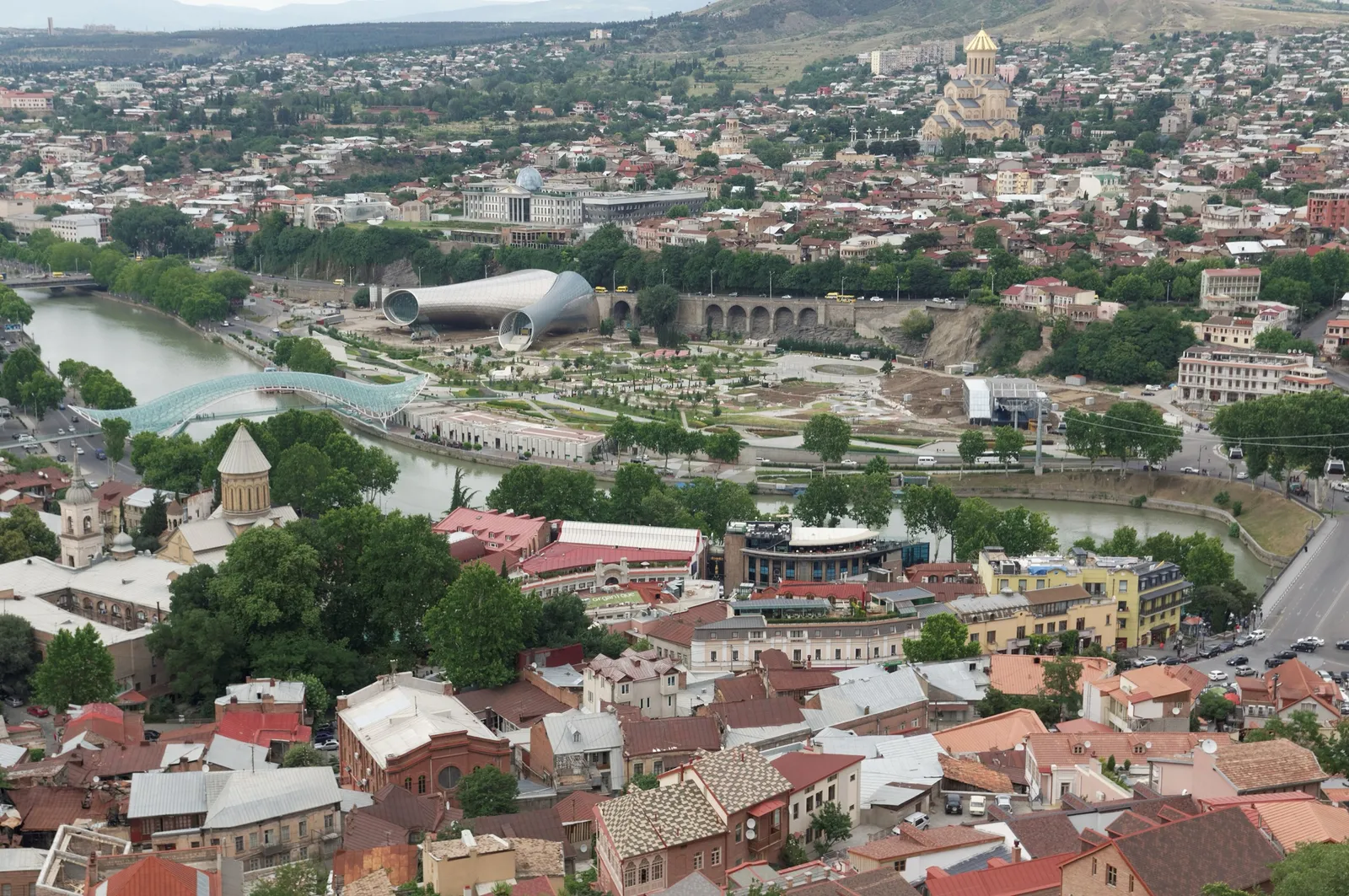
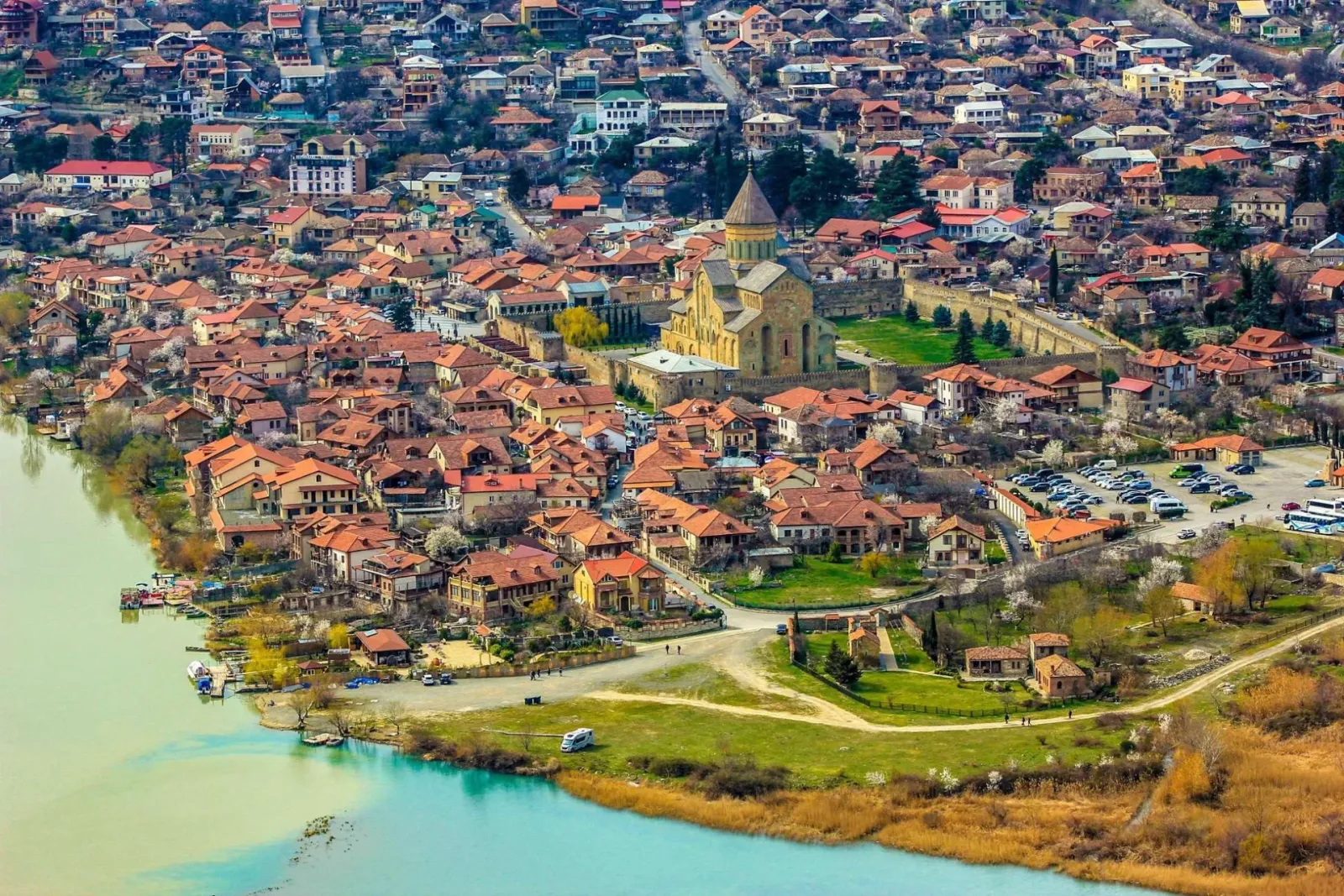
- Day 2: Tbilisi Old Town and the cable car to Narikala; afternoon in Mtskheta at Jvari and Svetitskhoveli.
- Day 3: Bodbe convent and Sighnaghi, with lunch and a tasting at a family cellar; night in Telavi.
- Day 4: Alaverdi, the Ikalto academy and Shuamta, back to Tbilisi over the Gombori pass.
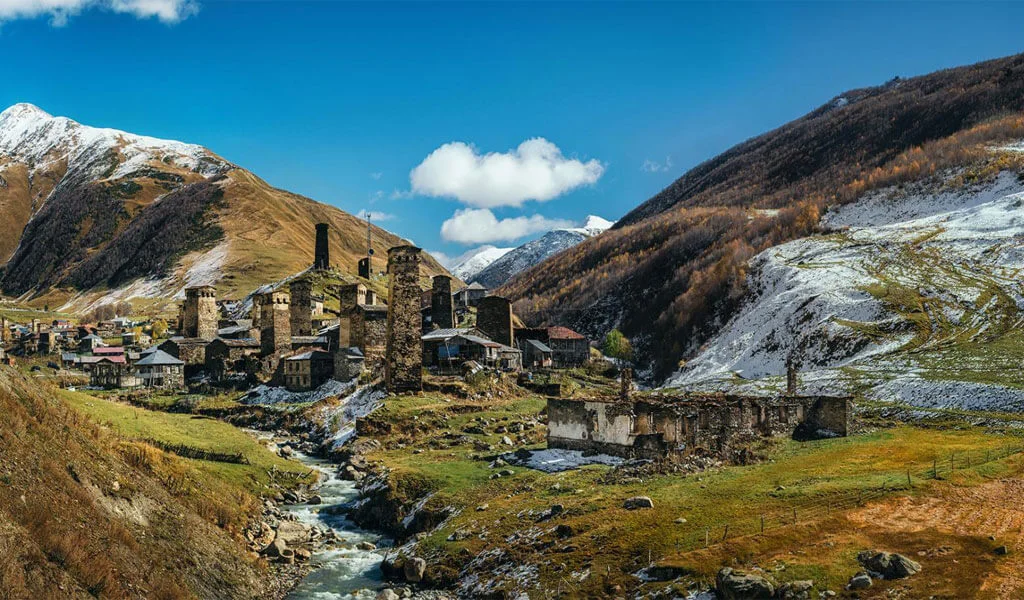
- Day 5: the Georgian Military Highway to Kazbegi: 152 km, 3–3.5 hours of driving, with Ananuri on the way and Gergeti Trinity Church (2,170 m) under Mt Kazbek (5,054 m).
- Day 6: the long day: back down the highway to Uplistsikhe and Gori, then on to Borjomi, about 290 km.
- Day 7: Borjomi park, Rabati Castle in Akhaltsikhe and Vardzia. Part of Vardzia's path has been closed since the 27 May 2026 rockfall; see what's open at Vardzia.
Armenia: days 8–12
- Day 8: Khertvisi fortress, then over the Javakheti plateau to the Ninotsminda–Bavra border and on to Gyumri, about 3–4 hours of driving plus the crossing.
- Day 9: Gyumri's old quarter, then 2 hours to Yerevan for Republic Square and the Cascade.
- Day 10: Garni, Geghard and Lake Sevan.
- Day 11: Etchmiadzin, Khor Virap and Noravank, about 280 km.
- Day 12: fly home from Zvartnots, 20–30 minutes from central Yerevan.
Armenian highlights
Yerevan
Armenia's capital is a city of pink tufa stone, Soviet boulevards and cafés, with Mt Ararat on the skyline on clear days. The Cascade, a giant stairway with views over the city, and Republic Square are the usual first walk.
Garni and Geghard
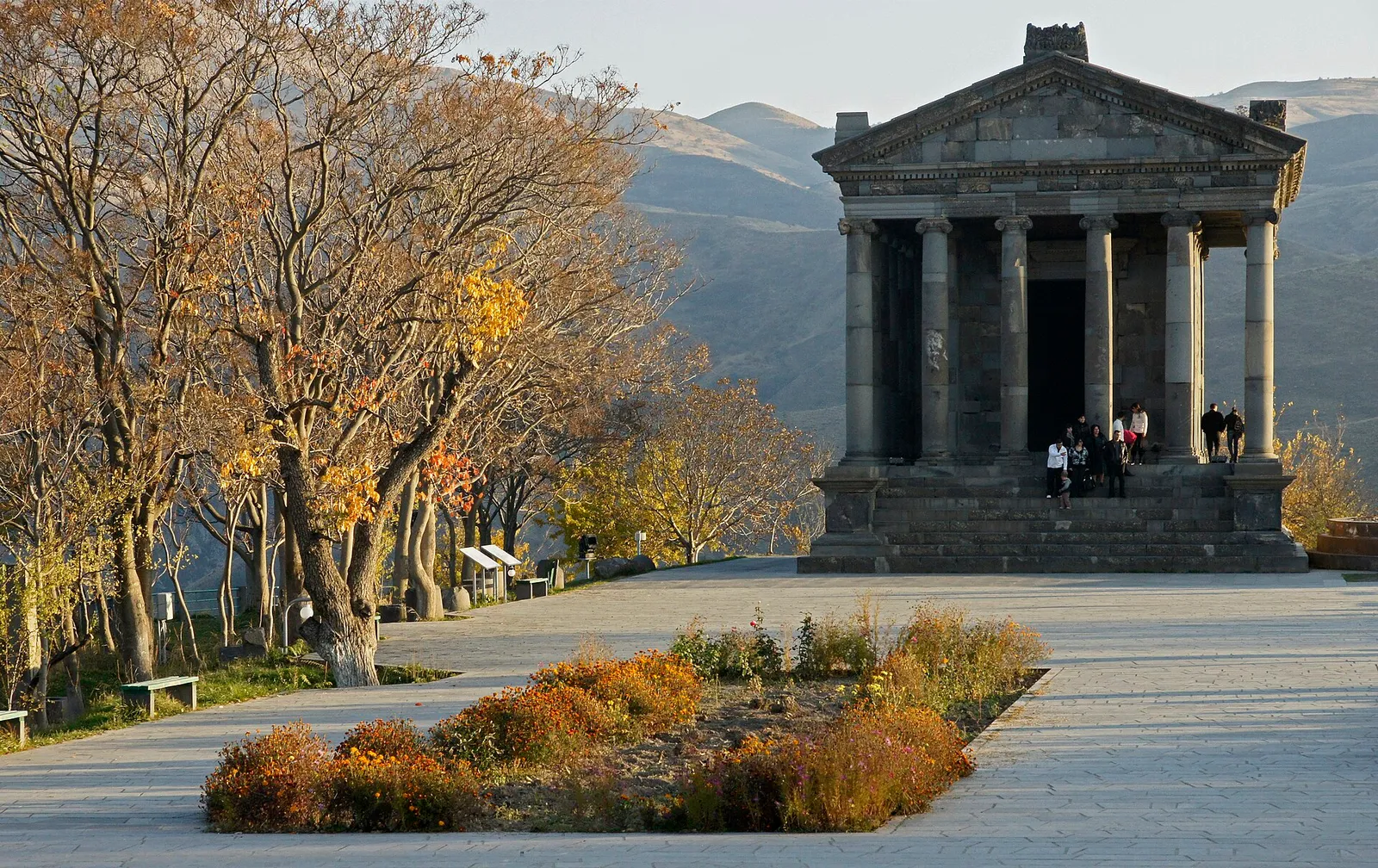
Garni, about 30 km east of Yerevan, is a colonnaded Greco-Roman temple of the 1st or 2nd century AD, usually linked to King Tiridates I. It fell in an earthquake in 1679 and was rebuilt from its original stones in 1969–1975; it is the only largely preserved building of its kind in the former Soviet Union [3]. A short drive up the Azat gorge, Geghard is a monastery partly carved into the cliff, with rock-cut churches of the 13th century; it is a UNESCO World Heritage site, listed in 2000 with the upper Azat valley [4].
Lake Sevan
Sevan lies at about 1,900 m and is the largest lake in the Caucasus [5]. The Sevanavank monastery stands on a peninsula that was an island until Soviet irrigation schemes lowered the water [5]. It is cool and windy even in summer; bring a layer.
Etchmiadzin
The Mother Cathedral at Etchmiadzin, about 20 km west of Yerevan, is the seat of the Armenian Apostolic Church. It reopened on 29 September 2024 after a long restoration.
Khor Virap
Khor Virap stands on a hillock on the Ararat plain, about 100 m from the closed Turkish border, with Ararat directly behind it on a clear morning. Beneath the church is the pit where, according to tradition, St Gregory the Illuminator was held for 13 years before converting King Tiridates III; Armenia adopted Christianity in 301 [6]. You can climb down a ladder into the pit.
Noravank
Noravank, about 120 km south-east of Yerevan, sits in a narrow gorge of red cliffs near Areni. Its two-storey church of Surb Astvatsatsin, finished in 1339 and designed by the sculptor Momik, is reached by a narrow stone stairway on the outside of the façade [7]. Areni's wineries are close by for lunch.
The border crossing
- Change of car and guide: Georgian vehicles and guides generally hand over at the border. On our route, your Georgian driver-guide takes you to Ninotsminda–Bavra, and our Armenian partner's guide and vehicle meet you on the other side.
- Time: passport checks on both sides can take an hour or more in summer.
- Documents: a passport valid for the whole trip. Check your visa rules for both countries; many nationalities enter Georgia without a visa.
- Insurance: travel insurance with at least 30,000 GEL of cover is mandatory for visitors to Georgia since 1 January 2026. Make sure your policy covers Armenia too.
Visas and money
- Armenian visas: citizens of the US, the EU, the UK, Canada, Australia, Japan and a number of other countries can visit visa-free for up to 180 days a year; many others need an e-visa, applied for online before travel [1][8]. Rules change, so check mfa.am for your passport.
- Currency: Georgia uses the lari (GEL), Armenia the dram (AMD). Lari are rarely accepted in Armenia; there are ATMs in Gyumri and Yerevan, and cards work in most Yerevan restaurants.
- Language: Armenian has its own alphabet, different from Georgian. Russian is widely understood in Armenia.
- Dress code: shoulders and knees covered in churches in both countries; women cover their hair in Georgian churches, while in Armenian churches it is common but not strictly required.
When to go
April to October. Spring and autumn are the most comfortable; July and August are hot in Yerevan and on the Ararat plain, while the Javakheti plateau and Sevan stay cool. The Bavra crossing and the Kazbegi road are less predictable in winter.
Shorter or different versions
If you have less time, a day trip from Tbilisi to the Debed canyon monasteries gives you a taste of Armenia; see our Armenia day trip guide.
Travelling both countries with us
Our trips are private: your own car and English-speaking driver-guide, for 1–8 travellers. The Georgia and Armenia in 12 days, private tour follows the route above, April to October, with the border handover arranged for you and a farewell dinner in Yerevan. If you only have a spare day in Tbilisi, the private Armenia day trip to Haghpat and Sanahin takes about 11 hours. We check the visa rules for your nationality when you book. See each tour page for the current price, or build your own two-country route. Nothing to pay now.
Sources
- Ministry of Foreign Affairs of Armenia, visa information: mfa.am
- Advantour, "Georgia and Armenia", 14 days (route via Vardzia and Gyumri): advantour.com
- Wikipedia, "Garni Temple": en.wikipedia.org
- Wikipedia, "Geghard": en.wikipedia.org
- Wikipedia, "Lake Sevan": en.wikipedia.org
- Wikipedia, "Khor Virap": en.wikipedia.org
- Wikipedia, "Noravank": en.wikipedia.org
- Wikipedia, "Visa policy of Armenia": en.wikipedia.org
Last checked: September 2026. Visa rules and border procedures change; check the official sources before you travel.