
Grand Tour of Georgia — 10-Day Private Tour, Mountains to the Black Sea
Tbilisi · Mtskheta · Bodbe · Sighnaghi · Tsinandali · Ananuri Fortress · Gudauri Ski Resort · Kazbegi · Trinity Church Gergeti · Gori Stalin Museum · Uplistsikhe Cave Town · Borjomi · Akhaltsikhe (Rabati Castle) · Vardzia · Khertvisi Fortress · Kutaisi · Gelati Monastery · Prometheus Cave · Batumi · Gonio Fortress · Batumi Botanical Garden
Overview
A ten-day private tour of Georgia from the Caucasus to the Black Sea with an English-speaking driver-guide: Tbilisi and Mtskheta, a Kakheti wine day, a night under Mt Kazbek, Uplistsikhe and the Vardzia cave monastery, Kutaisi with UNESCO-listed Gelati Monastery, Prometheus cave, and Batumi on the coast. The route loops through the east, south and west. From Batumi you take the evening train back to Tbilisi (about 5 h) instead of a 6-hour drive, or you fly home from Batumi. Days 3 and 5 are long, with about 5 hours of driving; most other days have 2–3.5 hours. The Kakheti tastings and family-marani lunch, three dinners and the listed entrance fees are included. The tour suits travellers who want both mountains and sea in one trip at a steady pace. It does not go to Svaneti; for that, see our 14-day tour. Part of Vardzia has been closed since a rockfall in May 2026, so we confirm current access before you travel.
Itinerary
21 stops: Tbilisi, Mtskheta, Bodbe, Sighnaghi, Tsinandali, Ananuri Fortress, Gudauri Ski Resort, Kazbegi, Trinity Church Gergeti, Gori Stalin Museum, Uplistsikhe Cave Town, Borjomi, Akhaltsikhe (Rabati Castle), Vardzia, Khertvisi Fortress, Kutaisi, Gelati Monastery, Prometheus Cave, Batumi, Gonio Fortress, Batumi Botanical Garden
1Day 1Arrival in Tbilisi
Airport pickup at any hour.
Airport pickup and hotel check-in
Welcome dinner (included)
Overnight: Tbilisi (hotel, breakfast)
 TbilisiDays 1–2: the Old Town and the cable car to Narikala, with a welcome dinner on day 1. Nights 1–3 and 9 in Tbilisi.
Days 1–2: the Old Town and the cable car to Narikala, with a welcome dinner on day 1. Nights 1–3 and 9 in Tbilisi.
Tbilisi, Georgia's capital, spreads along the Mtkvari river gorge between Narikala fortress and the Mtatsminda ridge. It is where most trips begin and end, and it deserves 2–3 days of its own. Walk the Old Town from the domed sulphur baths of Abanotubani up to Narikala, cross the Bridge of Peace, spend a morning with the gold of the Georgian National Museum and eat your way through the city's wine bars and khinkali houses. Every day trip in this area starts from here.
View destination details
2Day 2Tbilisi and Mtskheta
City walk and a 30-minute drive.
Old Town walk and the cable car to Narikala
Lunch (not included)
Jvari and Svetitskhoveli in Mtskheta
 MtskhetaDay 2 afternoon: Jvari Monastery and Svetitskhoveli Cathedral in UNESCO-listed Mtskheta, 30 minutes from Tbilisi.
Day 2 afternoon: Jvari Monastery and Svetitskhoveli Cathedral in UNESCO-listed Mtskheta, 30 minutes from Tbilisi.
Mtskheta, about 25 km (30 min) north of Tbilisi where the Aragvi meets the Mtkvari, was the capital of the ancient kingdom of Kartli (Iberia) and the place where Georgia adopted Christianity in the 4th century. Its churches are a UNESCO World Heritage Site: Svetitskhoveli Cathedral in the old town, Jvari Monastery on the hill opposite with the classic view over the river confluence, and the Samtavro convent. Allow half a day, or combine it with Gori and Uplistsikhe or a Mukhrani winery.
View destination details
Overnight: Tbilisi (hotel, breakfast)
3Day 3Kakheti wine day
⚠ About 280 km and 5 hours of driving.
Depart Tbilisi
Bodbe convent and Sighnaghi
 BodbeDay 3: Bodbe convent, the burial place of St Nino, 2 km below Sighnaghi.
Day 3: Bodbe convent, the burial place of St Nino, 2 km below Sighnaghi.
Bodbe is a working convent 2 km from Sighnaghi in Kakheti, about 115 km (2 h) from Tbilisi, and the burial place of St Nino, who brought Christianity to Georgia in the 4th century. Her tomb lies in a small basilica first built between the 9th and 11th centuries, set among cypress trees and flower gardens with a wide view over the Alazani valley to the Caucasus. From the convent a long, steep path of steps leads down to St Nino's Spring, where pilgrims collect water and bathe.
View destination details SighnaghiDay 3: a walk on Sighnaghi's 18th-century walls above the Alazani Valley, then lunch and a tasting at a family marani.
Day 3: a walk on Sighnaghi's 18th-century walls above the Alazani Valley, then lunch and a tasting at a family marani.
Sighnaghi is a small walled town at about 790 m on a ridge above the Alazani Valley in Kakheti, about 113 km (2 h) east of Tbilisi. Its 18th-century defensive wall with towers looks across the vineyards to the Greater Caucasus. You walk a section of the wall, see Niko Pirosmani's paintings in the Sighnaghi Museum, taste qvevri wine in the town's cellars, and visit Bodbe convent, the burial place of St Nino, 2 km away. It works as a half-day stop or a relaxed overnight in wine country.
View destination details
Family-marani lunch and tasting (included)
Tsinandali house-museum, park and tasting
 TsinandaliDay 3: the Chavchavadze family's Tsinandali estate: house-museum, landscaped park and a wine tasting.
Day 3: the Chavchavadze family's Tsinandali estate: house-museum, landscaped park and a wine tasting.
Tsinandali is the 19th-century country estate of Prince Alexander Chavchavadze, about 10 km south-east of Telavi in Kakheti, with a house museum, a large landscaped park and one of Georgia's oldest wineries. A visit takes 1.5–2 hours: tour the family house, walk the park under old plane trees and cedars, go down to the enoteca, whose collection starts in 1814, and taste the estate's wines. In early September the estate hosts the Tsinandali Festival of classical music.
View destination details
Back in Tbilisi via the Gombori pass
Overnight: Tbilisi (hotel, breakfast)
4Day 4Military Highway to Kazbegi
152 km, 3–3.5 hours of driving; 6–7 hours with stops.
Depart; Ananuri fortress
 Ananuri FortressDay 4: Ananuri, the 17th-century fortress above the Zhinvali reservoir, on the Military Highway.
Day 4: Ananuri, the 17th-century fortress above the Zhinvali reservoir, on the Military Highway.
Ananuri is a 17th-century fortress of the Dukes of Aragvi above the turquoise Zhinvali reservoir, about 70 km (1–1.25 h) north of Tbilisi on the Georgian Military Highway. Inside its walls stand two churches, one with richly carved façades from 1689, and a square watchtower you can climb for a view down the reservoir. It is the usual first stop on the way to Kazbegi or Pasanauri, and 30–45 minutes is enough to see it.
View destination details
 Gudauri Ski ResortDay 4: the Friendship Monument viewpoint over the Devil's Valley near Gudauri, then the Jvari Pass (2,379 m).
Day 4: the Friendship Monument viewpoint over the Devil's Valley near Gudauri, then the Jvari Pass (2,379 m).
Gudauri is Georgia's largest ski resort, on the Georgian Military Highway about 120 km north of Tbilisi, just below the Jvari Pass. The resort village sits at about 2,200 m, and its lifts, including gondolas, run from about 1,990 m to 3,279 m, serving wide open pistes above the tree line and large freeride slopes. The ski season usually runs from late December to mid-April. In summer the same slopes are used for hiking and tandem paragliding, and Gudauri is a common stop on the way to Kazbegi.
View destination detailsKazbegiNight 4 in Stepantsminda under Mt Kazbek (5,054 m), with dinner included.
Night 4 in Stepantsminda under Mt Kazbek (5,054 m), with dinner included.
Stepantsminda, still widely called Kazbegi, is the mountain town at about 1,740 m on the Georgian Military Highway, 152 km north of Tbilisi (3–3.5 h) and 15 km from the Russian border. Above it the 14th-century Gergeti Trinity Church stands at 2,170 m with Mount Kazbek (5,054 m) behind. It is the base for walks to Gergeti, the Gveleti waterfall and the Dariali gorge, and by 4x4 for the Truso and Juta valleys. Come as a long day trip, or stay a night or two to walk in the morning light.
View destination details
Lunch in Pasanauri (not included)
Friendship Monument and the Jvari Pass
Gergeti Trinity Church
- Trinity Church GergetiDay 4: Gergeti Trinity Church (14th century, 2,170 m), by local 4x4 up the steep road.
Day 4: Gergeti Trinity Church (14th century, 2,170 m), by local 4x4 up the steep road.
Gergeti Trinity Church (Tsminda Sameba) stands alone on a grassy ridge at 2,170 m above Stepantsminda, about 152 km north of Tbilisi, with the glaciated cone of Mount Kazbek (5,054 m) behind it. The 14th-century church and its bell tower are a working Orthodox site and the classic view of the Georgian Caucasus. You reach it by car on the paved road from town or on foot in about 1–1.5 hours up through meadows, 430 m of climbing. Most people stay 45–60 minutes for the church, the views and the photos.
View destination details
Dinner (included)
Overnight: Stepantsminda (hotel, breakfast and dinner)
5Day 5Uplistsikhe and Gori to Borjomi
⚠ About 290 km and 5–5.5 hours of driving.
Drive south down the Military Highway
Uplistsikhe rock-cut town
 Uplistsikhe Cave TownDay 5: Uplistsikhe, a rock-cut town above the Mtkvari river; about 1.5 h on uneven rock.
Day 5: Uplistsikhe, a rock-cut town above the Mtkvari river; about 1.5 h on uneven rock.
Uplistsikhe is a rock-cut town on a sandstone ridge above the Mtkvari river, about 12–15 km east of Gori and 1.25–1.5 h west of Tbilisi. Over roughly 2,000 years people carved halls, houses, temples, wine presses and streets into the rock here. You walk up the ancient main street past the cave halls to the 9th–10th-century brick basilica on the summit, then leave through a tunnel toward the river. Most visitors spend 1–1.5 hours, often combined with Mtskheta and the Stalin Museum in Gori.
View destination details
Lunch in Gori (not included) and the Stalin Museum
 Gori Stalin MuseumDay 5: the Stalin Museum in Gori, with his birth house and armoured railway carriage.
Day 5: the Stalin Museum in Gori, with his birth house and armoured railway carriage.
Gori, in Shida Kartli about 86 km west of Tbilisi, is the town where Joseph Stalin was born in 1878, and its Stalin Museum is the main reason travellers stop. The museum complex keeps the small house where he spent his first years under a marble pavilion, a Soviet-era exhibition that still presents him largely uncritically, and his green armoured railway carriage. Above the town stands the medieval Gori Fortress. Allow 1–1.5 hours for the museum and fortress, and combine it with Uplistsikhe cave town, 12 km away.
View destination details
Drive to Borjomi (about 1.5 h)
 BorjomiNight 5 in Borjomi; a walk in the Central Park and a taste of the mineral spring on the morning of day 6.
Night 5 in Borjomi; a walk in the Central Park and a taste of the mineral spring on the morning of day 6.
Borjomi is a 19th-century spa town in a forested gorge of the Mtkvari river, about 160 km (2.5 h) west of Tbilisi, famous across the former Soviet Union for its salty, naturally carbonated mineral water. You can taste the warm water straight from the spring in the Central Park, ride the cable car above the town, bathe in the open-air sulphur pools higher up the valley, and walk into Borjomi-Kharagauli National Park from the visitor centre. It is the usual stop on the way to Vardzia and Bakuriani.
View destination details
Overnight: Borjomi (hotel, breakfast)
6Day 6Vardzia, Khertvisi and Rabati
About 3.5 hours of driving.
Borjomi Central Park and the mineral spring
Drive to Vardzia (about 2 h)
 VardziaDay 6: Vardzia, the 12th-century cave monastery of Queen Tamar. Part of the route has been closed since the May 2026 rockfall; we confirm current access.
Day 6: Vardzia, the 12th-century cave monastery of Queen Tamar. Part of the route has been closed since the May 2026 rockfall; we confirm current access.
Vardzia is a 12th-century cave monastery cut into the cliff of Erusheti mountain above the Mtkvari river in Samtskhe-Javakheti, about 60 km south of Akhaltsikhe and 4.5–5 h from Tbilisi. Hundreds of rock-cut rooms, stairways and tunnels open onto the gorge, and the Church of the Dormition holds original frescoes with a portrait of Queen Tamar. Since a rockfall on 27 May 2026 the visitor route ends shortly after the church, so about half of the complex is closed; we confirm current access before your trip.
View destination details
Vardzia (about 2 h on site)
Khertvisi fortress; lunch by the Mtkvari (not included)
 Khertvisi FortressDay 6: Khertvisi fortress on its rock above the Mtkvari, on the way back from Vardzia.
Day 6: Khertvisi fortress on its rock above the Mtkvari, on the way back from Vardzia.
Khertvisi is a medieval fortress on a rocky spur where the Paravani river joins the Mtkvari, in Samtskhe-Javakheti, about 16 km before Vardzia. Its towers and curtain walls climb the ridge above the gorge, and it is one of the oldest fortifications in Georgia. Most travellers stop for 30–45 minutes on the way to the Vardzia cave monastery: walk up to the gate, look along the two river canyons and photograph the walls from the road bridge below.
View destination details
Rabati Castle, Akhaltsikhe
 Akhaltsikhe (Rabati Castle)Day 6: Rabati Castle, the restored fortress with a mosque, church and museum inside its walls. Night 6 in Akhaltsikhe.
Day 6: Rabati Castle, the restored fortress with a mosque, church and museum inside its walls. Night 6 in Akhaltsikhe.
Akhaltsikhe is the main town of Samtskhe-Javakheti in south-west Georgia, about 205 km (3–3.5 h) from Tbilisi via Borjomi, and the usual stop on the way to Vardzia. Its landmark is Rabati Castle, a 7-hectare walled complex where a church, a mosque, a madrasa, a Jakeli palace, a bathhouse and a history museum stand side by side, restored in 2011–12. Most travellers spend an hour inside the walls; the old Jewish quarter and its synagogue lie just west of the castle.
View destination details
Overnight: Akhaltsikhe (hotel, breakfast)
7Day 7To Kutaisi: Gelati and Bagrati
About 200 km via Khashuri and the Rikoti highway (3–3.5 h); the shorter Zekari pass road is still partly unpaved on the Abastumani side.
Drive to Kutaisi
 KutaisiDay 7: Kutaisi via the Rikoti highway, with Bagrati Cathedral (11th century; removed from the UNESCO list in 2017) and the central market. Night 7.
Day 7: Kutaisi via the Rikoti highway, with Bagrati Cathedral (11th century; removed from the UNESCO list in 2017) and the central market. Night 7.
Kutaisi, Georgia's third-largest city, sits on the Rioni river in Imereti, about 230 km west of Tbilisi. It is the natural base for western Georgia: UNESCO-listed Gelati Monastery and the hilltop Bagrati Cathedral are on its edge, and Prometheus Cave, Sataplia, and the Martvili and Okatse canyons are within an hour. In town, walk the Green Bazaar, the White Bridge and the old Jewish quarter, then eat Imeretian khachapuri with a glass of local Tsitska or Tsolikouri white wine.
View destination details
Lunch (not included)
Gelati Monastery
 Gelati MonasteryDay 7: Gelati Monastery, founded in 1106 by King David IV, with its 12th-century apse mosaic; UNESCO-listed, and parts may be under restoration.
Day 7: Gelati Monastery, founded in 1106 by King David IV, with its 12th-century apse mosaic; UNESCO-listed, and parts may be under restoration.
Gelati Monastery, on a wooded hillside about 11 km north-east of Kutaisi in Imereti, was founded by King David the Builder in 1106 and is a UNESCO World Heritage Site. Inside the main Church of the Virgin you see a 12th-century gold mosaic of the Virgin and Child in the apse and walls of frescoes painted from the 12th to the 18th centuries, including portraits of Georgian kings. Outside are King David's grave, the ruined academy and two smaller churches. It is a 1-hour visit, often combined with Motsameta and Kutaisi.
View destination details
Bagrati Cathedral and the central market
Overnight: Kutaisi (hotel, breakfast)
8Day 8Prometheus cave to Batumi
Kutaisi to Batumi about 150 km (2–2.5 h).
Prometheus cave (1.4 km route; boat when the water allows)
 Prometheus CaveDay 8: Prometheus cave near Tskaltubo, a 1.4 km walk through lit halls of stalactites, plus a short underground boat ride when the water level allows.
Day 8: Prometheus cave near Tskaltubo, a 1.4 km walk through lit halls of stalactites, plus a short underground boat ride when the water level allows.
Prometheus Cave is a large show cave at the village of Kumistavi, about 20 km (30–40 min) north-west of Kutaisi. A guided route of about 1.4 km leads through six lit halls of stalactites, stalagmites, curtains and underground lakes, and ends with a short optional boat ride on the underground Kumi river. The temperature stays around 14 °C all year, so it works in any season and makes a cool break on a hot Imereti day.
View destination details
Lunch (not included)
Drive to Batumi
 BatumiNight 8 in Batumi, with dinner and an evening on the seafront boulevard; on day 9 the evening train to Tbilisi.
Night 8 in Batumi, with dinner and an evening on the seafront boulevard; on day 9 the evening train to Tbilisi.
Batumi is Georgia's main Black Sea city and the capital of Adjara, about 370 km (5.5–6 h by road, about 5–5.5 h by train) from Tbilisi and 150 km from Kutaisi. Its seafront Boulevard runs for about 7 km past palms, pebble beaches and modern towers, and the compact old town around Europe Square has 19th-century houses, cafés and the Piazza. Travellers come for the sea from June to September, the Botanical Garden on Green Cape, Adjarian food and day trips into the green hills of mountainous Adjara.
View destination details
Evening on the seafront boulevard; dinner (included)
Overnight: Batumi (hotel, breakfast and dinner)
9Day 9Batumi, Gonio and the evening train
Evening train to Tbilisi (about 5 h; we book the current timetable); our driver meets you at Tbilisi station.
Gonio fortress
 Gonio FortressDay 9: Gonio, a Roman fort founded in the 1st century AD, later held by the Byzantines and the Ottomans, about 12 km south of Batumi.
Day 9: Gonio, a Roman fort founded in the 1st century AD, later held by the Byzantines and the Ottomans, about 12 km south of Batumi.
Gonio (Apsaros) Fortress stands near the mouth of the Chorokhi river, about 12 km south of Batumi and a few minutes from the Black Sea beach. Its rectangular Roman walls with 18 towers are well preserved, and inside you find excavated Roman baths and barracks, a small museum of finds and a grave that local tradition links to the Apostle Matthias. You can walk part of the wall top for views to the sea and the Adjaran mountains. It is a 1–1.5 hour visit, easy to combine with a beach afternoon in Gonio.
View destination details
Batumi Botanical Garden
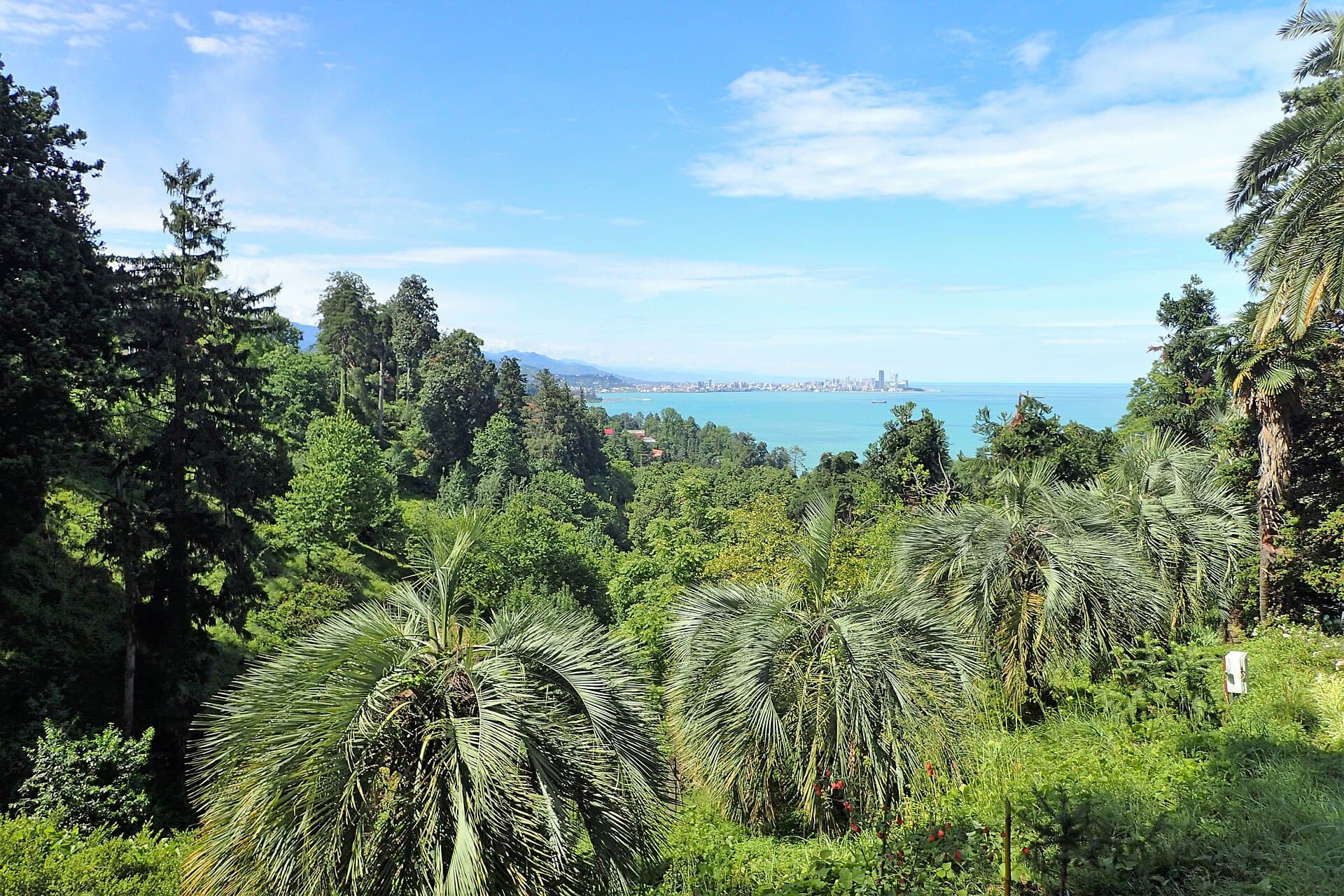 Batumi Botanical GardenDay 9: Batumi Botanical Garden on the Green Cape, about 9 km north of the city, with plants from the world's subtropical regions on terraces above the sea.
Day 9: Batumi Botanical Garden on the Green Cape, about 9 km north of the city, with plants from the world's subtropical regions on terraces above the sea.
Batumi Botanical Garden covers 111 hectares of coastal hills at Mtsvane Kontskhi (Green Cape), about 9 km north of Batumi. Founded in 1912, it is laid out in sections for nine regions of the world, from the Caucasian humid subtropics and East Asia to the Himalayas, New Zealand and the Mediterranean, with bamboo groves, palms, magnolias and views over the Black Sea. Allow 2–3 hours to walk the main route, or use the electric car for the longer stretches.
View destination details
Lunch and free time (not included)
Evening train to Tbilisi; transfer to your hotel
Alternative: end the tour in Batumi and fly home from Batumi airport
Overnight: Tbilisi (hotel, breakfast)
10Day 10Departure
Airport drop-off at any hour.
Transfer to Tbilisi airport
Make this tour your own:Build your own tour
What's Included
Included
- Private car or minivan with fuel and parking (sedan for 1–3 travellers, minivan for 4–8)
- English-speaking driver-guide throughout (Russian-speaking guide on request)
- Tbilisi airport pickup on arrival and drop-off on departure
- 9 nights in 3–4 star hotels, twin/double rooms, breakfast included (Tbilisi 4, Stepantsminda 1, Borjomi 1, Akhaltsikhe 1, Kutaisi 1, Batumi 1)
- 3 dinners (Tbilisi, Stepantsminda, Batumi), a family-marani lunch with tasting and the Tsinandali tasting
- Entry fees: Tsinandali, Uplistsikhe, Stalin Museum, Borjomi park, Vardzia with shuttle, Rabati, Prometheus cave with boat, Gonio, Batumi Botanical Garden; local 4x4 up to Gergeti Trinity
- Train ticket Batumi–Tbilisi
- Bottled water
Not included
- Lunches and dinners not listed as included (about 30–50 GEL per person per meal)
- Vardzia site guide (optional, paid at the site)
- Single room supplement
- Tips (optional)
- Travel insurance (mandatory for visitors to Georgia from 1 January 2026)
- Flights
Map
Good to know
- Best Time to Visit
- May–October; April on request
- Physical Requirements
- Moderate fitness level required. Includes longer walks, some uphill sections, and possibly uneven terrain.
- Cancellation Policy
- Nothing to pay now. Your quote includes the cancellation terms before you pay anything.
- Long days
- days 3 and 5 have about 5 hours of driving, and day 9 ends with a late arrival in Tbilisi after the evening train.
- Train
- we book the Batumi–Tbilisi train as soon as sales open; from June to September the evening trains fill up early.
- Ending in Batumi
- flying home from Batumi saves the train and the last night in Tbilisi; tell us when you book.
- Walking
- Uplistsikhe, Vardzia and Prometheus cave have steps and uneven or wet surfaces; wear shoes with grip and bring a layer for the cool cave.
- Dress code
- shoulders and knees covered in churches and monasteries; women cover their hair.
- Season
- in April snow can still close the Jvari Pass to Kazbegi, and the sea is too cold for swimming before June.
Categories:
Round trip (6–14 days)
Classic highlights
You Might Also Like

Western Georgia in 6 Days — Canyons, Svaneti & Batumi, Private
Private · 6 days
$875/person · 4 travellers