The short answer: the classic half day is a Tbilisi Mtskheta tour. Georgia's old capital is 25 km and about 30 minutes away, with Jvari Monastery on its hill and Svetitskhoveli Cathedral in the town. Add a tasting at Château Mukhrani, about 45 minutes from Tbilisi, and you have a 5.5–6 hour trip, which you can book as our private Mtskheta and Château Mukhrani half-day tour. Other good choices are the cave monastery of Shio-Mgvime beyond Mtskheta, the Chronicles of Georgia above the Tbilisi Sea, and the Open Air Museum of Ethnography. Kazbegi, Kakheti and Vardzia need a full day (see our day trips from Tbilisi).
The Tbilisi Mtskheta tour: Jvari and Svetitskhoveli
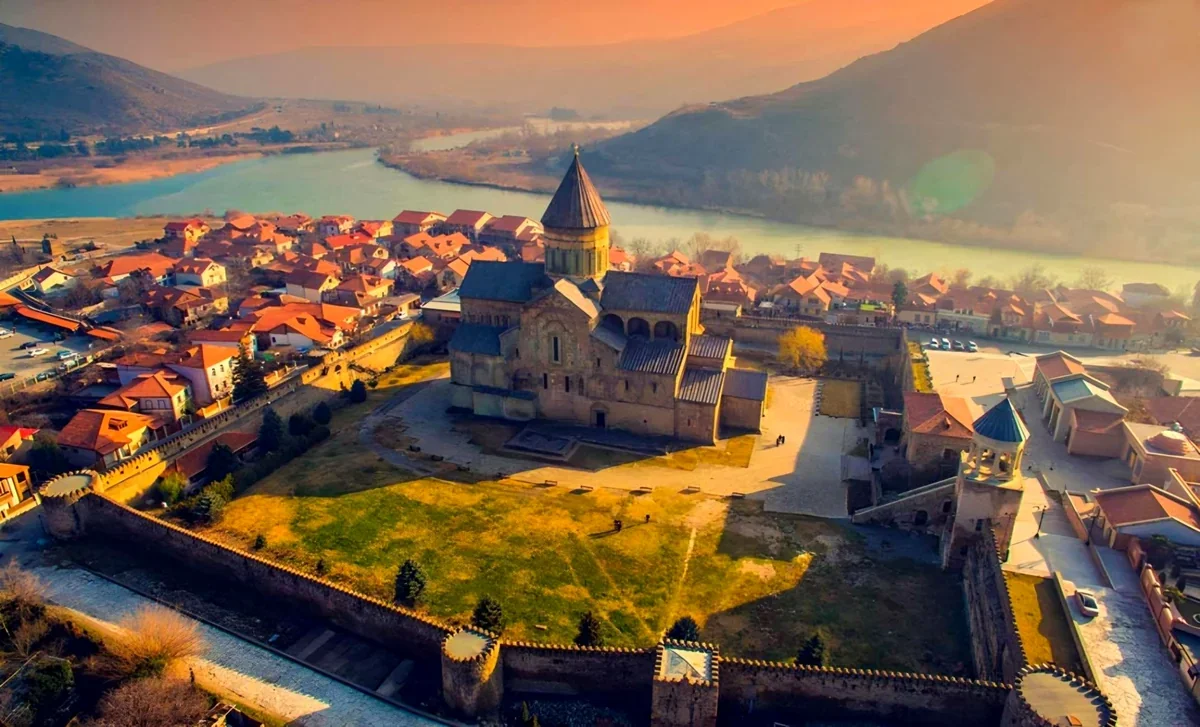
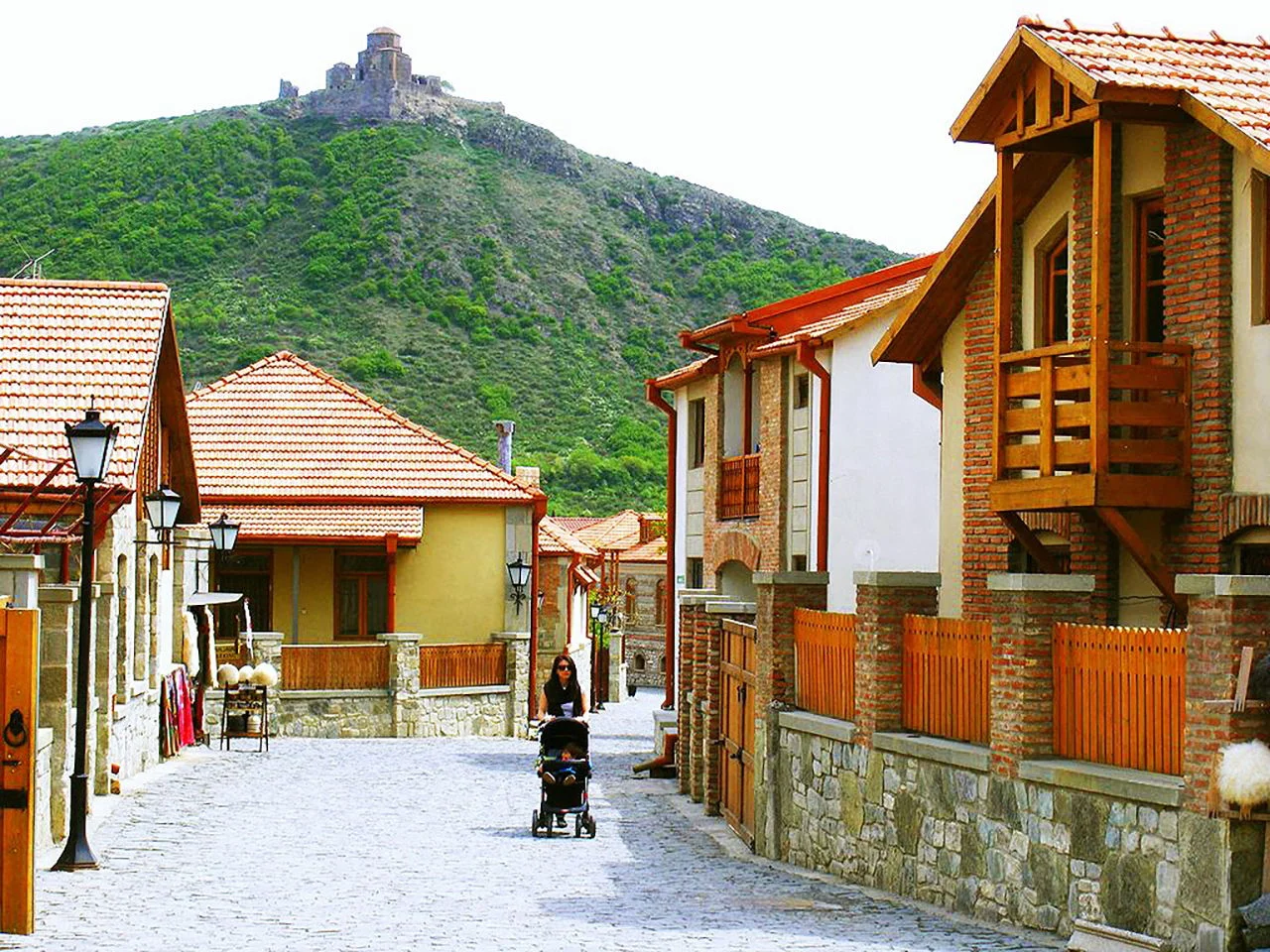
If you only do one thing outside Tbilisi, make it this. Jvari stands on a rocky hill above the meeting of the Mtkvari and Aragvi rivers, with the town below; Svetitskhoveli, in the old centre, is the most important cathedral in the country. Mtskheta's historic monuments are on UNESCO's World Heritage list[4]. Allow 30 minutes at Jvari and an hour for the cathedral and the old streets. For the history, read our guide to Mtskheta, Jvari and Svetitskhoveli.
Jvari is the older of the two, built between about 590 and 605 on the spot where tradition says St Nino raised a wooden cross[5]. Svetitskhoveli dates from 1010–1029; tradition places Christ's robe beneath it, and kings including Vakhtang Gorgasali and Erekle II are buried inside[6]. You can walk around the old town, but Jvari stands on its own hilltop, about 10 km away by road, so you need a car to see both.
- Time: 3–4 hours door to door on its own.
- Dress code: shoulders and knees covered; women cover their hair. Wraps are usually available at the door.
Entry to the churches is free, and candles are sold inside. Samtavro, a convent a few minutes' walk north of the cathedral, holds the tombs of King Mirian III and Queen Nana[7]. It takes 20–30 minutes. Half-day trips often leave it out, so tell us if you want it.
Mtskheta plus Château Mukhrani
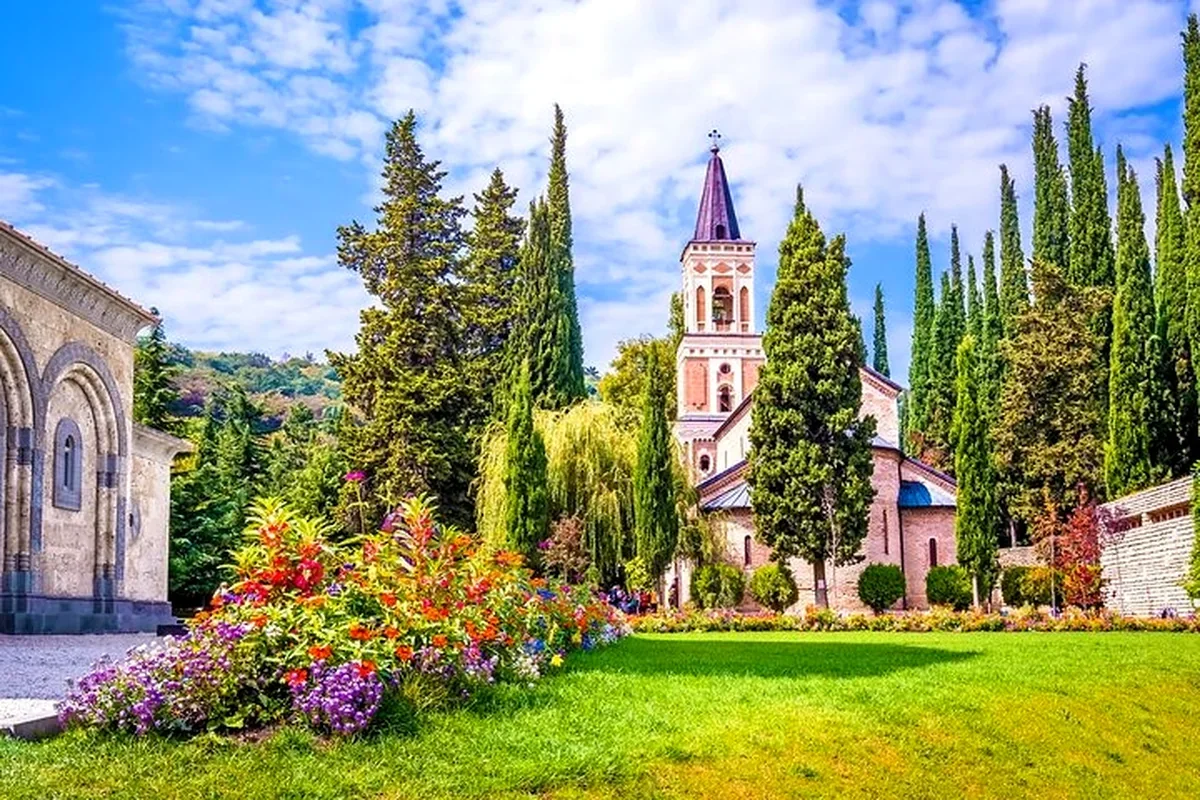
Château Mukhrani is a palace estate with a wine cellar in the Kartli plain, about 45 km from Tbilisi. After Mtskheta you drive on for a tour of the palace and cellars with a tasting. You can add lunch at the estate restaurant, which adds about an hour. It works as a morning (09:30 to about 15:30) or as an afternoon trip, which makes it useful on the day you arrive or fly out.
Prince Ivane Mukhranbatoni began the palace in 1873 and released his first vintage in 1878, after studying winemaking in France. The estate was abandoned in Soviet times and revived from 2002, and the palace reopened in 2022. You taste the estate's wines, from Georgian and French grape varieties. Allow 1.5–2 hours for the tour and tasting. A meal with wine at the restaurant costs about 60–120 GEL per person, and lunch should be reserved in advance, especially at weekends, so tell us early. There is more on our Château Mukhrani estate page.
How the half day runs, stop by stop
- Hotel pickup in Tbilisi. On the morning trip that is about 09:30. The afternoon trip visits the same places.
- Jvari. About 30 minutes from Tbilisi, up a paved side road off the highway. The hilltop catches the wind all year, so bring a layer.
- Svetitskhoveli and the old town. You drive down into Mtskheta, see the frescoes inside the cathedral and walk the street of cafés and souvenir stalls outside the gate.
- Château Mukhrani. About 30 minutes further on, for the palace, the 19th-century cellars and the tasting, with lunch if you want it.
- Back to your hotel. Tbilisi is 45–55 minutes from the estate. You are back after 5.5–6 hours, in time for an evening flight or dinner in town.
The tour runs daily, all year. A sedan carries 1–3 travellers and a minivan 4–8. Fuel, parking, the palace and cellar tour with tasting and bottled water are included; lunch is optional and not part of the tour.
Shio-Mgvime: the cave monastery
About 9 km from Mtskheta, in a limestone gorge, Shio-Mgvime was founded in the 6th century by St Shio, one of the Thirteen Assyrian Fathers who brought monastic life to Georgia[1]. The name means "Shio's cave": he lived as a hermit in a cave here, and the cliff above the churches is still honeycombed with monks' cells[1]. The buildings mix 6th-century work with later rebuilding from the 12th to 18th centuries[1]. It is quieter than Mtskheta, and the road in has fine views of the gorge. Mtskheta with Shio-Mgvime makes a relaxed 4–5 hour morning. There is more in our Shio-Mgvime guide.
The monastery itself takes about an hour, plus the forest road each way. Don't count on a wrap at the gate here: bring your own scarf. Wear shoes with grip too, because the stony paths slope. It isn't a fixed stop on the Château Mukhrani half day. We add it on request, and it makes the day longer.
Staying in Tbilisi
The Old Town on foot
A guided walk through the Old Town takes about 5 hours and 5–6 km: Metekhi, the cable car to Narikala fortress, the Leghvtakhevi waterfall and the sulphur-bath domes of Abanotubani, Sioni Cathedral, Anchiskhati Basilica and the Gabriadze clock tower. It suits a morning in spring or autumn; in July and August start early. Some streets are steep cobbles. Our Old Town walking route has the details if you would rather go alone.
The Open Air Museum of Ethnography
On a wooded hill above the Vake district, west of Turtle Lake, the museum was founded in 1966 by the ethnographer Giorgi Chitaia[2]. Around 70 houses, barns and churches have been brought here from the regions of Georgia, and rebuilt on about 52 hectares[2]. It takes 2–3 hours, and the paths are steep in places. Wear comfortable shoes. Our Ethnography Museum guide covers what to see.
The Chronicles of Georgia and the Tbilisi Sea
On Keeni hill above the Tbilisi Sea reservoir, on the northern edge of the city, stand 16 pillars, each 30–35 m tall, covered in bronze scenes from Georgian history and the life of Christ[3]. The sculptor Zurab Tsereteli began them in 1985, and they were never fully finished[3]. The scale is the point, and the view over the reservoir is wide. It takes about an hour with the drive, so it pairs well with another sight. For how to get there by taxi or by metro and bus, see our Chronicles of Georgia guide.
An evening food and wine walk
If your half day falls late, the food walk runs from about 16:00 to 20:30. It goes through the Dezerter Bazaar and a basement bakery where shoti bread is baked on the wall of a round tone oven, then on to khinkali and a natural-wine bar with three glasses of Georgian wine. The five or six stops add up to a full dinner.
Combinations that work
- The classic: Jvari, Svetitskhoveli and a tasting at Château Mukhrani, 5.5–6 hours.
- Churches only: Jvari, Svetitskhoveli and Shio-Mgvime, 4–5 hours, with a lunch of khachapuri or lobiani in Mtskheta.
- City morning, museum afternoon: the Old Town walk, then the Ethnography Museum after lunch.
- Arrival day: the Chronicles of Georgia and Jvari, both close to the main roads out of the city, then an early dinner.
- Rainy day: the Georgian National Museum on Rustaveli Avenue and a sulphur bath in Abanotubani.
If you only have one half day and have never been to Georgia, choose Mtskheta. It gives you the country's history in one place, and it is close enough that traffic rarely spoils the plan.
What doesn't fit in half a day
- Kazbegi is 152 km and 3–3.5 hours each way. A day trip takes 11–12 hours.
- Sighnaghi and Kakheti are 1.5–2 hours each way. Possible in theory, but you would spend more time in the car than at the tasting.
- Uplistsikhe and Gori can be squeezed in, but it feels rushed; combine them with Mtskheta on a full day instead.
- David Gareja has a slow last stretch; plan a full day, ideally with Sighnaghi.
For full-day options, see day trips from Tbilisi compared.
When to go
Spring and autumn are the most pleasant seasons for walking the old town and for the view from Jvari. In July and August average highs reach about 32 °C (90 °F)[8], so take the morning trip. Winter is quiet and still fine, with January highs of about 7 °C (45 °F)[8]. The estate stays open, and when snow closes the Jvari Pass on the road to Kazbegi we can replace Kazbegi with this trip. In September and early October you see the grapes coming in and new wine being made at Château Mukhrani.
Svetitskhoveli is busy on Sundays and feast days during services, and weekday mornings are quieter. On 14 October, Svetitskhovloba, the cathedral's feast and a public holiday, brings services and crowds[9]. It is a good day to watch and a slow one for sightseeing.
Tips for a half day
- On an arrival or departure day, tell us your flight time and we plan backwards from it.
- Tbilisi's evening rush hour can double the drive back; mornings are easier.
- Restaurants in Mtskheta serve lobio (bean stew) in clay pots, khinkali and khachapuri, and the restored lanes around the cathedral have cafés.
- In summer, start at 09:00 and finish by early afternoon.
- Churches are open every day, but check museums, some of which close on Mondays.
Half days with us
Our trips are private: your own car and English-speaking driver-guide, for 1–8 travellers. The private Mtskheta and Château Mukhrani half day runs as a morning or an afternoon, with Jvari, Svetitskhoveli and a palace-cellar tasting. The Tbilisi City Explorer is a 5-hour private walk through the Old Town, and the Tbilisi food and wine walk fills an evening. See each tour page for the current price, or build your own half day with Shio-Mgvime or the Chronicles added. Nothing to pay now.
Sources
- Georgia.to, "Shio-Mgvime Monastery": georgia.to; Wikipedia, "Shio-Mgvime Monastery": en.wikipedia.org
- Wikipedia, "Tbilisi Open Air Museum of Ethnography": en.wikipedia.org
- Wikipedia, "Chronicle of Georgia": en.wikipedia.org
- UNESCO, "Historical Monuments of Mtskheta": whc.unesco.org
- Wikipedia, "Jvari Monastery": en.wikipedia.org
- Wikipedia, "Svetitskhoveli Cathedral": en.wikipedia.org
- Wikipedia, "Samtavro Monastery": en.wikipedia.org
- Wikipedia, "Tbilisi" (climate normals 1991–2020): en.wikipedia.org
- Office Holidays, "Public holidays in Georgia, 2027": officeholidays.com
Last checked: September 2026. Opening hours change; we confirm them when we plan your day.