The short answer: the Georgian Military Highway runs 152 km north from Tbilisi to Stepantsminda (Kazbegi), about 3–3.5 hours without stops, and closer to 6 hours with the stops worth making. In order, they are: Jvari Monastery above Mtskheta (optional), the Zhinvali reservoir, Ananuri fortress, Pasanauri, Gudauri and the Friendship Monument, the Jvari Pass at 2,379 m, the travertine springs, Stepantsminda and Gergeti Trinity Church. Here is what each one is, with notes on driving the road.
The stops, in order
1. Jvari Monastery and Mtskheta (optional)
Just outside Tbilisi, the 6th-century Jvari Monastery stands on a hill above the meeting of the Mtkvari and Aragvi rivers, with Mtskheta below. It adds 45–60 minutes. On a day trip to Kazbegi most people skip it, or see Mtskheta on another day; on a two-day trip it's an easy first stop. Entry is free. The hilltop is windy and can be cold even when Tbilisi is warm. Our guide to Mtskheta and Jvari covers both.
2. Zhinvali reservoir
About an hour out of Tbilisi the road reaches the turquoise Zhinvali reservoir on the Aragvi. There are roadside viewpoints above the water; a 10-minute photo stop is enough.
3. Ananuri fortress
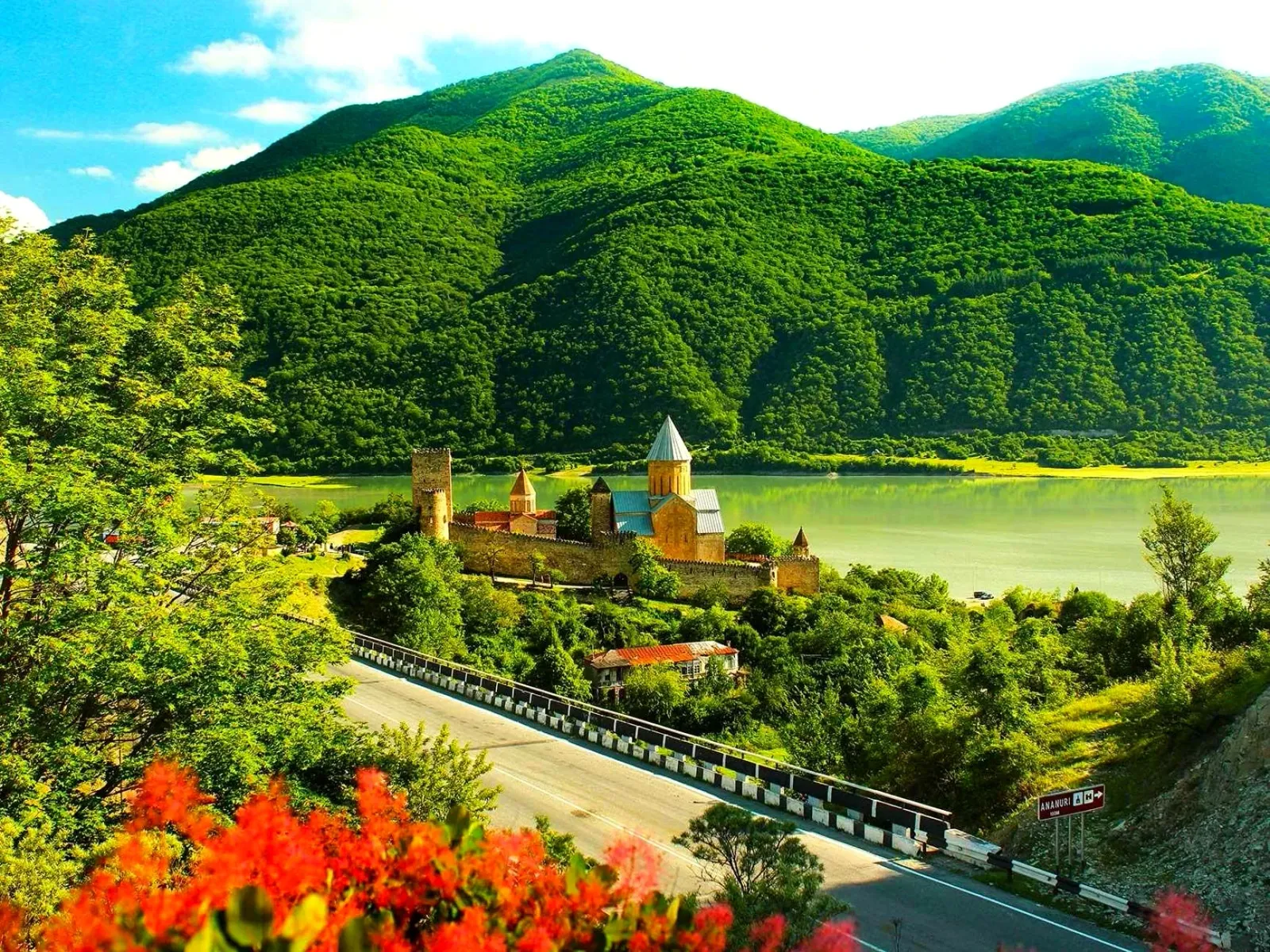
About 70 km from Tbilisi, Ananuri is a 17th-century fortress of the Aragvi dukes on the edge of the reservoir, with the Church of the Assumption inside its walls. Climb the tower for the view over the water. Allow 30–45 minutes; shoulders and knees covered in the churches.
Entry is free. The tower stairs are narrow and steep, with low doorways, and can be icy in winter. For the classic photo of the fortress above the water, use the road pull-outs just south of it. Our Ananuri fortress guide covers its history and churches.
4. Pasanauri
The village of Pasanauri, near where the White and Black Aragvi rivers meet, is known for its khinkali, and the roadside restaurants make it a good lunch stop. It is also the base for rafting on the White Aragvi from late spring to autumn.
The village is at about 1,050 m, about 90 km and 1.5 hours from Tbilisi. For lunch, order khinkali kalakuri (with herbs) or mtiuluri (plain, just meat and pepper), eat them by hand, holding the twisted top, and count on 5–10 per person. Our guide to khinkali has more. The rafting run goes about 12 km downstream to Meneso, at grade II–III in May and June and a calmer grade II from July; Rafting in Georgia has the details.
5. Gudauri and the Friendship Monument
The road climbs in hairpins to Gudauri, Georgia's largest ski resort, about 120 km from Tbilisi. Just past it, on a cliff above the Devil's Valley, is the Russia–Georgia Friendship Monument, a semicircular concrete viewpoint built in 1983 for the 200th anniversary of the Treaty of Georgievsk. Inside, a long tiled mosaic shows scenes from Georgian and Russian history. The view down the valley is the reason to stop; paragliders often launch nearby in summer. Allow 20 minutes.
The resort village sits at about 2,200 m. The ski season usually runs from late December to mid-April; from June to September the slopes are green and used for hiking and tandem paragliding. The monument is about 4 km north of the resort, and parking there, as at Ananuri, fills up on summer weekends.
6. Jvari Pass (2,379 m)
The highest point of the road, between Gudauri and Kobi. It is often colder, windier and snowier than anywhere else on the route. This is the section that closes in winter.
7. The travertine springs
Just below the pass on the north side, iron-rich mineral springs run down the hillside next to the road, leaving white and orange terraces of travertine. It's a short photo stop; some people fill a bottle from the spring.
8. Stepantsminda (Kazbegi)
The small town at the end of the road sits at about 1,750 m, with Mt Kazbek (5,054 m) above it on a clear day. There are cafés and restaurants for lunch, and ATMs.
9. Gergeti Trinity Church (2,170 m)
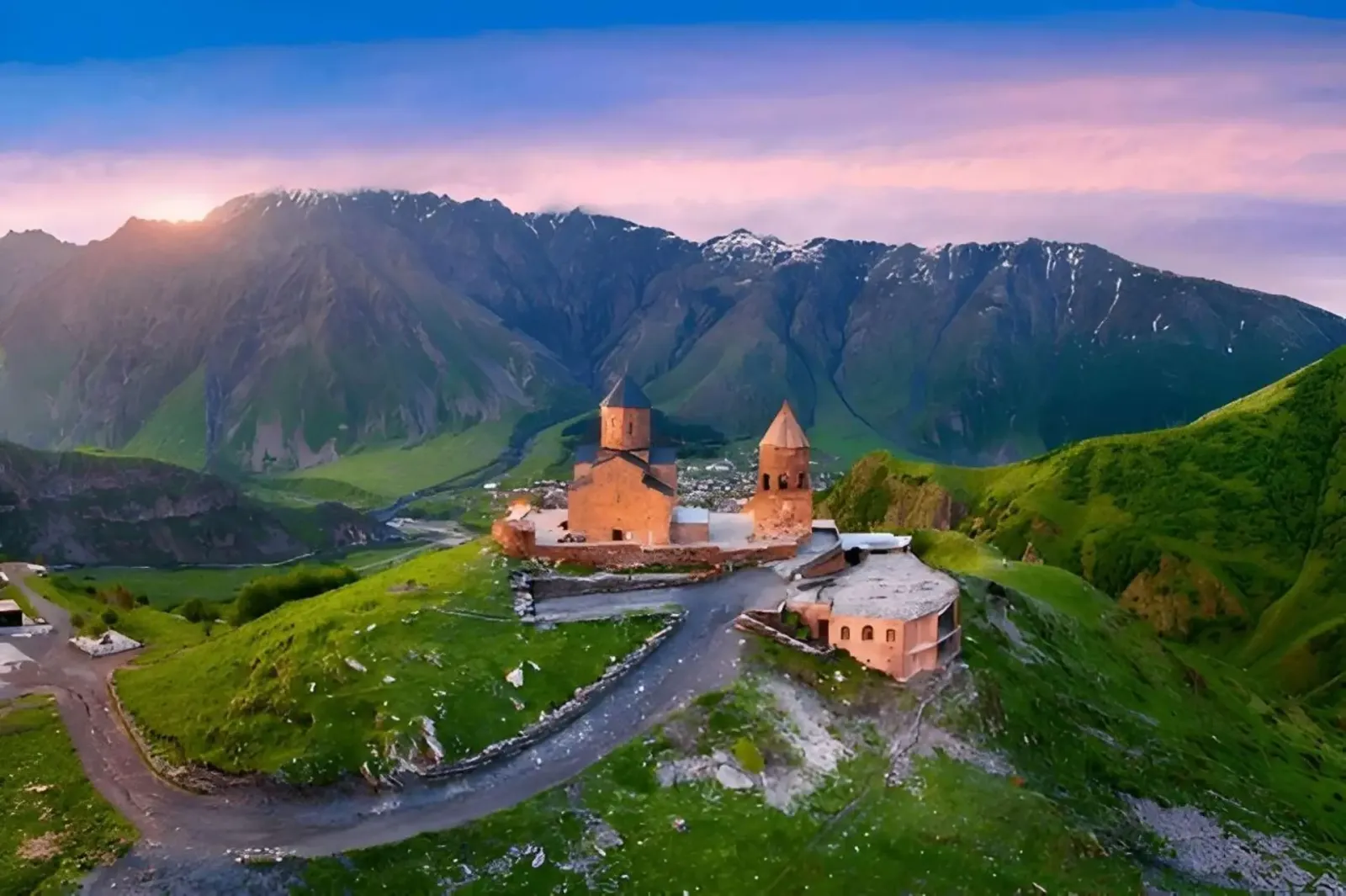
The 14th-century church on the ridge above town is the classic view of the whole trip. A sealed road goes up in season; walking up takes 1–1.5 hours. For more on the church and hikes around it, read our Kazbegi and Gergeti guide.
In season an ordinary car drives up in about 15–20 minutes. Without a car, a local 4x4 from town costs about 15–20 GEL per person or 60–80 GEL per car return.
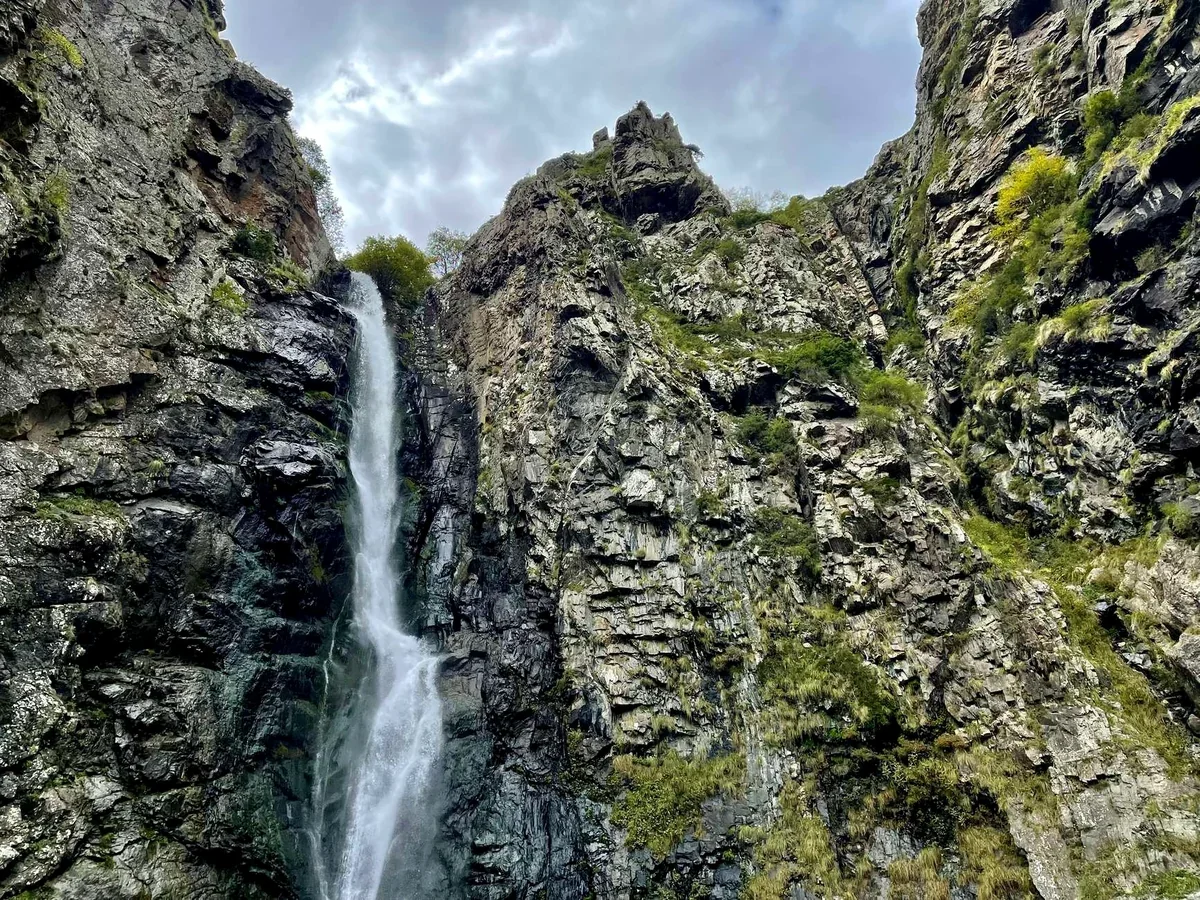
With time to spare, you can continue a few kilometres towards the Russian border to the Dariali gorge, or walk to the Gveleti waterfall (30–40 minutes each way on a rocky path, May–October).
The Gveleti walk starts from the main road about 7 km north of Stepantsminda. It is about 4.2 km return with 190 m of climbing and a few slippery steps near the falls, so wear shoes with grip.
Two side valleys also branch off this end of the road: Truso (May–October, bring your passport for the border police) and Juta (July–September, a harder walk). Our comparison of Truso or Juta valley goes through who each one suits.
Georgian Military Highway drive times between the stops
These are driving times only, so add the stop times above:
- Tbilisi to Ananuri, about 70 km and 1–1.25 hours
- Ananuri to Pasanauri, about 25 km and 30 minutes
- Pasanauri to Gudauri, about 30 km and 40 minutes
- Gudauri to the Jvari Pass, about 10 km and 15 minutes
- Gudauri to Stepantsminda, about 35 km and 40–50 minutes
How to plan the day
In one day
A day trip runs to 11–12 hours, with 6–7 of them in the car, so some stops have to go. This timetable is based on how our private trip usually runs: leave Tbilisi at 08:30, stop at the Zhinvali viewpoint around 09:30 and at Ananuri from 09:45 to 10:30, then reach the Friendship Monument about 11:30 and Stepantsminda at 12:30. Gergeti fills the time until 14:00, and lunch is in town rather than in Pasanauri. From May to October there may be time for Gveleti or a photo stop in the Dariali gorge before you start back at 16:15, reaching Tbilisi around 19:45–20:15.
Over two days
A night in Stepantsminda leaves time for every stop. Leave Tbilisi around 09:00, start with Jvari, have lunch in Pasanauri and reach town in mid-afternoon, with an hour to rest before going up to Gergeti in the early evening. The next morning is free for a valley walk or Gveleti; leave Stepantsminda around 15:00 and you are back at your Tbilisi hotel between about 17:30 and 19:00. Our two-day Kazbegi plan goes through it in detail.
Where to sleep along the road
- Stepantsminda: the usual choice, with family guesthouses and hotels in town or in Gergeti village across the river. Ask for a room facing the mountain. Guesthouses often serve a home-cooked dinner, which helps because the choice of restaurants is small outside summer. Book ahead for weekends in July, August and September.
- Gudauri: resort hotels and apartment hotels in New Gudauri, and smaller family guesthouses along the highway. The New Year and Orthodox Christmas (7 January) weeks book up early.
- Pasanauri: a few guesthouses and small hotels along the highway and the river, though most travellers stop here only for lunch or rafting.
When to drive it
- June to September: the easiest months, with a reliable road and long evenings. July and August are the busiest, especially at weekends.
- May and October: quieter and cooler, with a chance of snow on high paths. In October the wooded slopes around the Zhinvali reservoir turn colour.
Driving the road
- Lorries. The highway is also the road to Upper Lars, Georgia's only open land crossing with Russia, so it carries a steady stream of heavy lorries. Overtaking on the hairpins above Pasanauri needs patience, and queues of trucks for the border can add 1–3 hours, especially on the way back.
- Weekend traffic. Friday and Sunday evenings are slow near Tbilisi.
- Weather. It can be sunny in Tbilisi and snowing on the pass. Gergeti is often about 10 °C cooler than Tbilisi; bring a warm layer even in summer.
- Livestock. Cows and sheep walk on the road, especially in the villages.
- Roadworks. A new Kvesheti–Kobi road with tunnels is being built to bypass the pass. It is due to open in stages, with completion expected in late 2026–2027. Until it officially opens, plan on the old road.
In winter
From December to April the Gudauri–Kobi section over the Jvari Pass can close for a few hours, or occasionally one to three days, after heavy snow or when the avalanche risk is high. Winter tyres are compulsory on this road in winter, and snow chains are sometimes required. Ananuri, Pasanauri and Gudauri on the Tbilisi side usually stay reachable. Check the Roads Department announcements the evening before and in the morning, and don't make Kazbegi your last day before a flight. Our guide to the Kazbegi road in winter has the details.
When the road over the pass is closed and the gondola is running, some travellers ride the 9.5 km cable car from New Gudauri to Kobi and take a taxi on to Stepantsminda. It closes for maintenance for a period in spring and can stop in strong wind, so don't build a plan around it.
Driving yourself or with a driver?
The road is sealed and in decent shape, and plenty of visitors drive it in a hire car in summer. It is also a mountain road shared with heavy lorries, and the stops are easier to enjoy when someone else is handling the hairpins and finding parking. In winter, we'd strongly suggest a driver who knows the road. Our post on hiring a private driver-guide explains what is included.
Seeing the stops without a car
Public transport runs the whole road but doesn't stop along it. Marshrutkas leave Didube bus station in Tbilisi for Stepantsminda at about 20 GEL per person, and you pass Ananuri and the Friendship Monument through the window. A seat in a shared taxi costs roughly 40–60 GEL, and some drivers will make a short photo stop, but that depends on the driver and the other passengers. Our guide to getting from Tbilisi to Kazbegi compares the options.
Tours on the Military Highway
Our private Kazbegi day trip stops at Zhinvali, Ananuri, the Friendship Monument and Gergeti in an 11–12 hour day. With a night in Stepantsminda, the 2-day Kazbegi trip adds Jvari, a khinkali lunch in Pasanauri, Gergeti in the evening light and a walk in the Truso or Juta valley. For something active, the Ananuri and Aragvi rafting day covers the first half of the road with a raft run from Pasanauri. See each tour page for the current price, or plan your own route and we send a price for your own car and driver-guide. Nothing to pay now.
Sources
- Wander-Lush, "How to travel from Tbilisi to Kazbegi in 2026": wander-lush.org
- Wander-Lush, "Places to visit on a Georgian Military Highway road trip": wander-lush.org
- Wikipedia, "Russia–Georgia Friendship Monument": en.wikipedia.org
- Wikipedia, "Jvari Pass Travertine Natural Monument": en.wikipedia.org
- Roads Department of the Ministry of Infrastructure of Georgia: georoad.ge
- Kvesheti–Kobi road project: kveshetikobiroad.ge
- Wander-Lush, "Kazbegi to Gergeti Trinity Church hike guide": wander-lush.org
Last checked: September 2026. Road conditions and the Kvesheti–Kobi timeline change; the official announcement on the day always takes precedence.