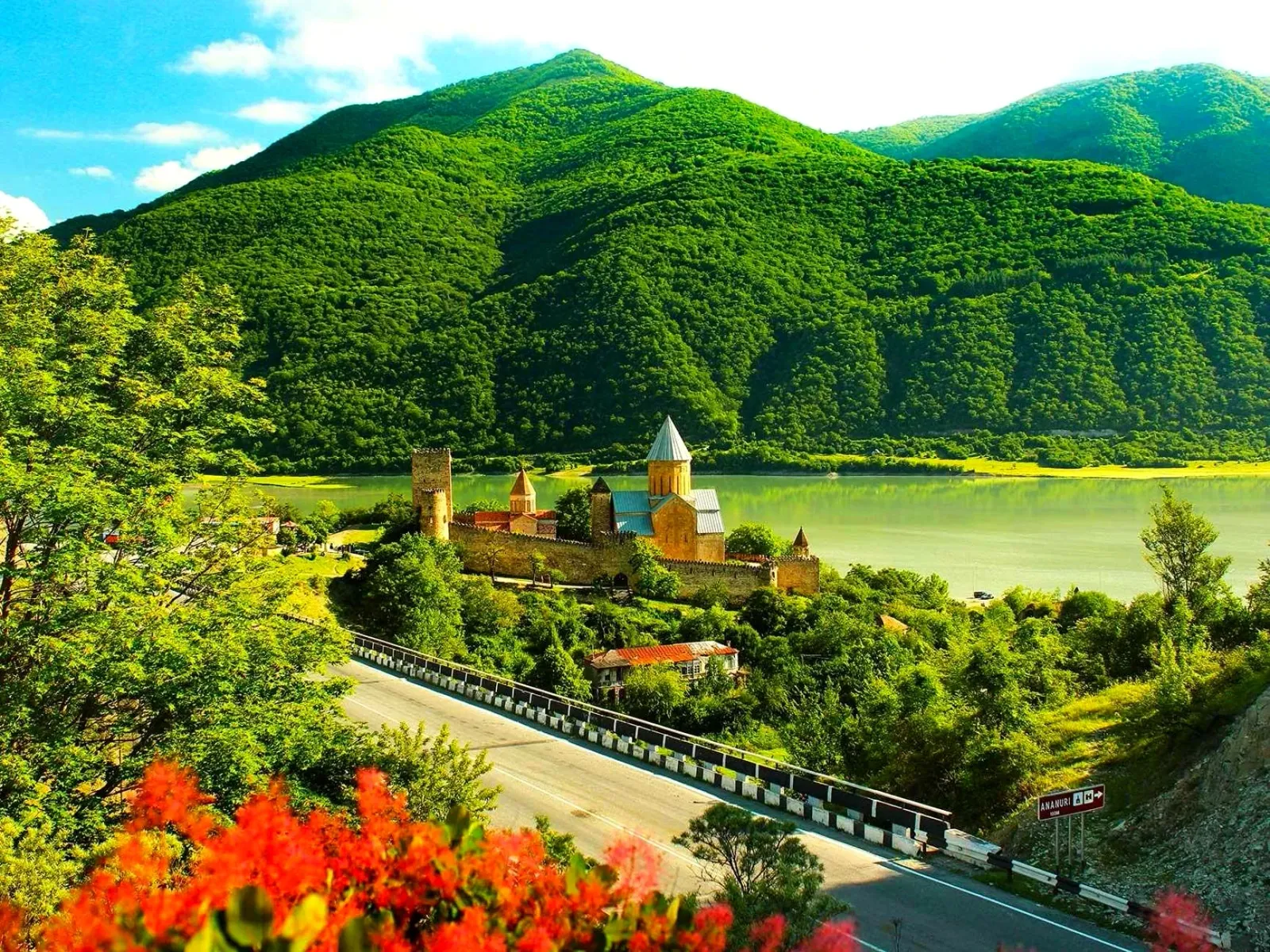
The short answer: Ananuri is the fortress of the dukes of Aragvi, on the Georgian Military Highway about 70 km (roughly 1–1.25 hours) north of Tbilisi, above the turquoise Zhinvali reservoir. Inside its walls are two 17th-century churches, one with a richly carved stone facade, and a square tower you can climb for the view over the water. It is the first proper stop on the way to Kazbegi, and 30–45 minutes is enough.
Who built it
Ananuri was the castle and seat of the eristavis, or dukes, of Aragvi, a feudal family who ruled the valley from the 13th century [1]. Their position on the road north gave them control of traffic over the Caucasus, and the fortress was their power base. It also saw their end: in 1739 Ananuri was attacked by the forces of a rival duchy, led by Shanshe of Ksani, and set on fire, and the Aragvi family was massacred [1].
Local legend explains the name. A woman called Ana from the village of Nuri, so the story goes, refused under torture to reveal the secret tunnel that brought water to the besieged fortress, and died rather than betray it [1]. Hence "Ana-Nuri".
Ananuri has been on UNESCO's tentative list for World Heritage status since 2007 [1]; it is not a World Heritage site.
What to see
The walls and towers
The complex is really two castles joined by a crenellated wall [1]. The upper castle, on the slope, has a large square tower called Sheupovari, the last refuge of the defenders; the lower castle has a round tower [1]. You can usually climb one of the towers by narrow, steep stairs to a view over the courtyard, the churches and the reservoir. Watch your head and footing.
The Church of the Mother of God (1689)
The larger church, with the central dome, was built in 1689 for the son of Duke Bardzim [1]. Its facades are carved with an unusual richness: look for the large grapevine cross on the south facade, a symbol of St Nino, and the carved animals and vines around it [1]. Inside, fragments of frescoes survive, many damaged in the fire of 1739.
The Church of the Virgin
The smaller, older brick church dates from the first half of the 17th century and holds the graves of Aragvi dukes [1]. Nearby is a stone baldaquin (canopy) put up in 1674 by the widow of Duke Edishera [1].
The Zhinvali reservoir
The reservoir that laps at the foot of the walls is modern, created by the Zhinvali dam on the Aragvi, and it changed the setting: the fortress once stood above a river valley. On a clear day the colour of the water, from turquoise to deep green, is one of the classic photos of the road. The roadside viewpoint a few minutes south of the fortress is worth a short stop.
How long to stop, and when
- 30–45 minutes covers the churches, the courtyard and a tower. On our Kazbegi day trips we stop for about 45 minutes.
- Morning is the usual time on the way north, before the tour buses bunch up around midday.
- In winter Ananuri stays reachable on the Tbilisi side of the Jvari Pass, even when the road beyond Gudauri is closed, so it works as part of a Plan B day.
Practical tips
- Dress code: shoulders and knees covered in the churches; women cover their hair. Wraps are usually available.
- Stalls: sellers outside the walls offer churchkhela, honey, knitted socks and felt hats. Have some small notes.
- Lunch: most people wait for Pasanauri, about half an hour further north, where the roadside restaurants serve khinkali.
- Children: the walls and tower make this one of the more fun stops for children; keep hold of small ones on the stairs and walls.
- Stairs: the tower stairs are dark, narrow and uneven; skip them if you are unsteady on your feet.
Ananuri through the year
- Spring and summer: green hills around the water and long days. It is busiest from June to September, when most visitors to Kazbegi pass through.
- Autumn: in October the wooded slopes around the reservoir turn colour, one of the prettiest times for photos.
- Winter: quiet, often with snow on the walls and hills. The courtyard and tower steps can be icy, so take care.
Whatever the season, it is a short stop on a long day. If you are driving to Kazbegi and back in one day, see Ananuri on the way north, while you are fresh and the light is on the facades, rather than at the end of the day when everyone is tired and the traffic back to Tbilisi is building.
What comes next on the road
About 25 km further north is Pasanauri, known for its khinkali and the base for rafting on the White Aragvi; see our guide to khinkali. Then the road climbs to Gudauri, the Friendship Monument and the Jvari Pass (2,379 m) before dropping to Stepantsminda, 152 km and 3–3.5 hours from Tbilisi without stops. Our guide to the stops on the Georgian Military Highway goes through them in order, and Rafting in Georgia covers the river.
Tours that stop at Ananuri
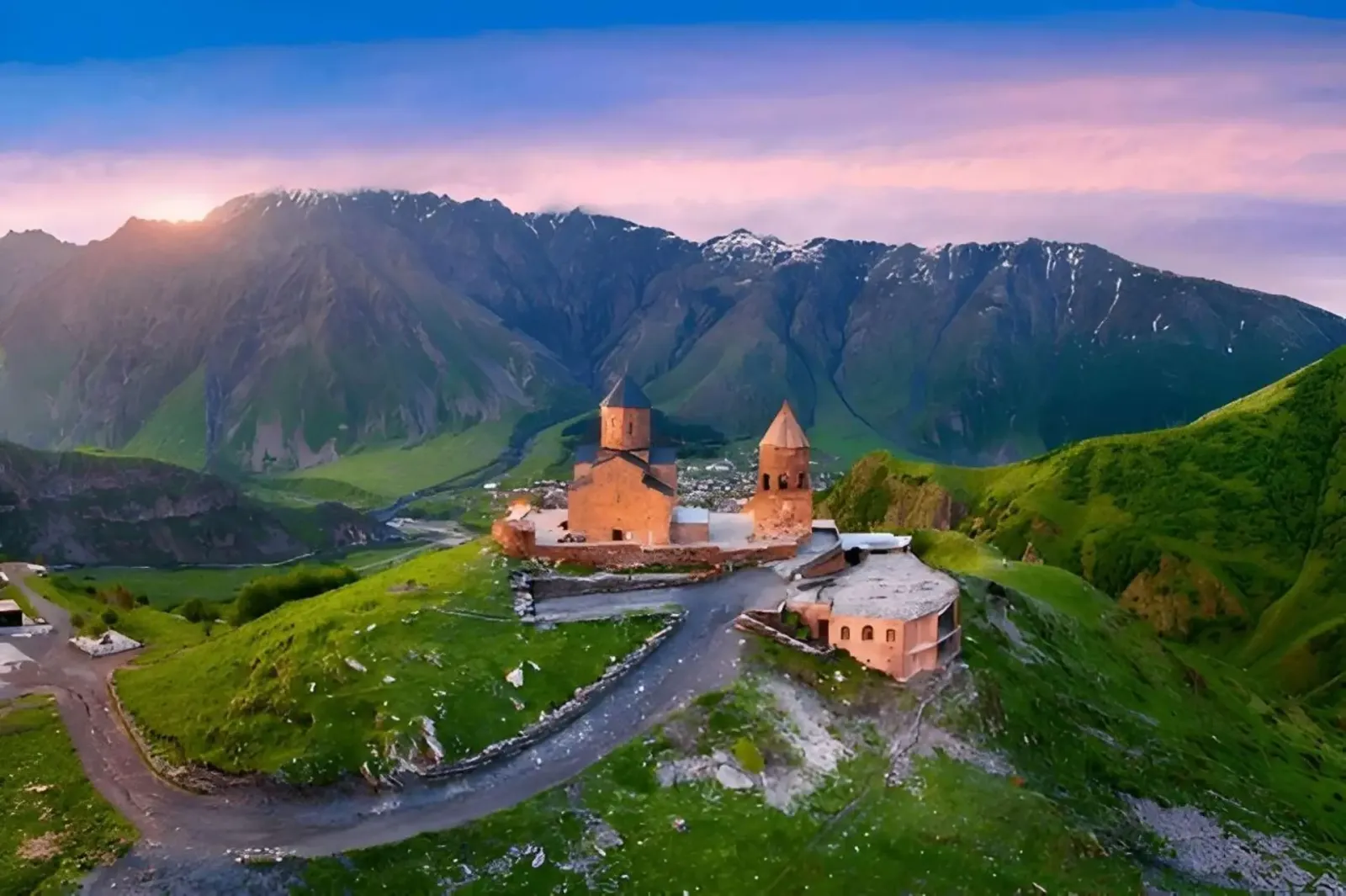
All our trips are private: your own car and English-speaking driver-guide, for 1–8 travellers. The private Kazbegi and Gergeti day trip stops at the Zhinvali viewpoint and Ananuri on the way to Gergeti Trinity Church (2,170 m) and Mt Kazbek (5,054 m), in an 11–12 hour day. For something active, the Ananuri and Aragvi rafting day spends 45 minutes at the fortress before a raft run from Pasanauri. See each tour page for the current price, or plan your own route. Nothing to pay now.
Sources
- Wikipedia, "Ananuri": en.wikipedia.org
- Wander-Lush, "Places to visit on a Georgian Military Highway road trip": wander-lush.org
- Wander-Lush, "How to travel from Tbilisi to Kazbegi in 2026": wander-lush.org
Last checked: September 2026.