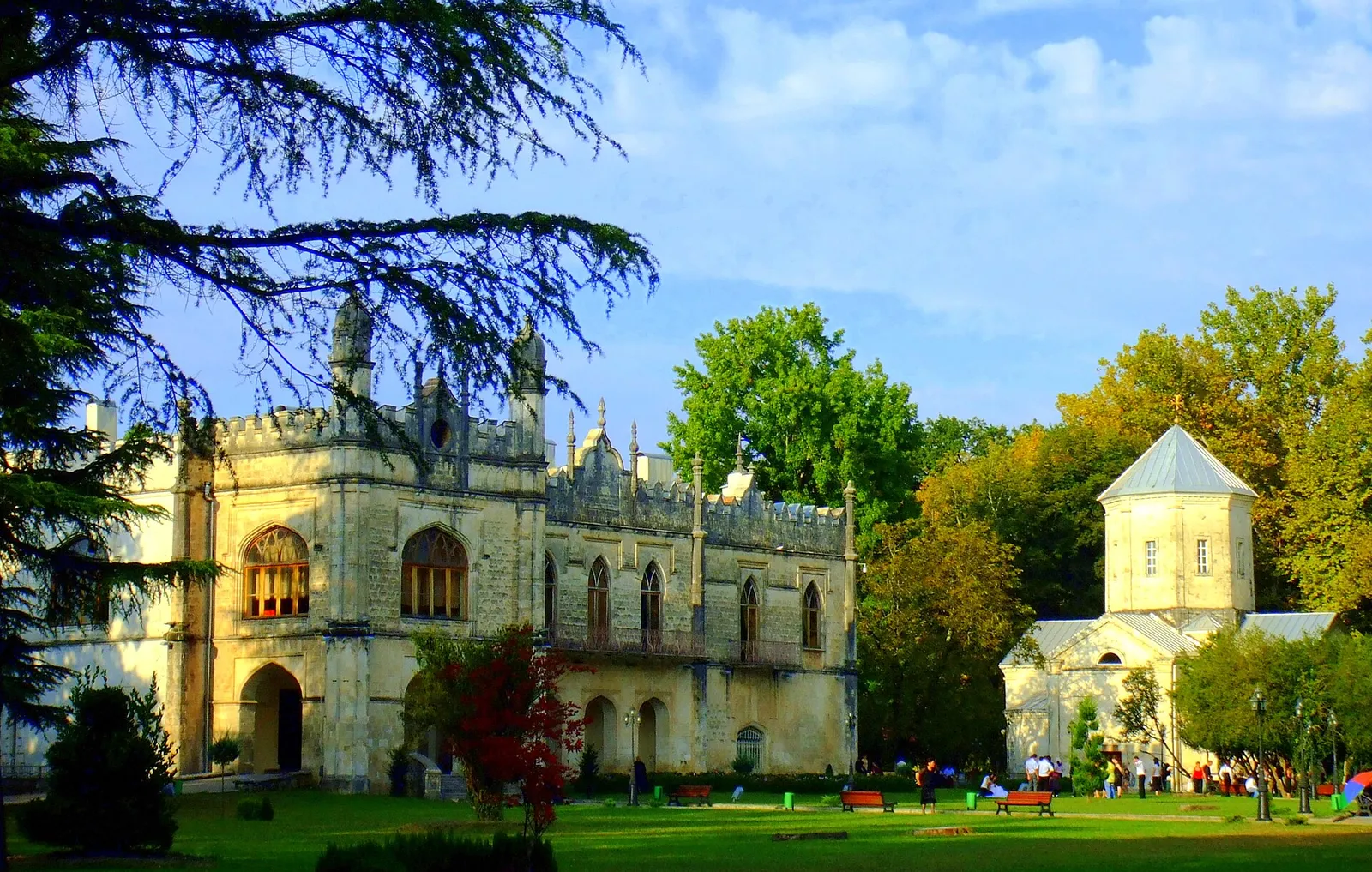
The short answer: Zugdidi is the main town of Samegrelo in western Georgia and the usual gateway to Svaneti: the train from Tbilisi ends here, and the road to Mestia starts here. It is worth a stop of 2–3 hours for the Dadiani Palace, the former residence of the princes of Samegrelo, now a museum whose collection includes a death mask of Napoleon, and for the botanical garden behind it[1][2]. Most travellers see it on the way to or from the mountains rather than staying the night.
The Dadianis and their palace
The Dadiani family ruled Samegrelo, historically called Odishi or Mingrelia, for centuries. Their palace in Zugdidi dates back to the 17th century, but what you see today is largely the result of a thorough rebuilding in the 19th century, led by an English architect[1][2]. The style is mostly neo-Gothic, with Georgian, Russian and other touches mixed in[2].
The resident most people remember is Ekaterine Chavchavadze-Dadiani, the last ruling princess of Odishi, who gave the palace and garden much of their European character[1][3]. The Napoleon collection came through marriage: Salome Dadiani married into the Murat family, and Prince Achille Murat, a great-nephew of Napoleon, brought Murat family possessions to Zugdidi[1][2].
The museum
The palace became a museum on 1 May 1921[2]. The complex now includes the main palace, the palace of Prince Niko Dadiani, the court church and the botanical garden, with a collection of tens of thousands of objects[1][2]. Highlights:
- Napoleon's death mask: one of the casts of the death mask of Napoleon Bonaparte, together with other items from the Murat family[1][2].
- Archaeology: finds from the excavations at Nakalakevi, the ancient city of Archaeopolis in Samegrelo[2].
- Icons and manuscripts: religious art, including the icon of Queen Bordokhan, and manuscripts from the 13th–14th centuries[2].
- Palace interiors: furniture, porcelain and paintings from the family's European-style life in the 19th century[1][4].
- Library: thousands of books, many in French[1].
The court church, the Blachernae church of the Virgin, holds a relic venerated as part of the robe of the Virgin Mary; it is displayed for pilgrims on the feast of Vlakernoba in July[1][2]. Allow 1–1.5 hours for the museum. It is closed on Mondays; check current hours before you go[5].
The botanical garden
Behind the palace is the Zugdidi Botanical Garden, laid out from the mid-19th century when the princess invited European gardeners and ordered rare plants from abroad[1][3]. Today it is a large, shady park with paths, old trees and a pond, and a pleasant place to stretch your legs after a long drive. Allow 30–60 minutes.
The rest of Zugdidi
Beyond the palace, Zugdidi is a lively provincial town with a long central boulevard, cafés and a market. It is a good place to eat Megrelian food, the spiciest in Georgia. There is little else for visitors, which is why most people pass through.
Zugdidi lies close to the administrative boundary line with Abkhazia. You cannot cross into Abkhazia from here as a normal tourist trip, and we don't go near the crossing point.
Zugdidi as the gateway to Svaneti
- By train: the morning train from Tbilisi takes about 5.5 hours to Zugdidi[6].
- By road to Mestia: about 130 km and around 3 hours, past the Enguri dam and up the Enguri gorge[6][7]. The road is open all year, with winter tyres required in winter.
- From Kutaisi: about 1.5–2 hours by road[7].
A sensible plan is to take the morning train, see the palace in the early afternoon, and drive up to Mestia before dark, or to visit on the way down from Svaneti towards the coast. For what comes next, see our Mestia guide, and for Martvili canyon, an hour or so away towards Kutaisi, our Kutaisi caves and canyons day trip.
A half day in Zugdidi
- Arrive by the morning train from Tbilisi, or by road from Kutaisi or Martvili.
- Dadiani Palace museum (1–1.5 hours), then a look at the court church.
- Botanical garden (30–60 minutes).
- Lunch in town: elarji, kharcho and Megrelian khachapuri.
- Drive up to Mestia (about 3 hours), arriving before dark.
When to go
The museum is open all year. The garden is greenest from spring to early autumn, and Samegrelo is hot and humid in July and August, so visit the garden early in the day. Around the feast of Vlakernoba in July the church is busy with pilgrims. In winter the road to Mestia stays open, but daylight is short, so plan a quick stop.
Who it suits
The palace suits anyone with an interest in 19th-century history, the Napoleon connection or grand interiors, and it breaks up a long travel day nicely. If you only care about mountains, you can skip it without regret, but the garden is a better lunch stop than a roadside café.
Seeing Zugdidi with us
All our tours are private, with your own car and driver-guide. The Western Georgia and Black Sea tour, 6 days stops at the Dadiani Palace between Martvili canyon and the drive up to Mestia, then carries on to Ushguli and Batumi. On the Svaneti highland expedition, you take the train to Zugdidi and meet your Mestia-based driver-guide at the station; ask us and we add a palace visit before the drive up. See each tour page for the current price, or build your own route. Nothing to pay now.
Sources
- Georgian National Tourism Administration, "Dadiani Palace and Zugdidi Botanical Garden": georgia.travel
- Wikipedia, "Dadiani Palace": en.wikipedia.org
- Georgian Tour Adviser, "Zugdidi Dadiani Palace": georgiantour.com
- Georgia.to, "Dadiani Palace Museum": georgia.to
- National Parliamentary Library of Georgia, "The Dadiani Palace Museum": nplg.gov.ge
- Geotour research on multi-day routes, citing Wander-Lush, "Tbilisi to Svaneti": wander-lush.org
- OrbiTrip, "Zugdidi to Mestia transfer guide": orbitrip.ge
Last checked: September 2026. Museum hours and train times change; check before you travel.