The short answer: Niko Pirosmani (1862–1918) is Georgia's national painter, a self-taught artist who painted feasts, animals and the people of old Tbilisi, usually on black oilcloth, often for tavern owners in exchange for a little money or a meal. He was barely known in his lifetime and died in poverty. The largest collection of his work is at the National Gallery in Tbilisi, with a smaller one at the Sighnaghi Museum in Kakheti and a house museum in his home village of Mirzaani.
His life
Nikoloz Pirosmanashvili was born in 1862 in Mirzaani, a village in Kakheti, to a peasant family[1]. Orphaned young, he moved to Tbilisi around 1870 with his sisters and worked as a servant, learning to read and write in Georgian and Russian[1].
He never had formal training. From the early 1880s he painted signboards with a partner; in 1890 he worked as a conductor on the railway; and from 1893 to 1901 he ran a small dairy business[1]. After that he lived by painting: signs, portraits and pictures for the dukhans, the taverns of Tbilisi, and whitewashing and house-painting when there was no other work[1].
How he painted
Pirosmani's usual material was black oilcloth, the kind used to cover tavern tables. He let the black show through as background and shadow, and painted over it in a few strong colours[1][2]. His figures are flat and face you directly, and his scenes are calm and still, even when they show a feast.
His subjects are the life he knew:
- Feasts: long tables of men raising their glasses, with wine, bread and roast meat. For how that works in real life, read our guide to the supra.
- Animals: often a single animal alone against the dark background, looking strangely human.
- People: archetypal figures such as a mother with her children, a fisherman, a cook or a postman, and a few portraits of real people, such as the actress Marguerite de Sèvres and the artist Ilia Zdanevich[2].
About 200 of his paintings survive; many more were lost as signboards and tavern pictures wore out[1].
Discovery and death
In 1912 the brothers Ilia and Kirill Zdanevich, with their friend Mikhail Le-Dantyu, came across his paintings in Tbilisi taverns and began to collect them[1][3]. Ilia's first article about him, calling him a natural-born artist, appeared in a Tbilisi newspaper in February 1913, and word of him reached the avant-garde in Moscow[1][3]. In 1916 the new Society of Georgian Artists invited him to join, but the relationship with the professional artists remained uneasy[1].
He died in Tbilisi in April 1918, in poverty and ill health[1]. His fame came afterwards: today he is treated as a national artist, his work has appeared on Georgian banknotes, and it is shown in major museums abroad, including a large exhibition at the Fondation Beyeler near Basel in 2023[1][2].
The legend of a million roses
Many visitors from Russia and Eastern Europe know Pirosmani through a song. The story goes that he fell in love with Margarita, a French actress touring Tbilisi, and filled the square outside her hotel with flowers. Andrei Voznesensky turned the tale into the lyrics of "A Million Roses", sung by Alla Pugacheva in 1982[4]. Nobody knows how much of it is true, but his portrait of the actress Margarita hangs in the National Gallery.
Where to see his work
National Gallery, Tbilisi
The National Gallery on Rustaveli Avenue reopened in spring 2026 after a long closure. Its Pirosmani exhibition fills four rooms, with 54 works[5]. This is the one place to go if you want to understand him. It is closed on Mondays. See our guide to Tbilisi's museums for the rest of Rustaveli Avenue.
Sighnaghi Museum
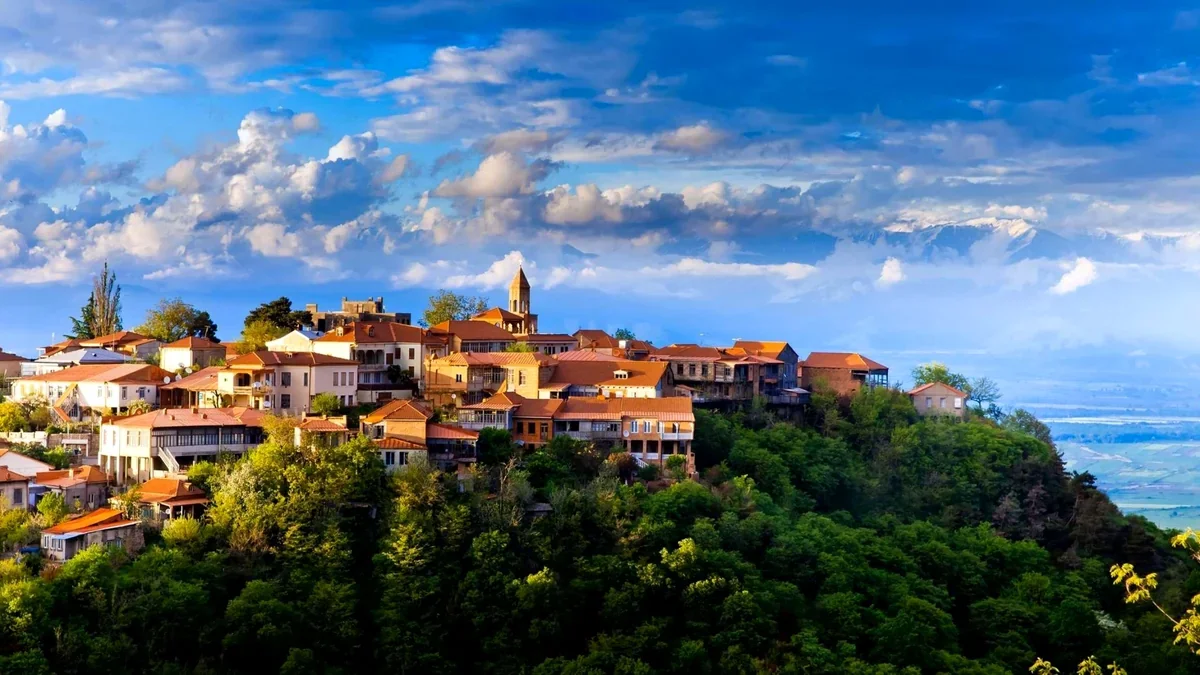
The museum in Sighnaghi, part of the Georgian National Museum, has a room of his paintings upstairs: around sixteen works, about a dozen of them usually on display, the largest collection outside Tbilisi[6]. It takes 30–45 minutes and fits easily into a day in Sighnaghi; see our Sighnaghi and Bodbe guide.
Mirzaani
His native village of Mirzaani, in southern Kakheti, has a house museum with personal belongings, period objects and some original works[7]. It is off the usual wine routes, so combine it with Sighnaghi on a longer Kakheti day. There is also a small Pirosmani house museum in Tbilisi[8].
What to look for
- How much of the black oilcloth he leaves unpainted.
- The food and wine on the tables; it is much the same as at a supra today.
Planning your visit
In Tbilisi, combine the National Gallery with the Georgian National Museum a few doors down Rustaveli Avenue; together they make a full morning, and both are closed on Mondays. In Kakheti, the Sighnaghi Museum takes under an hour and sits in the middle of the old town, so it fits between the walls and lunch. Mirzaani needs its own detour.
Seeing Pirosmani with us
All our tours are private, with your own car and driver-guide, so adding a museum is easy. The Kakheti wine day trip spends time in Sighnaghi, where the museum is a few minutes' walk from the walls; tell us and we plan the stop in. The private Tbilisi Old Town walk ends on Rustaveli Avenue, close to the National Gallery. With more time, the Kakheti wine tour, 3 days can include Mirzaani. See each tour page for the current price, or build your own trip. Nothing to pay now.
Sources
- Wikipedia, "Niko Pirosmani": en.wikipedia.org
- Fondation Beyeler, "Niko Pirosmani" press kit (2023): fondationbeyeler.ch
- Wikipedia, "Ilia Zdanevich": en.wikipedia.org
- Wikipedia, "Million Roses": en.wikipedia.org
- Wander-Lush, "Tbilisi museums and galleries, 2026": wander-lush.org
- Hikasus Travel, "Sighnaghi Museum": hikasustravel.com
- Advantour, "House Museum of Niko Pirosmani in Mirzaani": advantour.com
- GeorgianMuseums.ge, "Niko Pirosmanashvili house museum": georgianmuseums.ge
Last checked: September 2026. Museum hours vary; check before you go.