In short: Narikala is the ruined fortress on the ridge above Tbilisi's Old Town, first built in the 4th century [1]. The quick way up is the cable car from Rike Park on the left bank of the Mtkvari, a ride of just under two minutes across the river [3]. From the top you can walk along the walls, go on to the Mother of Georgia statue, then walk down to the sulphur baths or into the National Botanical Garden behind the fortress. Allow one to two hours, more with the garden.
A short history
A fortress stood on this ridge from the reign of King Varaz-Bakur, around 364, before Tbilisi became the capital [1]. The Umayyad Arabs, who ruled Tbilisi as an emirate for long periods, expanded it in the 7th century, and King David the Builder (1089–1125) strengthened it again after he took the city back [1]. The Mongols called it Narin Qala, "little fortress", which is where the name comes from [1].
Most of the walls you see today date from the 16th and 17th centuries. In 1827 an earthquake damaged parts of the fortress, and they were later demolished [1]. It has been a registered Cultural Heritage Monument of Georgia since 2007 and is open as a ruin, with steps and paths along the walls.
Inside the walls stands the Church of St Nicholas. The 13th-century church burned down; the present one was built in 1996–1997 and is painted inside with scenes from the Bible and from Georgian history [1]. Dress code applies: shoulders and knees covered, and women cover their hair.
The cable car from Rike Park
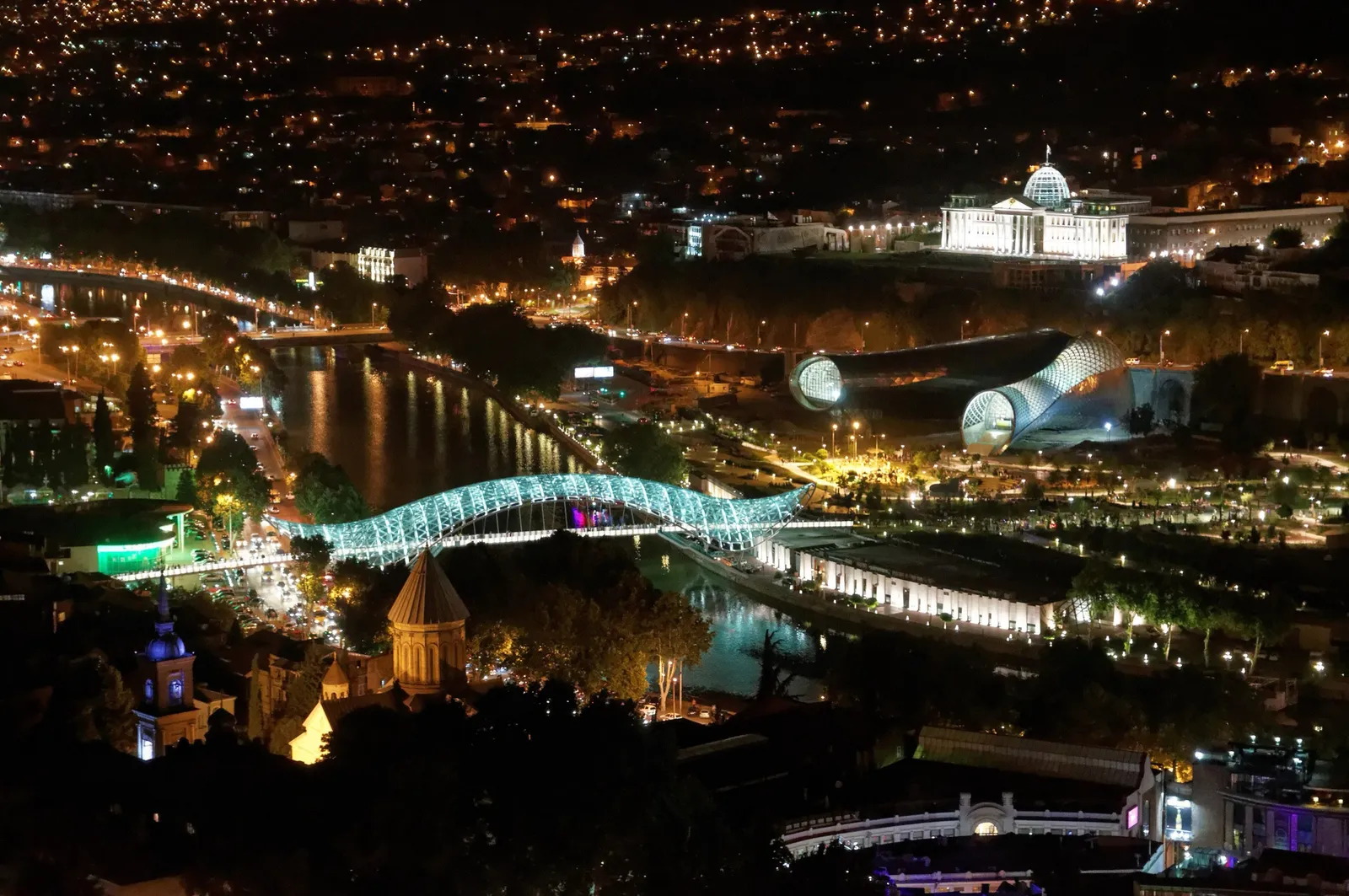
The aerial tramway opened in June 2012 and links Rike Park, by the Bridge of Peace, with the fortress ridge [3]. It is about 500 m long, with small gondolas taking up to eight people each [2].
- Fare: 2.5 GEL each way on the city's official tariff [4]. Up and down are charged separately.
- Payment: by the Metromoney transport card, which you can buy at the station and also use on the metro and buses [2][5]. Cards bought for Tbilisi's public transport work here.
- Hours: roughly late morning to late evening, closing earlier in winter than in summer, and it can stop in high wind or for maintenance [5].
- Queues: expect a wait on summer evenings and weekends. Mornings are quieter.
Most people ride up and walk down, which is the easier direction on the knees.
Walking up instead
If you'd rather walk, paths climb from the Old Town near the baths and from Sololaki. It is short but steep, on cobbles and steps that are slippery after rain. Flat shoes with grip matter more here than anywhere else in Tbilisi.
The Mother of Georgia
Along the ridge to the west stands Kartlis Deda, the Mother of Georgia: a 20 m figure first put up in 1958 for Tbilisi's 1,500th anniversary [6]. The sculptor was Elguja Amashukeli. The first statue was wooden, covered in aluminium in 1963 and replaced by a new one in 1997 [6]. She holds a bowl of wine in her left hand for guests who come as friends and a sword in her right for those who come as enemies [6], which Georgians will tell you sums up the national character.
The path from the upper cable car station to the statue runs along the ridge with views down over Sololaki on one side and the Old Town on the other.
Down to the baths and the waterfall
From the fortress, a path and steps lead down into Abanotubani, the brick-domed bath quarter. At the bottom of the gorge behind the baths is the Leghvtakhevi waterfall, a short walk up a boardwalk. It is a natural place to finish, and a private sulphur-bath room makes a good end to the day; book one ahead. See our guide to the sulphur baths.
The National Botanical Garden
Behind the fortress, in the Tsavkisis-Tskali gorge, is the National Botanical Garden of Georgia. It covers 161 hectares and was officially founded in 1845, though royal gardens are recorded on the site earlier [7]. Its most photographed sight is an arched bridge over a waterfall, built in 1914 [7]. The main entrance is at the foot of the fortress, so it combines easily with Narikala [7]. There is an entrance fee, and the paths are hilly; give it at least an hour.
When to go
- Late afternoon and sunset: the light falls on the Old Town, Metekhi and the river, and the city lights come on as you walk down. It is also the busiest time.
- Morning: quieter, cooler in summer, and better for the Botanical Garden.
- Summer: Tbilisi averages around 30 °C at midday in July and August [8], and the ridge has little shade. Go early or late.
- Winter: clear winter days give views to the snow on the Caucasus; paths can be icy.
Who it suits
Almost everyone. The cable car removes the climb, but the fortress itself is all uneven stone and steps, and the walk down is steep. It is hard going with a pushchair, and for anyone unsteady on their feet the cable car there and back, with a short look from the upper station, is the sensible option. The walls have unfenced drops in places; keep children close.
Seeing Narikala with us
Our private Tbilisi city tour starts at Metekhi, takes the cable car from Rike Park to Narikala and the Mother of Georgia viewpoint, and walks down past the Leghvtakhevi waterfall and the bath domes into the Old Town. The Central Georgia heritage tour, 5 days pairs the National Museum with an Old Town walk and the cable car on its first day, and the Georgia in Winter tour, 6 days does the same on its Tbilisi day. For how to fit Narikala into a longer stay, see Tbilisi in 1, 2 or 3 days and our Old Town walking route. See each tour page for the current price, or plan your own Tbilisi days and we send a private itinerary with a price. Nothing to pay now.
Sources
- Wikipedia, "Narikala": en.wikipedia.org
- Georgia.to, "Rike Cable Car": georgia.to
- Georgia About, "Aerial tramway in Tbilisi" (June 2012): georgiaabout.com
- Tbilisi Transport Company, standard tariff: ttc.com.ge
- Wander-Lush, "Tbilisi Public Transport Guide": wander-lush.org
- Wikipedia, "Kartlis Deda": en.wikipedia.org
- Wikipedia, "National Botanical Garden of Georgia": en.wikipedia.org
- Climates to Travel, "Tbilisi climate": climatestotravel.com
Last checked: September 2026. Cable car fares and hours change; check on the day.