The short answer: Javakheti is a treeless volcanic plateau in southern Georgia, above 2,000 m in places, near the Armenian and Turkish borders. It is home to Paravani, Georgia's largest lake by area, at 2,073 m, several smaller lakes full of birds in spring and autumn, the Poka nunnery, famous for its cheese, and the last villages of the Doukhobors, a Russian religious community exiled here in the 1840s. Most of its people are ethnic Armenians. It is at its most welcoming from June to September; winters are long and harsh.
Where it is
Javakheti is the eastern half of the Samtskhe-Javakheti region, around the towns of Akhalkalaki and Ninotsminda. It lies south of Borjomi and east of Vardzia, between the Abul-Samsari and Javakheti ranges of volcanic hills[1]. Coming from Tbilisi, the road climbs through Tsalka onto the plateau; coming from Vardzia, you drive up the Paravani river from Khertvisi to Akhalkalaki. It feels very different from the rest of Georgia: wide grassland, big skies, stone villages and very few trees.
The lakes
Paravani
Paravani is Georgia's largest lake by surface area, about 37.5 km², at 2,073 m above sea level. It is surprisingly shallow, with a maximum depth of about 3.3 m, and it freezes over in winter, with ice around half a metre thick or more[1][2]. It is popular with fishermen, and the view across it to the volcanic peaks is the classic Javakheti picture.
The smaller lakes
South of Paravani, Saghamo lake sits on the Paravani river, and closer to the Armenian border are Khanchali, Madatapa, Bughdasheni and Kartsakhi[2]. These shallow lakes are the reason birders come here: in spring and autumn they fill with migrating waterbirds, and Madatapa is one of the most important lakes in the country for breeding and staging birds, including the Dalmatian pelican[3][4]. Common cranes, ruddy shelducks, geese, ducks and waders are all found here[3]. Several of these lakes are protected as part of the Javakheti protected areas.
Poka: St Nino's nunnery
On the shore of Paravani, the village of Poka has a small medieval church of St Nino and a nunnery founded beside it in 1993[5]. Tradition says St Nino, who brought Christianity to Georgia, rested here on her way from the south[2]. The nuns are known across Georgia for their cheeses, made with French techniques and local milk, as well as chocolate and other products, all sold in the nunnery shop[5]. Dress as for any Georgian church: shoulders and knees covered, and a headscarf for women. Our guide to Georgian cheese puts the Poka cheeses in context.
The Doukhobors of Gorelovka
The Doukhobors, whose name means roughly "spirit wrestlers", are a Christian group from Russia who rejected the rituals of the Orthodox Church and refused military service. Tsarist Russia exiled them to the Caucasus in the 1840s, and they founded villages on the Javakheti plateau, including Gorelovka, about 11–12 km south-east of Ninotsminda[6][7]. At the end of the 19th century many emigrated to Canada; more left after the Soviet Union collapsed. Only a small community remains today[7]. Gorelovka, with its painted wooden houses, is often called one of Georgia's most colourful villages[2]. Visit quietly and ask before photographing people.
Armenian Javakheti
Akhalkalaki and Ninotsminda are majority ethnic Armenian towns, and in many villages Armenian and Russian are more useful than Georgian[8]. You will see Armenian churches, hear Armenian spoken in the markets and, if you are lucky, eat at a family table. It adds another layer to a country that is often presented as simply Georgian.
What to expect on the ground
Javakheti is not set up for tourism the way Kakheti or Kazbegi are. Accommodation is limited to a few simple hotels and guesthouses in Akhalkalaki and Ninotsminda and around the lakes, restaurants are few and plain, and English is rarely spoken. Bring cash, as village shops don't take cards. The altitude matters too: at over 2,000 m the sun is strong, the wind is cold and the weather changes quickly, so pack a warm layer and a hat even in July. The upside is space. You can drive for an hour across the plateau and see more birds and shepherds than cars.
When to go
- June–September: the easiest months, with green grassland and mild days. Nights are cool even in summer; this is high country.
- April–May and September–October: bird migration on the lakes, with colder, changeable weather.
- November–March: long, hard winters, snow, and Paravani frozen solid. Only for the determined.
How to fit it into a trip
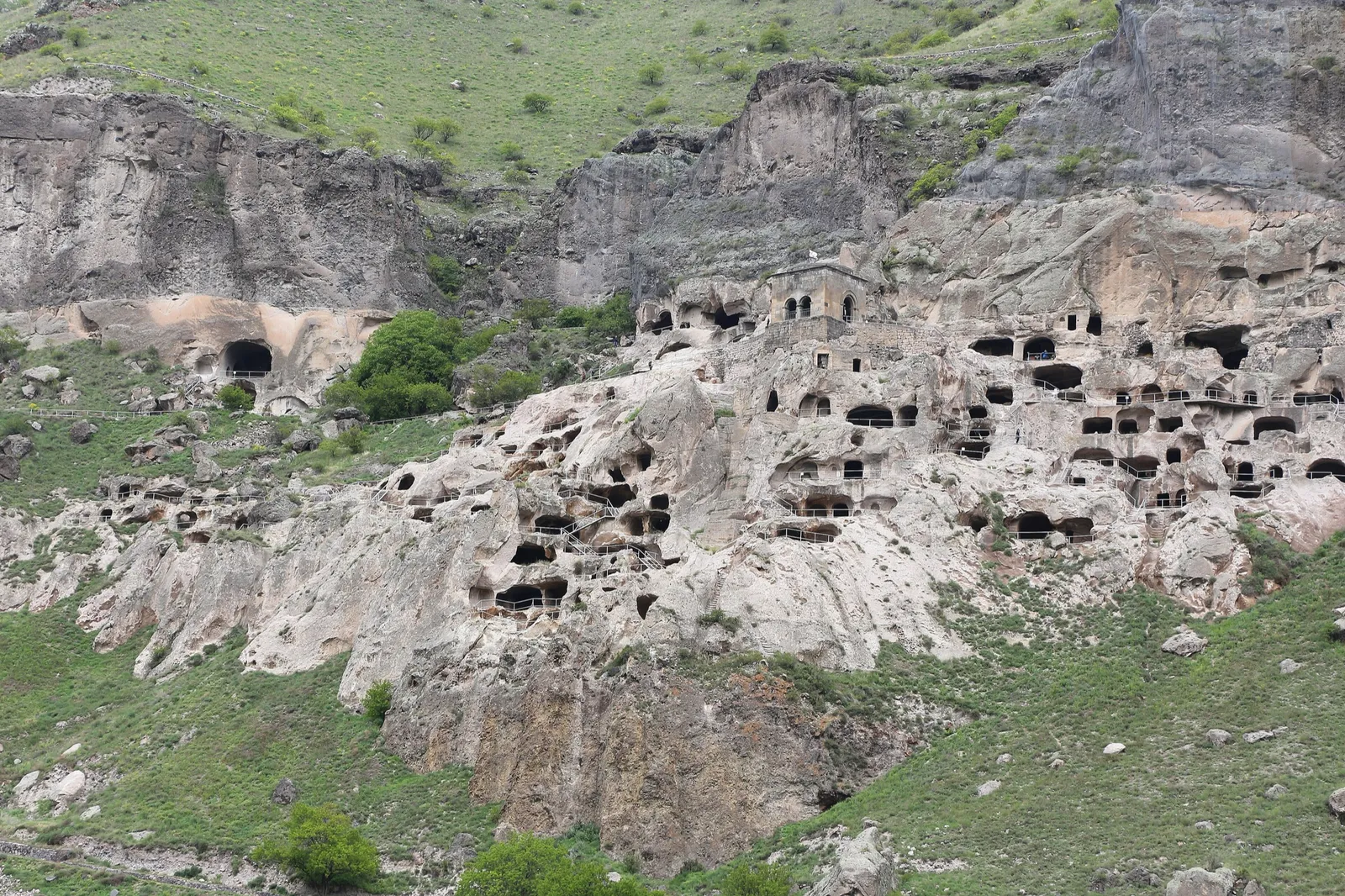
Javakheti is off the main tourist circuit, which is part of its appeal. The practical way to see it is together with Vardzia: after the cave monastery, instead of going back to Tbilisi via Borjomi, take the higher road across the plateau past Akhalkalaki, Paravani, Poka and Tsalka. It is a longer drive than the Borjomi road, so plan it as a full day with stops. Part of Vardzia has been closed since the rockfall of 27 May 2026; see Vardzia in 2026: what's open before you go.
Birders heading for the lakes need a longer stay and a specialist bird guide; tell us and we arrange one.
Javakheti on a trip with us
Our private Vardzia and Borjomi, 2 days covers Borjomi, Rabati Castle, Vardzia and Khertvisi; on request, we return to Tbilisi across the plateau via Paravani and Poka instead of through Borjomi. The private Archaeological Georgia trail spends two nights in Akhaltsikhe for Vardzia and Rabati, a natural base for a Javakheti day. Or build your own route, and we send you a private itinerary with a price. Nothing to pay now.
Sources
- Wikipedia, "Paravani Lake": en.wikipedia.org
- Georgia Travel (Georgian National Tourism Administration), "Lake Tour in Javakheti": georgia.travel
- Birdingplaces, "Madatapa Lake": birdingplaces.eu
- Birdingplaces, "Khanchali Lake": birdingplaces.eu
- Georgia.to, "Poka St. Nino Monastery": georgia.to
- Doukhobor Heritage, "A Fading Minority: The Doukhobors' Continued Struggle for Survival": doukhobor.org
- Human Rights Centre, "Gorelovka – Sorrow of the Last of Doukhobors": humanrights.ge
- JAMnews, "The corridor. Who lives in Javakheti, Georgia's southern land": jam-news.net
Last checked: September 2026. The plateau roads can be snowbound from late autumn to spring; check conditions before you travel.