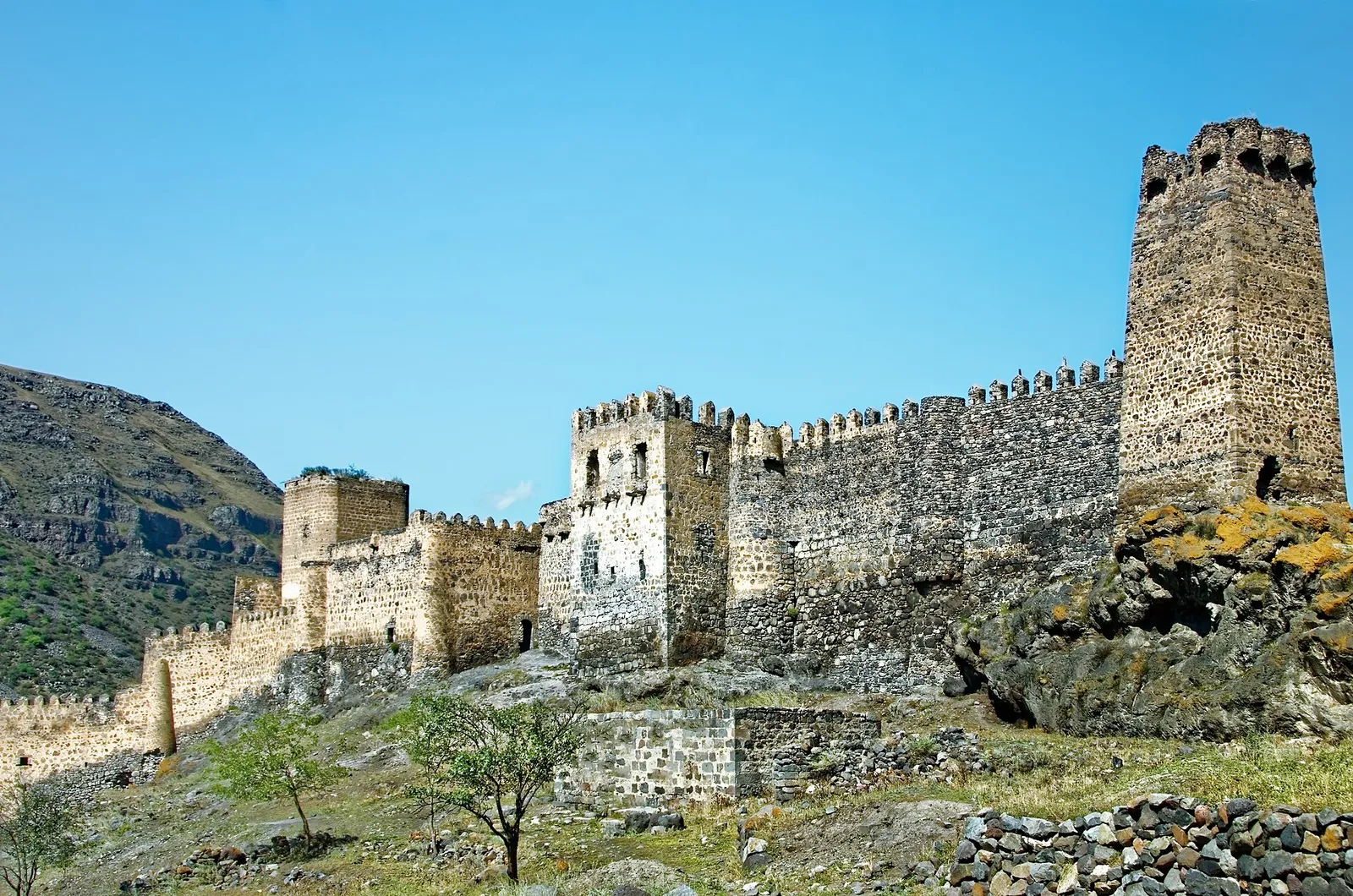
The short answer: Khertvisi is a medieval fortress on a rocky spur where the Mtkvari and Paravani rivers meet, in southern Georgia, 16 km north of Vardzia on the main road. It is one of the oldest fortresses in the country: tradition places the first fortifications in the 2nd century BC, the church dates from 985, and the walls you see today were rebuilt in 1354. Most people stop on the way to or from Vardzia. A photo stop from the road takes 15 minutes; climbing up inside takes 45 minutes to an hour.
Where it is
Khertvisi stands above the village of the same name in Aspindza municipality, in the historic region of Meskheti. The road from Akhaltsikhe to Vardzia follows the Mtkvari gorge, and the fortress appears suddenly on a rock at the point where the Paravani joins from the east. That position is the whole point of it: whoever held Khertvisi controlled the routes along both valleys, towards Javakheti and towards the south-west.
From Tbilisi it is about 260 km by road via Borjomi and Akhaltsikhe, so nobody comes just for Khertvisi. It is a stop on the Vardzia road, between Rabati Castle in Akhaltsikhe and the cave monastery.
History in brief
- 2nd century BC: the traditional date for the first fortress on the site.
- Legend: a story recorded in the Georgian chronicles says Alexander the Great destroyed Khertvisi on his campaigns. Historians don't support it, but the story has stuck locally.
- 985: the church inside the fortress was built.
- 10th–11th centuries: Khertvisi was the centre of Meskheti, and in the 12th century it grew into a town.
- 13th century: damaged in the Mongol invasions.
- 1354–1356: an inscription records a major rebuilding by Zakari Kamkamishvili; most of the present walls date from this time.
- 16th century on: the region fell to the Ottomans. Khertvisi was retaken briefly by Georgian forces in 1624 and again in 1771.
- 1828: the Ottomans lost the fortress for good, and in the later 19th century it became a Russian military post.
Today it is a monument of national importance, and it is on Georgia's tentative list for UNESCO World Heritage.
What you see
From the road, the view is of tall stone walls and towers following the edge of the rock, with the citadel at the highest point. It is most dramatic from the bridge and the road just to the south, with the two rivers below.
Inside, you climb through the lower yard to the citadel. The walls, towers and the small church are ruined but solid, and from the top you look down into both gorges. The fortress had tunnels leading down to the river, a way of getting water during a siege; they are not open to visitors.
How long, and how to visit
- Photo stop: 10–15 minutes from the road or the bridge.
- Climbing inside: 45 minutes to an hour, on steep, uneven paths and steps with no railings in places. Wear shoes with grip, and keep children close.
- Fee: a small fee has been reported (about 10 GEL), though some visitors report no charge; bring some cash.
- Season: it is usually visited from April to November. In winter the paths can be icy.
- Facilities: very few. There are family restaurants along the river on the road to Vardzia, where trout is the local dish.
- Heat: in summer there is no shade on the rock; go in the morning or late afternoon.
Combining it with Vardzia
Khertvisi fits naturally into a trip to Vardzia. Since the rockfall of 27 May 2026, part of the path at Vardzia has been closed and visitors return the way they came, so the visit there is a little shorter than it used to be. That leaves time to climb Khertvisi properly instead of just stopping for a photo. See Vardzia: what's open after the rockfall.
A good order for a two-day trip from Tbilisi:
- Day one: Borjomi's Central Park and mineral spring, then Rabati Castle in Akhaltsikhe, and a night in Akhaltsikhe or near Vardzia. Our Rabati Castle guide covers the castle.
- Day two: Vardzia at opening time, then Khertvisi on the way back, a trout lunch by the river, and the drive to Tbilisi, arriving in the evening.
In one day from Tbilisi it can be done, but it is 13–14 hours door to door, and Khertvisi becomes a short photo stop.
Photography
The classic photograph of Khertvisi is from the south, with the walls rising above the meeting of the two rivers. Morning light suits the eastern walls; in the late afternoon the stone turns warm gold. Stop somewhere safe, as the road is narrow and busy with lorries in places.
Who it suits
Khertvisi is worth the stop for anyone driving to Vardzia, and worth climbing for travellers who like castles and views. It is not suitable for anyone who finds uneven ground difficult; for them, the view from the road is the visit. For the story of the region in the time of Queen Tamar, when Vardzia was carved, see our post on Queen Tamar.
Seeing Khertvisi with us
The private Vardzia and Borjomi tour, 2 days is the relaxed option: Borjomi and Rabati Castle on the first day, a night in the area, then Vardzia with a site guide and Khertvisi fortress before lunch by the river. If you can't add a night, the Vardzia, Borjomi and Rabati day trip includes a photo stop at Khertvisi on the way back. Both are private, with your own car and English-speaking driver-guide; see the tour pages for the current price. Or plan your own route through the south. Nothing to pay now.
Sources
- Wikipedia, "Khertvisi Fortress": en.wikipedia.org
- UNESCO World Heritage Centre, tentative list for Georgia: whc.unesco.org
- Notes from Camelid Country, "The legend of Alexander the Great at Khertvisi Fortress": notesfromcamelidcountry.net
- Wander-Lush, "How to get to Vardzia": wander-lush.org
Last checked: September 2026. The open route at Vardzia can change at short notice; we check it before every trip.