The short answer: Georgia has grown tea since the mid-19th century, mainly in the humid west, in Guria, Adjara, Imereti and Samegrelo. In Soviet times it became one of the world's big producers, supplying most of the USSR's tea, but the industry chased quantity, and after 1991 it collapsed. Since the 2010s a small revival has been under way: family farms and a few estates now make hand-rolled and organic teas, and some welcome visitors. If you are travelling in the west between late spring and early autumn, a tea farm makes a gentle half-day.
How tea came to Georgia
The first tea bushes were planted as ornamental plants in Guria in the early 19th century, by the princely Gurieli family[1]. Prince Mikheil Eristavi later brought seeds from China, and the first tea plantation was established in Guria, in what is now Ozurgeti municipality, in 1847[1].
The industry proper began in Adjara in the 1890s. The Russian tea merchant Popov bought land at Chakvi, on the coast north of Batumi, planted about 300 hectares and brought in the Chinese tea specialist Lau Dzhen Dzhau (often written Lao Jin Jao) with a team of workers to build up production[1]. Georgian tea won a gold medal at the Paris World Exhibition of 1899[1]. Lau's old house in Chakvi, now abandoned, is still a place tea lovers seek out[1].
The Soviet boom
Under Soviet rule, tea became a mass industry. The state planted huge areas, a Georgian tea cultivar was bred in 1941, and harvesting was mechanised[1][2]. By the 1980s Georgia supplied about 95% of the Soviet Union's tea and employed some 180,000 people in the industry, and in 1985 production peaked at about 152,000 tonnes[1][2].
The catch was quality. Plans rewarded tonnage, and the harvesting machines worked like hedge-trimmers, cutting tough old leaves and twigs along with the tips[2]. When the Soviet Union fell apart in 1991, Georgia lost its guaranteed market almost overnight, and couldn't compete with cheaper imports on quality. Plantations were abandoned, factories were stripped for scrap, and by 2014 production had fallen to about 1,800 tonnes, a drop of some 99%[1][2]. Travelling in the west, you still see overgrown rows of tea bushes on the hillsides.
The revival
Since the 2010s, a small number of producers have brought old plantations back into use, often organically, with hand-picking and small-batch processing instead of volume[1][2].
- 2011: the Georgian Organic Tea Producers Association was set up, starting with a dozen families[1].
- 2017: a revived Soviet-era plantation near Kutaisi began producing as Renegade Tea Estate, founded by entrepreneurs from Estonia and Lithuania[1][2].
- 2018: Ozurgeti launched a Tea Route to connect visitors with producers in Guria[1].
A government programme has also brought more than 1,000 hectares of abandoned plantations back into use[2]. The teas are mostly black and green, some hand-rolled, and the old Soviet bushes, left unpruned for decades, give leaves with a character of their own. Quantities are tiny compared with the Soviet years, and that is the point.
Where to taste it
Guria
Guria, the small region inland from the coast around Ozurgeti, is the heart of Georgian tea. Places mentioned by visitors include a family tea farm and guesthouse in the village of Tsitelmta, the Anaseuli tea factory near Ozurgeti, which dates from 1935 and still runs, and a family estate in Bakhvi[1]. Guria is also good walking and eating country, much less visited than Adjara.
Adjara
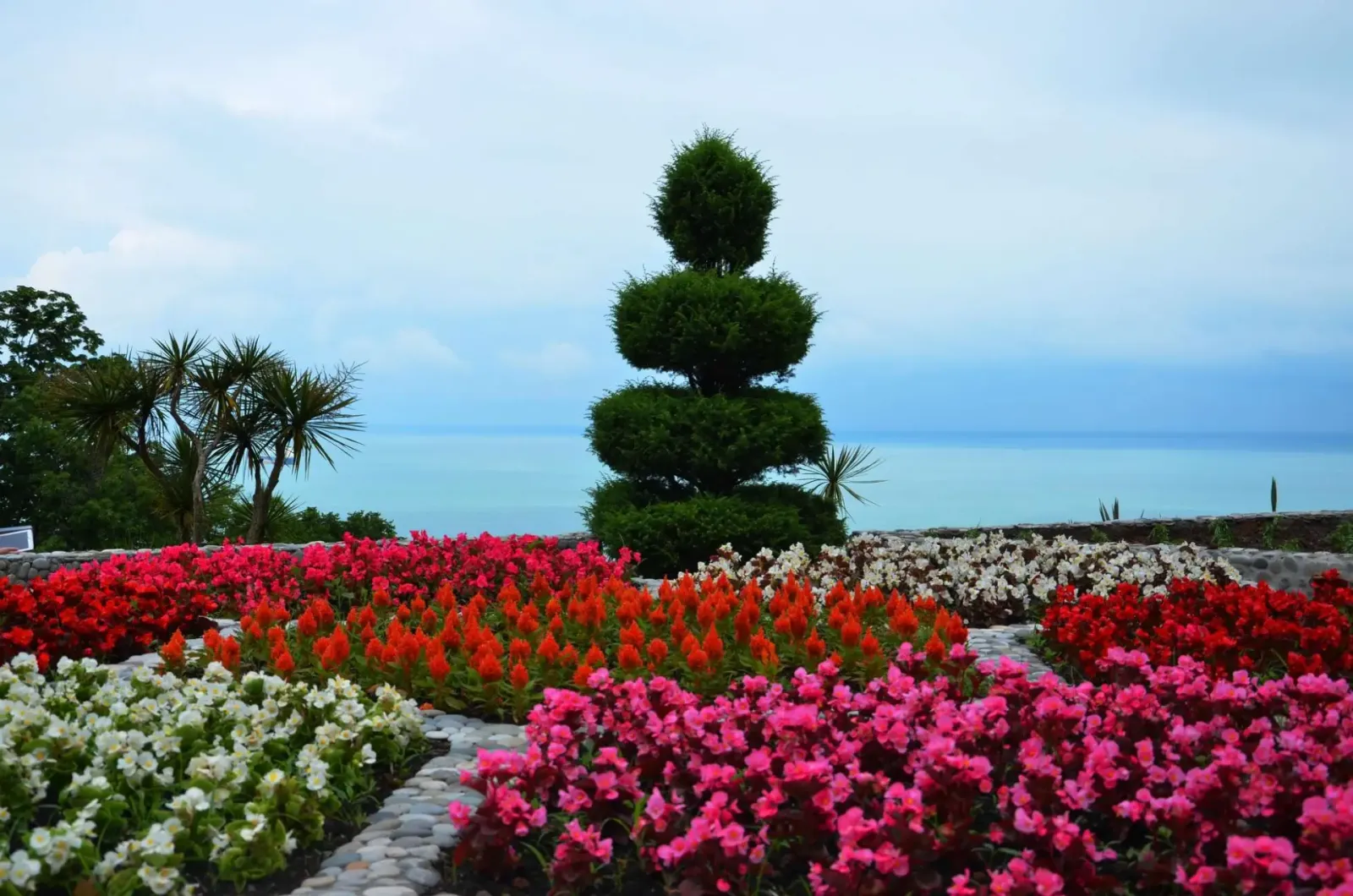
Around Chakvi, between Batumi and Kobuleti, is where the plantation era started. Besides Lau's old house, there are modern producers in the area, and hillside tea rows are part of the coastal landscape[1]. From Batumi it is a short drive, easily combined with the Botanical Garden; see Batumi beyond the beach.
Imereti
Near Kutaisi, Renegade Tea Estate welcomes visitors by arrangement for farm walks and tastings[1]. It fits a day in the Kutaisi area.
What a farm visit looks like
Visits are small and informal. Usually you walk the rows with the grower, see how the leaves are picked, and then follow them through the steps of making tea: withering, rolling, oxidising for black tea, and drying. At a family farm the rolling may still be done by hand. The visit ends with a tasting, often of several teas side by side, and sometimes with a meal at the family table. Allow two to three hours, including the drive from Kutaisi, Ozurgeti or Batumi.
When to go, and how to visit
- Season: picking runs from about May to September, so late spring to early autumn is the time to see the fields green and the processing under way[1].
- Arrange ahead: these are small farms, not visitor centres. Most visits need to be booked, and hosts may speak little English.
- Weather: western Georgia is wet. Bring a rain jacket, even in summer.
- Buying: small farms sell loose tea directly, and it makes a light, easy souvenir.
Tea on our western Georgia trips
None of our set itineraries has a fixed tea stop, but tea country is on the way. Our Western Georgia in 6 days private tour covers Kutaisi, Martvili, Svaneti and Batumi, and a tea-farm visit near Kutaisi or on the coast can be arranged on request. From Batumi, the Mountain Adjara private day trip heads inland to waterfalls, arched stone bridges and a family lunch; for more on that valley, read our Mountain Adjara guide. All our tours are private, with your own car and English-speaking driver-guide; see the tour page for the current price. Or build a western Georgia trip around tea, food and the coast. Nothing to pay now.
Sources
- Red Fedora Diary, "Georgian Tea: History, Tea Regions and Plantation Visits": redfedoradiary.com
- RFE/RL, "Tea Time: The Revival Of Georgia's Lost Industry": rferl.org
- Wikipedia, "Chakvi": en.wikipedia.org
Last checked: September 2026. Small farms change their visiting arrangements; always contact them ahead.