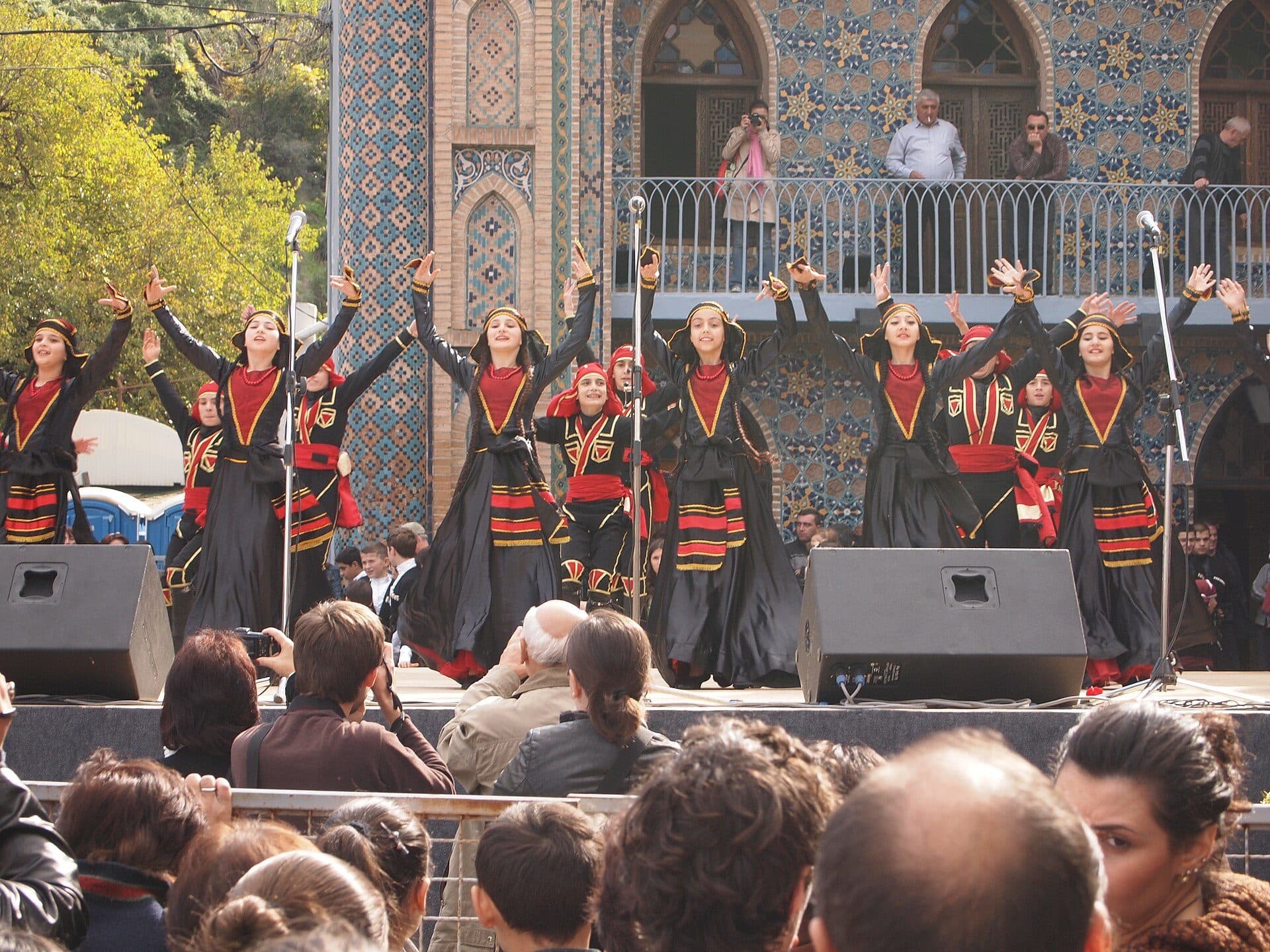
Georgia's calendar mixes Orthodox church feasts, village festivals with pre-Christian roots and newer city events built around wine and food. A few have fixed dates; many move with Orthodox Easter or are set by the organisers each year. This guide tells you roughly when each one falls. Check the exact date for your year before you plan a trip around it.
How the dates work
- The Georgian Orthodox Church follows the Julian calendar, so Christmas is on 7 January, and Easter often falls a week or more after Western Easter (some years on the same day).
- Several festivals are counted from Easter: Lamproba and Berikaoba before Lent, Lelo Burti on Easter Sunday, and some mountain feasts weeks later.
- Village festivals are community events, not shows. Visitors are generally welcome, but there are no tickets, fixed timetables or reserved seats.
January
- New Year (1–2 January): the biggest family holiday. The first guest to cross the threshold, the mekvle, is said to bring the household's luck for the year, and satsivi and gozinaki (walnuts in honey) are on every table.
- Orthodox Christmas (7 January): Alilo processions of singers and children in costume walk through Tbilisi and other towns, collecting food and gifts for people in need.
- Epiphany, Natlisgheba (19 January): water is blessed at churches, and some people plunge into rivers and lakes.
February and March
- Lamproba (Upper Svaneti, usually in February): an evening feast of St George in which the men of each family carry burning torches to the church and light a bonfire. The date moves with Easter [1].
- Berikaoba (before Lent): a masked village carnival with roots in pre-Christian spring rites, held in some villages of Kakheti and eastern Georgia, with costumed berikas, improvised comic plays and wrestling [1].
April and May
- Orthodox Easter (movable, April or early May): night services from Saturday into Sunday, red-dyed eggs and paska cake. The Monday after Easter is the day for visiting family graves. Good Friday to Easter Monday are public holidays [2].
- Lelo Burti (Easter Sunday): in Shukhuti, in Guria, the upper and lower halves of the village play a mass game with a heavy hand-made ball, somewhere between rugby and a street brawl, in memory of the village's dead [1].
- New Wine Festival (usually May, Tbilisi): one of the largest tastings of the year, with winemakers from across the country pouring the latest vintage. The venue and date are announced each spring.
- Independence Day (26 May): flags, concerts and stalls in central Tbilisi and other cities [2].
June to August
- Mountain feasts: summer is when the high valleys hold their church and village feasts. Tushetoba in Omalo, Tusheti, falls in late July or early August, with horse races and wrestling; Atengenoba feasts are held in Khevsureti and Tusheti in summer; Kvirikoba at Kala in Upper Svaneti is on 28 July [1]. They are pilgrimages and family reunions first, and the roads to them are long.
- Art-Gene (July, Tbilisi): a festival of folk music and crafts at the Open Air Museum of Ethnography [1].
- Mariamoba (28 August): the Dormition of the Mother of God, a public holiday, with services at churches across the country [2].
September and October
- Rtveli, the grape harvest: in Kakheti usually from late August or September into October (in 2026 it began on 10 September), later in western Georgia [3]. It isn't one festival but weeks of picking, pressing and feasting in family vineyards, and visitors can join a host family.
- Tsinandali Festival (early September): a classical music festival at the Tsinandali estate in Kakheti.
- Alaverdoba (late September): the feast of Alaverdi Cathedral in Kakheti, with pilgrims and a fair outside the walls.
- Tbilisoba (a weekend in October): the city festival, with food and wine from every region, concerts and craft stalls in the Old Town. In recent years it has been held on the first weekend of October [1].
- Svetitskhovloba (14 October): the feast of Svetitskhoveli Cathedral in Mtskheta, a public holiday, with a large service and crowds in the old town [2].
- Gurjaani Wine Festival (October): a one-day wine fair in Kakheti with dozens of producers; in 2026 it is on 10 October [3].
November and December
- Giorgoba (23 November): St George's Day, a public holiday and a major church feast [2]. St George is also honoured on 6 May, though that is not a public holiday.
- December: Christmas markets and lights in Tbilisi from mid-December, and preparations for New Year.
Planning a trip around a festival
- Check the date for your year: movable feasts and organiser-run festivals change every year.
- Book early for Rtveli weekends in September and October and for Tbilisoba; hotels in Sighnaghi and Telavi fill up.
- Public holidays close banks and offices, and some museums change their hours.
- Dress for church at religious feasts: long trousers for men; shoulders, knees and hair covered for women.
- Ask before photographing people at services and village rituals.
With us
We don't sell festival packages or reserved seats, and we can't promise you a place at a private family celebration. What we can do is plan a private trip around a date. In harvest season, the Kakheti grape harvest day and the 2-day Rtveli trip take you to a family vineyard, with the date confirmed by the host 7–10 days ahead. In summer, the 4-day Tusheti trip runs from July to September, and we can time it for Tushetoba if the dates allow. At any time of year, the supra and polyphonic singing evening near Tbilisi gives you a feast with toasts and songs. Nothing to pay now.
Sources
- Wander-Lush, "2026 Georgia Calendar: List of Events and Festivals in Georgia" (updated September 2026): wander-lush.org
- Wikipedia, "Public holidays in Georgia": en.wikipedia.org
- Wander-Lush, "Where to Go for the 2026 Rtveli": wander-lush.org
Last checked: September 2026. Festival dates change from year to year; the organisers' announcement is the one that counts.


