The short answer: the Didgori Battle Memorial is a hilltop monument in Kvemo Kartli, about 40 km west of Tbilisi as the crow flies, built to mark the Georgian victory over a Seljuk-led army on 12 August 1121. Dozens of giant steel swords stand in the meadow like crosses, among huge sculptures of fallen warriors. Entry is free, and there is no public transport: expect roughly 1 to 1.5 hours each way by car, and allow two hours at the site. Below: the history, what you will see, the road, and when not to go.
What happened at Didgori
On 12 August 1121, King David IV of Georgia, known as David the Builder, fought a much larger Muslim coalition led by Seljuk and allied commanders in the Didgori valley[1]. Georgian sources put his army at around 55,000, including Kipchak and Alan troops and a small group of Frankish knights; estimates for the other side vary enormously, from tens of thousands to several times the Georgian force, and medieval accounts are not reliable on numbers[1]. The coalition was routed[1].
The victory mattered far beyond the field. It let David retake Tbilisi in 1122 and soon after make it his capital in place of Kutaisi[1]. Georgians still treat it as one of the turning points of their history, and 12 August is marked every year as Didgoroba, with speeches and celebrations in the valley[2][3].
What the memorial looks like
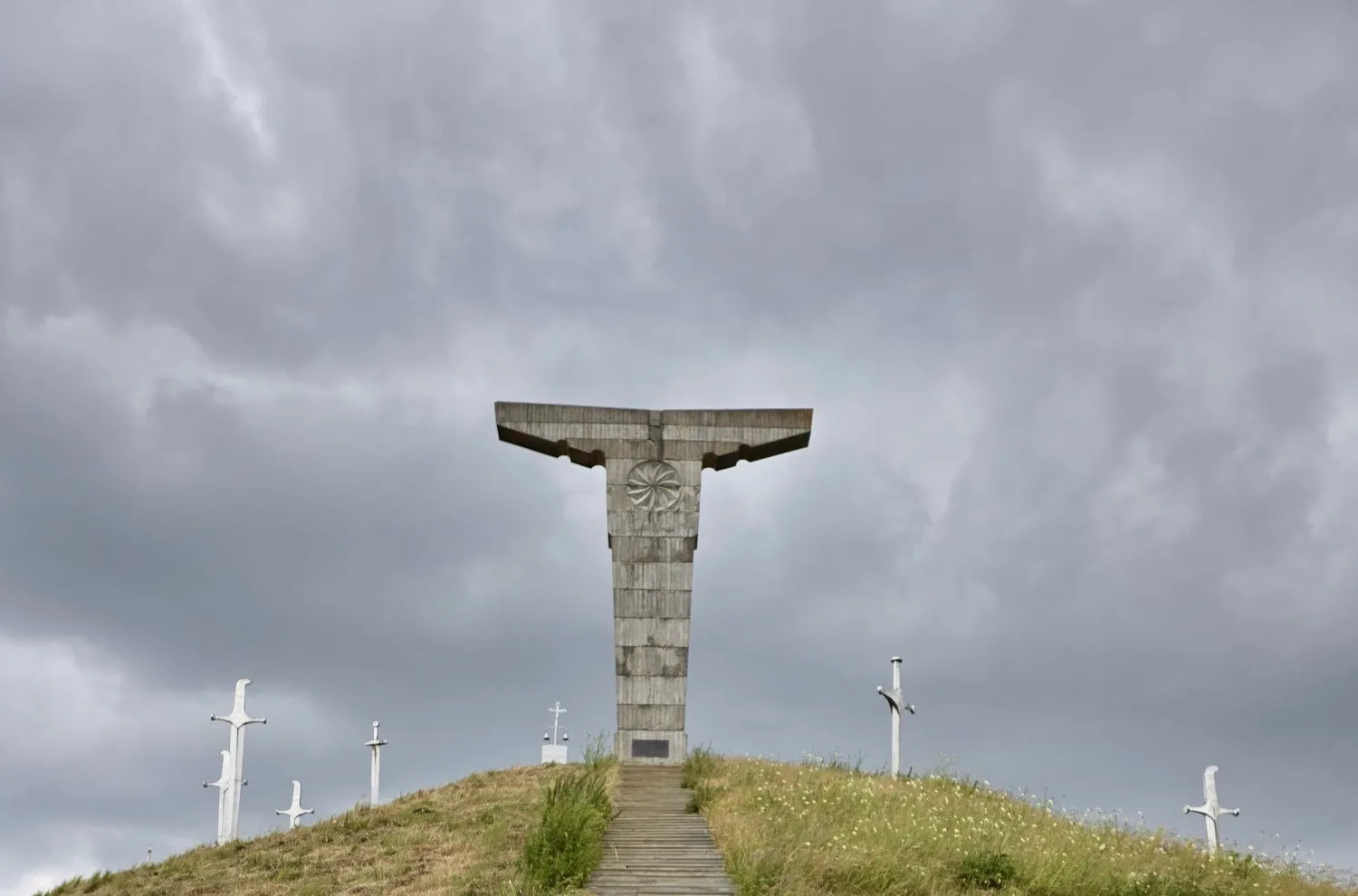
The monument stands on the slopes of Mount Didgori, in the eastern Trialeti Range of the Lesser Caucasus[4]. The mountain is listed at roughly 1,630 to 1,650 m, so it is high, open and exposed[4]. It is a spread-out site rather than a single statue. There are dozens of massive swords pushed blade-first into the ground, which double as crosses; colossal, fragmentary sculptures of warriors; and a tall concrete column modelled on the central pillar of a medieval Georgian house[4]. Wander-Lush also describes stone steps up to the top, a small auditorium, a tower of bells and a lion-and-sword emblem on the main stone[5].
You may see a precise sword count online: one outlet gives 49, one for every 1,000 Georgian soldiers[2]. We have not found a second independent source for that number, and other guides say only "dozens", so we do not give a figure. The memorial also does not mark the exact spot where the fighting took place; it stands near where the battle is thought to have unfolded[6].
Dates and credits differ between sources. Wikipedia names the sculptor Merab Berdzenishvili and the architect Tamaz Gabunia, and dates the complex to the early 1990s, adding that its designers received the State Prize of Georgia in 1995[4]. Wander-Lush also says early 1990s[5], while some travel guides give 1976[6]; the early 1990s, in the first years of independence, is the better-supported date.
Visiting
- Entry: free; open-air, no ticket office[7].
- Time on site: about two hours; the pieces are spread over a wide meadow[5].
- Weather: windy and noticeably cooler than Tbilisi, even in summer. Bring a windbreaker[5][7].
- Best light: early morning or early evening; late spring and summer bring wildflowers in the meadows[5].
- Winter: heavy snow and icy roads are normal. Wander-Lush advises a suitable car with winter tyres[5]. After fresh snowfall, check conditions with your driver before setting out, and be ready to change the plan.
- 12 August: the Didgoroba commemoration brings crowds, folk music and officials to the site[3]. Come on another day if you want it quiet.
- Facilities: expect a very basic site. Bring water and snacks from Tbilisi.
Getting there
By private car with a driver
This is the realistic option. Distance figures vary by source: about 40 km west of Tbilisi in a straight line[1][4], and about 60 km by road according to Wander-Lush, which puts the drive at around 1.5 hours[5]; others say about an hour[7]. Plan on 1 to 1.5 hours each way, depending on traffic and weather. Two routes are described, one through Tskneti and Manglisi and one over the hills via Mtskheta, taking similar time[5].
The final stretch climbs a mountain road. Wander-Lush found the road smooth and newly paved, but another guide warns that rain and fog make it difficult[5][7]. A driver who knows the road is a good idea, and with one waiting you can stay as long as you like.
By public transport
There is none. Both guides we checked say there is no regular marshrutka service and recommend a private car, a taxi with agreed waiting time, or a tour[5][7]. We could not find a marshrutka that gets you even part of the way, so do not plan on one.
Driving yourself
Possible, with a rental car from Tbilisi[5]. Allow for fog and wind, and avoid the route in snow unless you have winter tyres.
Combining it with other stops
From Tbilisi the memorial pairs well with the old capital of Mtskheta, if you take the northern route, or with a more modern landmark on the other side of the city: see our guide to the Chronicles of Georgia monument at the Tbilisi Sea. For the rest of the country's story, start with our overview of Georgia.
Seeing Didgori with us
We run this as a private trip: your own car and driver for 1 to 8 travellers, leaving from your hotel in Tbilisi. Our private driver service covers a Didgori half day on its own, and you can stretch it into a full day by adding Mtskheta, Uplistsikhe or Gori. More ideas are on the day trips from Tbilisi page. If you want to put your own route together, build your own tour and we quote it. See the pages for current prices. Nothing to pay now.
Sources
- Wikipedia, "Battle of Didgori": en.wikipedia.org
- Georgia Today, "The Miraculous Didgori Battle": georgiatoday.ge
- Georgia Today, "Georgia celebrates Didgoroba": georgiatoday.ge
- Wikipedia, "Mount Didgori": en.wikipedia.org
- Wander-Lush, "How to visit the Didgori Battle Memorial from Tbilisi": wander-lush.org
- Eurasia Travel, "Battle of Didgori Memorial Site": eurasia.travel
- Madloba, "The Didgori Memorial: what is it, and how do you get there?": madloba.info
Last checked: November 2026. Road and weather conditions in the mountains change quickly; check the forecast before you set off.