In short: the country of Georgia, in the Caucasus, has two kinds of natural springs a traveller can use. Some are for drinking: the naturally fizzy mineral water of Borjomi, Sairme, Likani and Utsera. Others are for bathing: the hot sulphur water under Tbilisi's old bathhouses, the warm open-air pools above Borjomi Park, the radon water of Tskaltubo near Kutaisi and the baths at Sairme and Nunisi. The easiest to reach are the Tbilisi sulphur baths, in the city centre, and Borjomi, about two hours west by road. In the Truso valley near Kazbegi the springs are something to look at, not to swim in. Below: each place, what you do there, how to get there, and a word on health.
Drinking springs or bathing springs?
It helps to know which you are going for. At a drinking spring you fill a cup or a bottle from a tap or a pavilion; the water is cold or lukewarm, strongly mineral in taste and often naturally carbonated. At a bathing spring you pay to soak in warm water in a pool or a private room. Some resorts have both: Sairme serves four kinds of mineral water to drink and a warm thermal water to bathe in[3][4]. Most of the old spa towns also run sanatoriums where doctors prescribe treatment courses; you do not need one to visit, drink or swim.
Borjomi: the park, the free spring and the sulphur pools
Borjomi is the name everyone in the former Soviet Union knows, because its salty sparkling water is bottled and sold abroad. The tourism board says it reaches 32 countries and that the water has been rising from 9 to 10 km underground for more than 1,500 years; the first bottling plant opened in 1890[1]. The town is about two hours from Tbilisi by road[1], and Wikipedia puts it at 165 km[5].
The spring in Borjomi Park
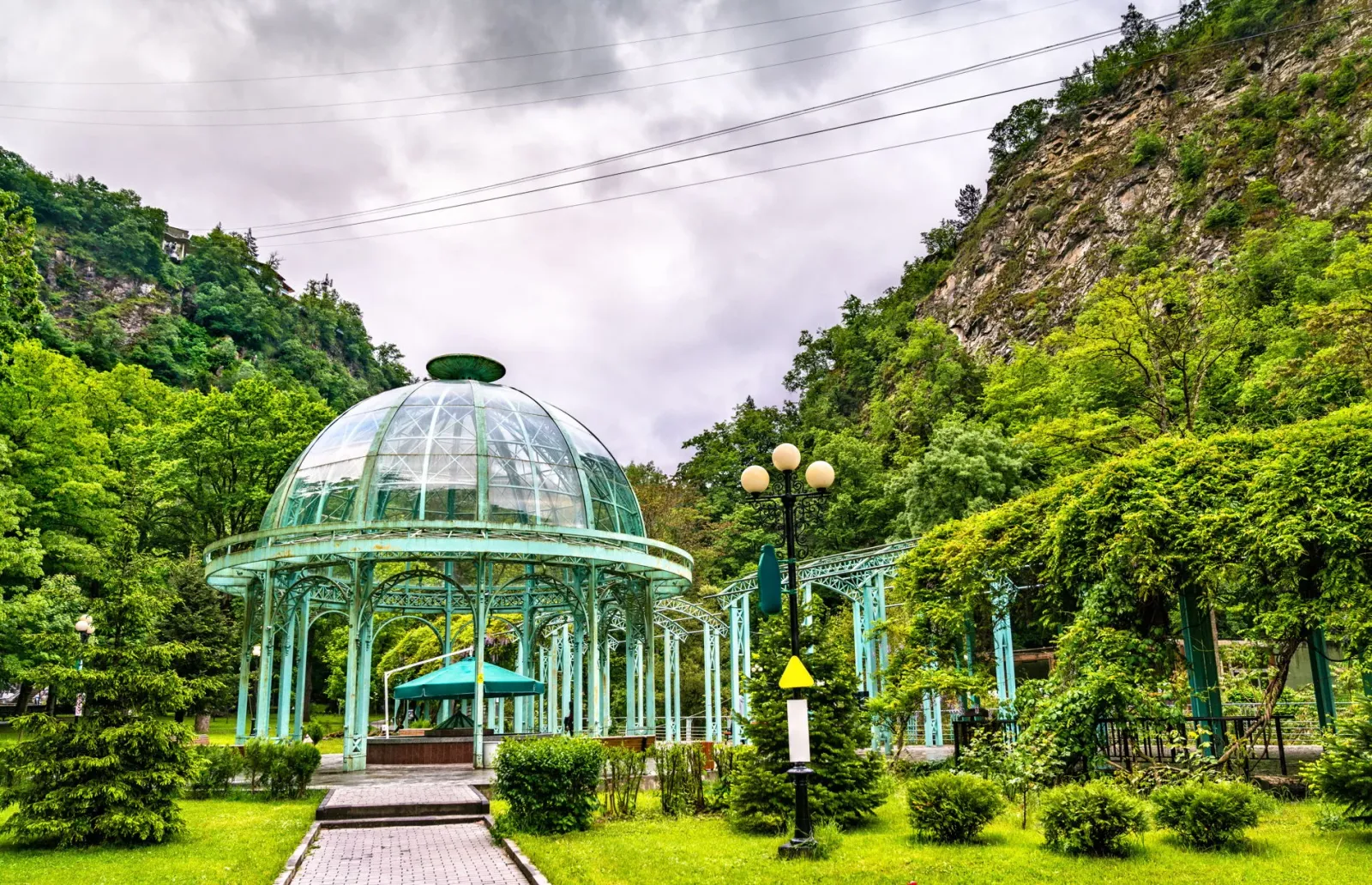
In the historic park in the town you can taste the water straight from the mineral spring, and the tourism board calls Ekaterine Spring the park's most loved sight[1]. Wikipedia says the spring is named after the daughter of General Golovin[5]. Filling a bottle at the spring costs nothing, but the park itself has charged an entry fee in recent seasons, and the figures we found differ; check at the gate.
The sulphur pools above the park
Walk on through the park along the Borjomula river and you reach a set of open-air sulphur pools in the forest. The tourism board gives two distances on two pages: about 2 km along the river on one, 2.5 km from the park on the other[2][1]. The water is between 32 and 38°C on average, and the semicircular pool is the warmest[2]. Bring a swimsuit and a towel[1]. For a full day in the town, see our Borjomi day trip guide.
Likani: Borjomi water at the west end of town
Likani lies at the western end of Borjomi, and its park has mineral springs similar in composition to Borjomi's[6]. It is known for the Romanov Palace, built in 1892 to 1895 as a summer house for Grand Duke Nicholas Mikhailovich[6]. Today the springs are used mainly by the Borjomi Likani resort hotel, which stands on the grounds of a Soviet sanatorium and offers health procedures based on the water[7]. Sources disagree on the palace: Wikipedia says the President of Georgia uses it as a summer residence[6], while the hotel says it is under renovation and will open to guests[7]. Do not count on going inside; treat Likani as a place to stay rather than a stop.
Tbilisi: the Abanotubani sulphur baths
The most visited natural springs in Georgia are in the capital. The brick domes of Abanotubani, the bath quarter of Old Tbilisi, sit over naturally hot sulphur water[8], and the city's very name comes from the Georgian word for hot[9]. By the tourism board's count there were 65 baths in the 12th century and there are more than 10 today[9]. The best known include Chreli Abano (the Orbeliani or Colourful Bath, with its tiled facade), Bath No. 5, King Erekle's Bath, the Bohema Bath and Gulo's Bath[10]. Besides the public baths there are private rooms; Chreli Abano has 12 of them and takes bookings by date on its own site[11]. Our sulphur baths guide covers private rooms, the scrub and what to bring.
Tskaltubo: radon baths near Kutaisi
Tskaltubo is a spa town in Imereti, 7 km from Kutaisi by the tourism board's figure (Wikipedia says about 9 km) and about 25 minutes by road[12][13]. Its water is radon-carbonate, and its natural temperature of 33 to 35°C means it is used without heating[13]. The tourism board says the water's healing reputation goes back to the 7th to 9th centuries and that the baths belonged to the royal house under Queen Tamar[12]. The central park covers 70 hectares and once had nine working bathhouses[12].
Most of the 22 Soviet sanatoriums are now abandoned[13], which is why many visitors come for the ruins as much as the water: see our post on the abandoned Tskaltubo sanatoriums. You can still bathe. Spring No. 6 is the largest bathhouse still in use[13], and Wander-Lush counts it as one of two working bathhouses in town, with Bathhouse No. 2 the other[14]. From Kutaisi, Wander-Lush lists marshrutka routes 30 and 34, about 20 to 25 minutes[14]; a taxi or driver is simpler.
Sairme: drinking springs and thermal pools in the forest
Sairme is a mountain resort in Baghdati municipality, Imereti, at 950 m above sea level, about 1 hour 20 minutes by road from Kutaisi[4]. It offers four mineral waters to drink and warm thermal water to bathe in, plus a full treatment centre[4]. Wander-Lush describes numbered drinking-water pavilions along the river and a separate set of indoor and outdoor thermal pools a short drive from the main resort, open to day visitors for a ticket[15]. There is a marshrutka from Kutaisi only as far as Baghdati; for the last stretch you need a taxi or your own car[15].
Nunisi: warm baths inside a national park
Nunisi sits in the southeastern part of Borjomi-Kharagauli National Park, on the Imereti side[16]. The tourism board says it has been known since the 17th century and has treated patients since 1856, and that the warm water from Zvare is used both for drinking and for bathing[16]. It is a quiet, out-of-the-way spa: about 1 hour 55 minutes by road from Kutaisi and 3 hours 25 minutes from Tbilisi[16]. It suits people who want several days in the forest more than a quick soak.
Utsera: mineral water in the Racha mountains
Utsera is a small climatic and spa resort in Racha, 11 km from the town of Oni[17]. Its mineral water is drunk as a cure, and the tourism board names May to October as the best season[17]. Oni is about four hours by road from Tbilisi[17]. Utsera is a village with guesthouses rather than a grand resort, and it fits naturally into a trip through the region; our Racha guide covers the rest.
Truso valley: mineral springs you look at
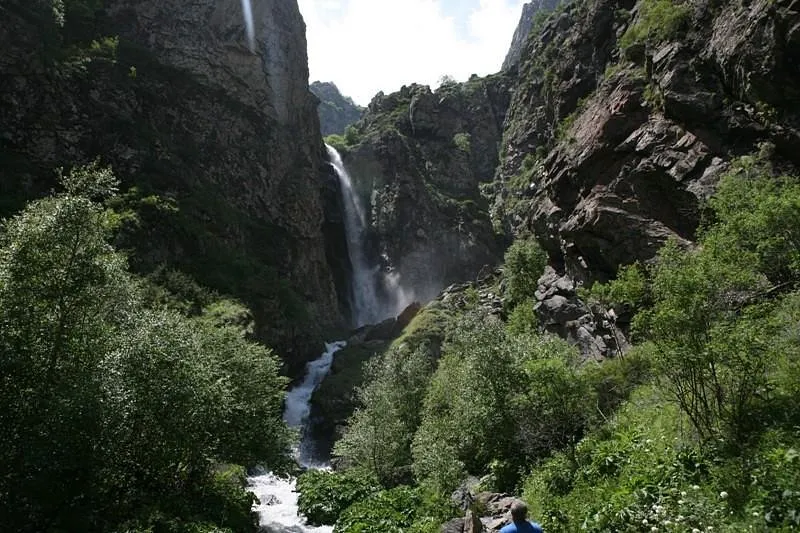
The Truso valley, about 22 km from Stepantsminda (Kazbegi), is known for its mineral springs, which leave orange and red travertine terraces across the valley floor[18]. The tourism board also lists Abano Mineral Lake among the valley's natural monuments[18]. These are not bathing spots. The tourism board asks visitors not to climb on the travertine, because it damages the formations[18]. Access is by off-road car, on horseback or on foot, and you need your ID for a permit beyond Zakagori Fortress[18].
A word on health
We make no medical claims for any of these waters. The resorts themselves describe treatments, and the bigger ones, such as Sairme, have doctors who prescribe courses[4]. If you are pregnant, have a heart or blood-pressure condition, or are travelling with small children, ask your own doctor before a long hot soak or a radon bath. Mineral water has a strong taste; a cup is a taste, not a drink to swap for your water bottle. Keep soaks short in hot pools, and drink plain water afterwards.
FAQ
Are there hot springs in Georgia you can swim in?
Yes. The open-air sulphur pools in Borjomi (about 32–38 °C) and the thermal pools at Sairme are open to visitors, and in Tbilisi you can rent a private sulphur-bath room by the hour.
Can you drink the water at Borjomi?
Yes, at the free spring in Borjomi Central Park you can fill a bottle with the salty, sparkling water. Don't drink the water in the sulphur pools.
Which springs are closest to Tbilisi?
The Abanotubani sulphur baths in the Old Town itself. Outside the city, the nearest in this guide are Borjomi and Likani, about two and a half to three hours' drive west.
What are radon baths at Tskaltubo?
Baths in the town's naturally warm (33–35 °C) radon-carbonate spring water, given as a treatment at the working bathhouses. Ask a doctor first if you have a health condition.
Is this about Georgia the country or the US state?
The country, in the South Caucasus on the Black Sea. Georgia in the United States has its own springs, but they are not covered here.
Visiting Georgia's springs with us
We run private trips with your own car and driver. Borjomi is part of our Vardzia and Borjomi day trip from Tbilisi, with time in the park; the Truso travertines are on our Kazbegi and Truso valley 4x4 day trip. For Tskaltubo, Sairme, Nunisi or Utsera, book our private driver service from Kutaisi or Tbilisi, or build your own tour with a night at a spa and we quote it. See the pages for current prices. Nothing to pay now.
Sources
- Georgian National Tourism Administration, "Borjomi": georgia.travel
- Georgian National Tourism Administration, "Borjomi Sulfur Pools": georgia.travel
- Georgian National Tourism Administration, "Top Wellness Resorts in Georgia": georgia.travel
- Georgian National Tourism Administration, "Resort Sairme": georgia.travel
- Wikipedia, "Borjomi": en.wikipedia.org
- Wikipedia, "Likani": en.wikipedia.org
- Borjomi Likani Resort, "About": borjomilikaniresort.com
- Georgian National Tourism Administration, "Tbilisi": georgia.travel
- Georgian National Tourism Administration, "Abanotubani in Tbilisi": georgia.travel
- Georgian National Tourism Administration, "Tbilisi Sulfur Baths": georgia.travel
- Chreli Abano, official site: chreliabano.ge
- Georgian National Tourism Administration, "Tskaltubo": georgia.travel
- Wikipedia, "Tskaltubo": en.wikipedia.org
- Wander-Lush, "The Ultimate Guide to Tskaltubo": wander-lush.org
- Wander-Lush, "Travel Guide to Sairme and Baghdati": wander-lush.org
- Georgian National Tourism Administration, "Nunisi": georgia.travel
- Georgian National Tourism Administration, "Oni": georgia.travel
- Georgian National Tourism Administration, "Upper Truso Gorge": georgia.travel
Last checked: November 2026. Spa tickets, opening hours and park fees change from season to season; check locally before you go.