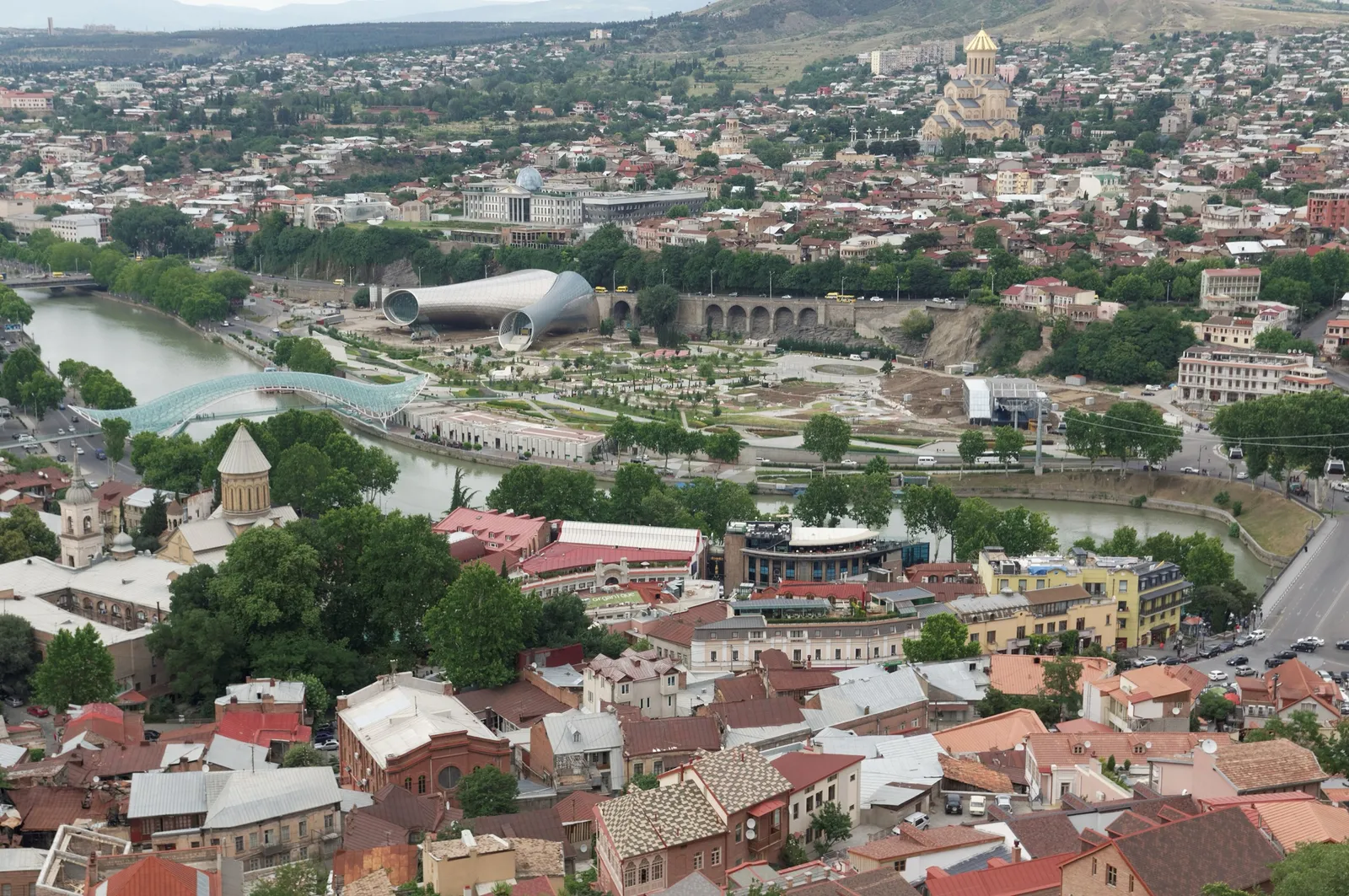
The short answer: the Tbilisi funicular is a railway, opened in 1905, that climbs about 500 m up the side of Mtatsminda, the mountain behind the city centre. At the top there is an amusement park with a Ferris wheel, a restaurant in the old funicular building, and the widest view in the city. Halfway up, the funicular stops at the Mtatsminda Pantheon, where many of Georgia's writers and public figures are buried. You pay with a rechargeable Mtatsminda card; recent guides give the funicular fare as about 10 GEL each way. Go in the late afternoon and stay for sunset.
The funicular
The line was designed by the Belgian engineer Alphonse Roby and made its first run in March 1905. It runs through a steep cutting for roughly 500 m (sources give figures between 491 and 501 m), from a lower station off Chonkadze Street, above Rustaveli Avenue, at about 460 m above sea level, to the upper station at about 727 m. The upper station building was rebuilt in the late 1930s and still houses a restaurant.
- Tickets: you need a plastic Mtatsminda card (about 2 GEL), bought at the station and topped up at kiosks. Each ride is charged separately, including a stop at the Pantheon. Reported fares vary, but most recent sources give about 10 GEL one way for visitors; Georgian citizens and residents pay less, and small children travel free.
- Hours: the funicular runs later in summer than in winter. Recent reports give roughly 09:45–23:30 in summer and 12:00–21:00 in winter; check on the day.
The other way up is the cable car from Rustaveli Avenue, which reopened in October 2024 after a long closure. It uses the same card.
The Mtatsminda Pantheon
The funicular's middle stop is by the Church of St David, known as Mamadaviti, and the Pantheon around it. The Pantheon was established officially in 1929, for the centenary of the death of the Russian writer and diplomat Alexander Griboyedov, whose grave was the first here. His wife, Nino Chavchavadze, is buried beside him. Among the others:
- Ilia Chavchavadze (1837–1907), writer and one of the founders of modern Georgian national life;
- Akaki Tsereteli (1840–1915), poet;
- Vazha-Pshavela (1861–1915), poet of the mountains;
- Keke Geladze, the mother of Joseph Stalin.
The Pantheon is a quiet, shaded terrace with views over the city, and a good place to stop on the way up or down. You can also reach it on foot from the streets above Rustaveli, but the path is steep. The church is a working church: dress for it and keep your voice down.
Mtatsminda Park
The park at the top was laid out in the 1930s and covers more than 100 hectares at about 770 m, the highest point in Tbilisi. It was rebuilt as a modern amusement park from 2001.
- The Ferris wheel, about 65 m high, takes 10–12 minutes to go round and gives the highest view in the city.
- Rides for younger children and teenagers, including carousels, a roller coaster and a haunted-castle ride, each paid separately with the park card. Entry to the park itself is free.
- The TV tower, built in 1972, stands above the park; it is a landmark rather than something you visit.
The park's hours are shorter than the funicular's outside summer, and some rides close in bad weather or in winter.
Eating at the top
The restaurant in the upper funicular building has a terrace facing the city, and is a popular choice for a special dinner; book ahead for a window table at sunset. For something simpler, the café in the same building is known for ponchiki, Georgian doughnuts filled with custard, a Tbilisi childhood memory for many locals.
When to go
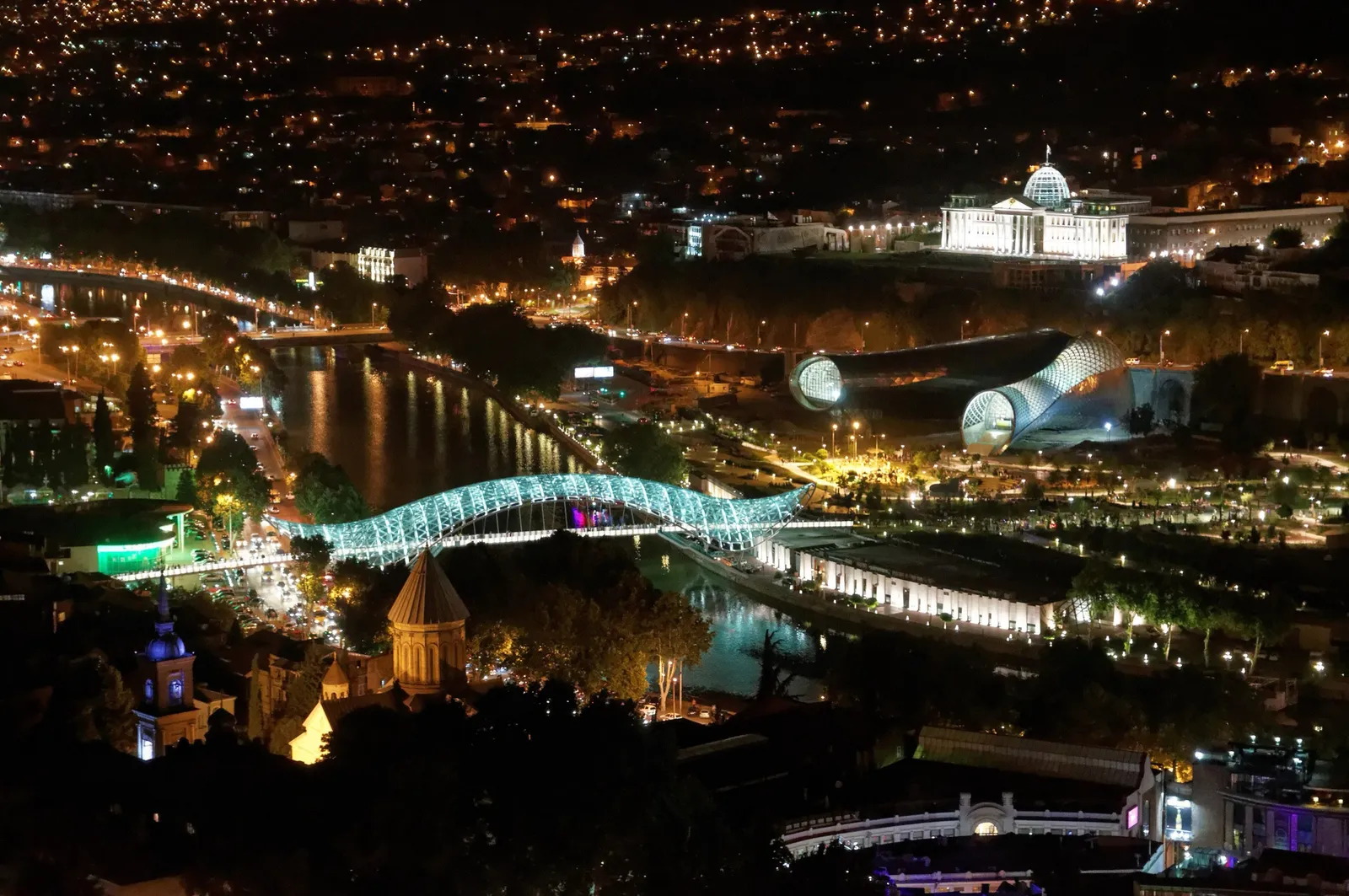
- Sunset: the classic time. Arrive an hour before, walk the terrace, and watch the city lights come on.
- Clear days: in autumn and winter you can sometimes see the snowy Caucasus to the north.
- Summer evenings: the top of the mountain is noticeably cooler than the city, which is why Tbilisi families come up on hot nights.
- Weekends: busy with families; weekday evenings are calmer.
Who it suits
Mtatsminda is good for families with children, couples looking for a sunset dinner, and anyone who wants the view without a steep walk. If you dislike crowds and fairground music, go for the view and the Pantheon and skip the park. If you only have one evening, compare it with the other viewpoints in our guide to Tbilisi's viewpoints; Narikala is closer to the Old Town, Mtatsminda is higher.
Combining it with the city
The lower funicular station is a short walk from Rustaveli Avenue, so Mtatsminda fits well at the end of a day in the centre: the Old Town and Narikala in the morning, Rustaveli and a museum in the afternoon, and the funicular at sunset. Our Tbilisi in 1, 2 or 3 days shows how the days fit together.
Seeing Mtatsminda with us
Our private Tbilisi Old Town walk covers the Old Town, Narikala and the Bridge of Peace in about five hours and finishes on Rustaveli Avenue, a short walk from the funicular. We can extend the day with Mtatsminda and the Pantheon by car or funicular; tell us when you book and we quote the extra time. See the tour page for the current price, or plan your own Tbilisi days. Nothing to pay now.
Sources
- Wikipedia, "Mtatsminda Park": en.wikipedia.org
- Wikipedia, "Mtatsminda Pantheon": en.wikipedia.org
- Wander-Lush, "Essential guide to Mtatsminda, Tbilisi's Holy Mountain": wander-lush.org
- Georgian Holidays, "Tbilisi funicular": georgianholidays.com
Last checked: September 2026. Fares and hours are set by the park and change often; check at the station.